

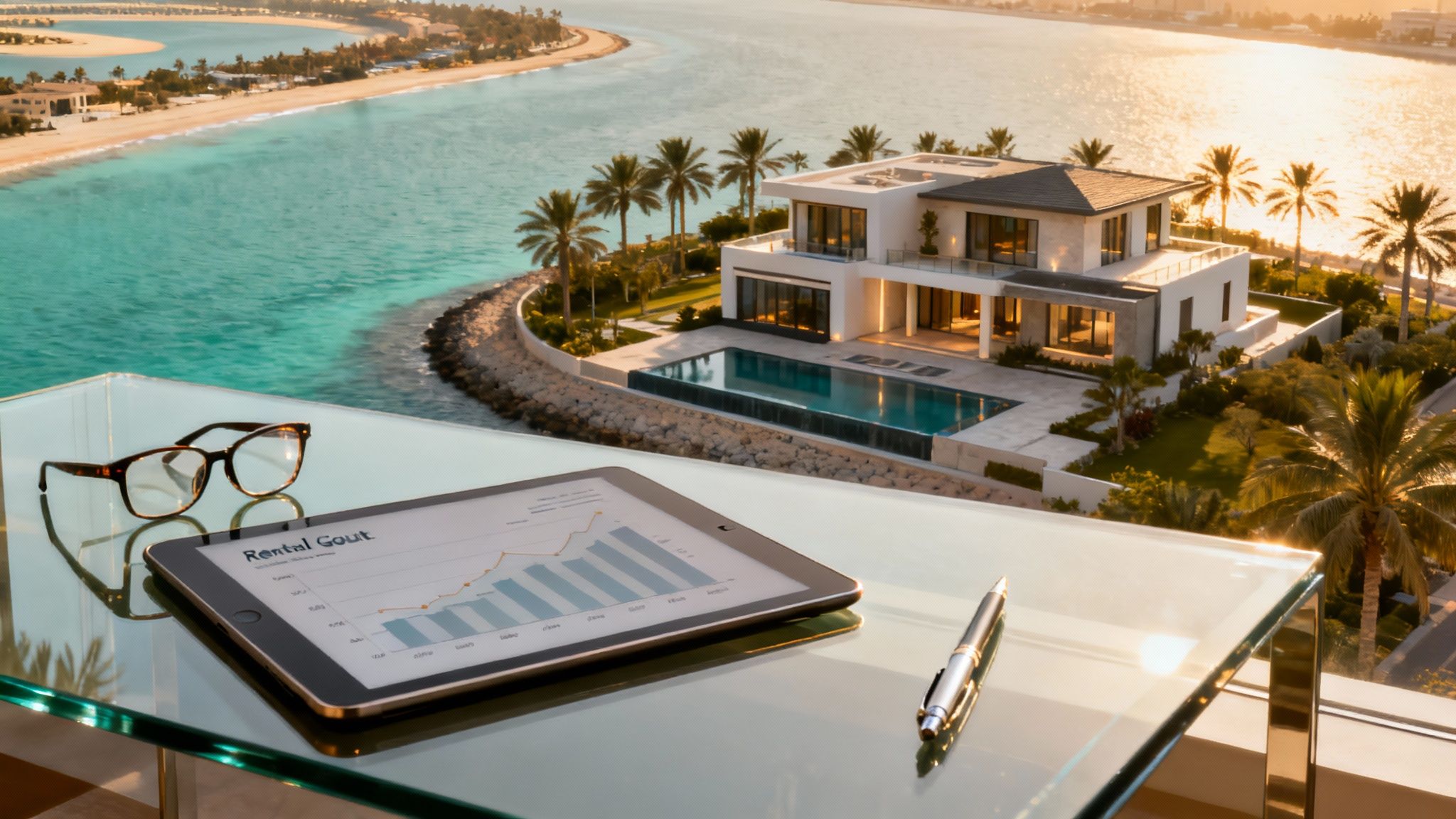
Entering 2026, the market for villas for rent in Palm Jumeirah has transitioned from the post-Covid boom into a sustainable growth cycle. This asset class represents a premier holding for High-Net-Worth Individuals, delivering consistent rental income from a tenant base of senior executives who demand exclusive waterfront living. This dynamic guarantees steady demand for well-maintained, strategically located assets.
Dissecting the Palm Jumeirah Villa Rental Market
Last year's benchmarks confirmed a robust market. As we move through 2026, we are observing a recalibration. For astute investors, the focus has shifted from speculative capital appreciation to optimising long-term yield and preserving asset value. This requires a granular analysis of rental performance metrics, moving beyond simple gross yield figures.
The core demand from top-tier tenants remains intact, insulating prime villas from the price adjustments seen in other segments. This stability and predictable cash flow now define the asset class.
Understanding the Yield Dynamics
To gain accurate context, one must analyze Dubai's broader rental landscape. By the end of 2025, the average gross rental yield for villas across the city hovered around 5%. While apartments often report higher percentage yields on paper, the absolute returns from villas—especially on Palm Jumeirah—are larger due to their higher capital values. This data confirms that demand from end-users who prioritize lifestyle over pure yield percentages remains strong. The current Dubai real estate market analysis shows this trend is holding.
This dynamic establishes Palm Jumeirah as a unique submarket. An investment here is not a short-term play on rental arbitrage; it is a long-term strategy to secure a high-quality income stream from a globally recognized address. The Palm stands apart from many of the best villa communities in Dubai because of its unparalleled brand power and constrained supply.
As an asset manager, I advise clients to view a Palm Jumeirah villa not as a speculative instrument but as a blue-chip holding. It delivers predictable, premium returns and acts as a hedge against inflation, anchored by an irreplaceable location and a financially resilient tenant base.
Current Market Projections
Comparing 2025 data with our forward-looking analysis reveals a market that is solidifying. We are transitioning from a market driven by velocity to one defined by intrinsic value and operational efficiency.
The following table provides a snapshot of key performance indicators, comparing last year's data with forward-looking estimates to guide investor strategy.
Palm Jumeirah Villa Rental Metrics: 2025 Benchmarks vs. 2026 Projections
| Metric | 2025 Benchmark (Actual) | 2026 Projection | Investor Implication |
|---|---|---|---|
| Average Gross Yield | 4.8% - 5.2% | 4.5% - 5.0% | A slight compression indicates price stabilization. Focus shifts to net yield and operational efficiency. |
| Occupancy Rate | ~95% (Long-term leases) | Sustained at ~92-94% | Demand remains strong; minor dips create opportunities for upgrades and repositioning assets. |
| Average Lease Value | Stable with slight upward trend | Moderate, single-digit growth | Landlords with superior properties can still command premium rents. Quality is the key differentiator. |
| Tenant Profile | C-suite executives, HNWIs | Consistent, with growing demand from tech and finance principals | The tenant base remains resilient, securing rental income streams against economic headwinds. |
This data indicates that while the explosive growth phase has concluded, the underlying fundamentals of the Palm Jumeirah rental market remain exceptionally strong. The focus now is on quality, management, and long-term value—the hallmarks of a mature investment market.
Analyzing Villa Types and Locations for Optimal Yield
Acquiring a property on Palm Jumeirah is straightforward. Securing the correct one is what drives performance. The difference between a sprawling Signature Villa on a high-numbered frond and a Garden Home closer to the trunk directly impacts yield, tenant profile, and long-term asset value.
It is a common error to assume all waterfront views are equal. A view of the Dubai Marina and JBR skyline, for example, consistently commands a 5-7% rental premium over an open sea view. This is driven by tenant demand for iconic cityscapes, a detail broad market reports often miss.
Differentiating Villa Typologies
Each villa category on the Palm attracts a specific segment of the high-end rental market. Understanding these differences is how you align your asset with the most stable and lucrative tenant profiles. A similar logic applies when analyzing villas for rent in Jumeirah Dubai, though the demand drivers differ slightly.
Signature Villas: These are the apex assets, often on double plots, sought by UHNWIs and prominent families demanding absolute privacy and space. Their investment appeal is rooted in scarcity and trophy status, anchoring both high capital values and premium lease rates.
Garden Homes: As the most prevalent villa type, Garden Homes are the workhorses of the Palm’s rental market. They meet the needs of senior executives and their families, offering a balance of beachfront luxury and practicality.
Canal Cove Townhouses: These properties offer a more accessible entry point to the Palm villa lifestyle. They are well-suited for professional couples or smaller families and maintain consistent occupancy rates due to a more approachable rental price point.
This infographic illustrates how yield, asset value, and tenant profiles align across Palm Jumeirah's villa offerings.
While Signature Villas represent the peak in asset value, Garden Homes often present a more balanced opportunity for investors focused squarely on yield, supported by deep and consistent tenant demand.
Location as a Primary Yield Driver
On the Palm, location is measured by frond number and proximity to the trunk. The higher-numbered fronds (M, N, O, P) are perceived as more exclusive and private. Conversely, the lower-numbered fronds (A, B, C, D) offer faster access to Sheikh Zayed Road, making them a top choice for commuting executives.
From an asset management perspective, the ideal acquisition is often a mid-frond Garden Home with a marina view. This property type hits the nexus of high tenant demand, strong yield potential, and a more liquid resale market compared to the ultra-niche Signature Villas.
The following table moves beyond aesthetics to provide a comparative analysis focused on financial performance.
Comparative Analysis of Palm Jumeirah Villa Types
This breakdown of villa categories by their core investment characteristics is designed to inform acquisition decisions.
| Villa Type | Typical Size (sq. ft.) | Primary Tenant Profile | Est. Gross Yield Range | Key Investment Driver |
|---|---|---|---|---|
| Signature Villa | 7,000 - 14,000+ | UHNWIs, C-Suite, Diplomats | 3.5% - 4.5% | Capital Preservation & Prestige |
| Garden Home | 5,000 - 6,000 | Senior Executives, Families | 4.5% - 5.5% | Balanced Yield & Occupancy |
| Canal Cove Townhouse | 4,000 - 4,500 | Professional Couples, Small Families | 5.0% - 6.0% | Higher Yield & Accessible Price |
This data-driven approach reframes the question from, "Which villa is best?" to, "Which villa best aligns with my portfolio's risk and return objectives?"
Understanding Rental Demand Drivers and Market Cadence
Forecasting occupancy rates and rental income for a Palm Jumeirah villa requires an understanding of the specific rhythm of this micro-market. Demand is a direct result of Dubai's strategic position in the global economy.
The main engine is the steady influx of HNWIs and senior executives driven by corporate relocations, particularly in the finance and tech sectors. When global firms establish regional headquarters in DIFC, the need for premium, family-sized homes in a secure, iconic community like the Palm becomes a priority for their leadership.
The Impact of Geopolitical and Economic Tailwinds
Global economic uncertainty has positioned Dubai as a safe harbor for capital and talent, triggering relocations from Europe and Asia that directly fuel demand for long-term villa leases. These tenants are typically less price-sensitive and more focused on quality and stability, making them ideal from an owner's perspective.
Government initiatives like the Golden Visa program have anchored this demand. By offering long-term residency, the program encourages HNWIs to establish roots, shifting the mindset from transient expat to long-term resident. For more on this, you can review what is golden visa uae and its direct support for property investment.
We are no longer just leasing properties; we are facilitating the establishment of long-term family bases. The Golden Visa has transformed the tenant profile from a transient executive on a two-year contract to a stakeholder invested in the city's future—a far more stable foundation for rental income.
Seasonality and Pricing Cadence
While the long-term rental market is more stable than short-term lets, a distinct seasonal rhythm affects leasing velocity and pricing. Proper timing is crucial for scheduling renewals and marketing a vacant villa.
- Peak Leasing Season (September - November): This period aligns with the start of the academic year and the return of business post-summer. Demand is at its absolute peak, allowing landlords to lock in premium rental rates.
- Secondary Peak (January - March): Driven by new corporate hires and favorable weather, this window presents another strong opportunity to place a quality tenant.
- Low Season (June - August): The summer months bring a natural slowdown. Astute landlords use this period for property upgrades and maintenance to command optimal pricing when demand returns in September.
This predictable cycle allows for strategic asset management, minimizing void periods and maximizing annual revenue.
Navigating the Legal and Financial Framework
Operating a rental villa on Palm Jumeirah profitably requires a sharp understanding of Dubai's legal and financial regulations. This transparent system is designed to protect all parties, but knowledge of its mechanics is essential for effective asset management.
At the core of any rental agreement is the Ejari system. This government-mandated registration of the tenancy contract officially formalizes the lease and makes it legally enforceable. It is not an optional step.
This registration is also the key for tenants to connect their DEWA account. Understanding these utility costs is fundamental, and a detailed guide on the various housing charges and DEWA helps in forecasting a tenant's total living expenses.
RERA Regulations and Dispute Resolution
The landlord-tenant relationship is governed by clear rules from the Real Estate Regulatory Agency (RERA). These regulations cover security deposits, maintenance responsibilities, and, critically, rent increases.
Landlords cannot implement arbitrary rental hikes. Any increase upon renewal must align with the RERA Rental Increase Calculator, which benchmarks the property against current market averages. A 90-day written notice is mandatory for any proposed change to the contract, including rent adjustments. This framework is a core component of the UAE property law.
Should a disagreement arise, the Rental Disputes Centre (RDC) acts as the judicial arm. It provides a structured process for resolving conflicts based on the contract and established law.
This legal pathway provides investors a high degree of confidence and predictability.
Financial Obligations Beyond the Purchase Price
A realistic financial model for a rental villa must account for recurring operational costs. Overlooking these will skew net yield calculations and cash flow projections.
- Community Service Charges: These fees, collected by the master developer, cover the upkeep of common areas and security. For villas, they are calculated on the plot size, typically between AED 4 to AED 6 per square foot annually.
- Routine Maintenance: The tenancy contract usually assigns minor, day-to-day maintenance to the tenant. A clear maintenance clause is essential to prevent future disputes.
- Property Management Fees: For non-resident or hands-off investors, professional management is essential. Fees typically range from 5% to 8% of the annual rent.
Clarifying the Tax and Fee Structure
The absence of income tax on rental earnings is a major draw for property investors in Dubai. However, specific government fees must be included in financial planning. The primary fee to understand when modeling returns is the cost associated with taxes on property.
The main levy is the 5% housing fee (Dubai Municipality Fee) on the annual rental value. This is collected directly from the tenant through their monthly DEWA bills, streamlining the process for the landlord. When acquiring the property, a one-time 4% Dubai Land Department (DLD) transfer fee must also be budgeted.
Choosing Between Short-Term and Long-Term Rental Strategies
Post-acquisition, the focus shifts to management. For a Palm Jumeirah villa, this presents a critical decision: the stability of a long-term lease versus the higher potential returns of a short-term holiday home. This choice dictates operational involvement, cash flow predictability, and net return.
The analysis must be quantitative. A long-term lease offers consistent, predictable income with minimal daily involvement. The short-term market offers higher gross revenue potential but introduces operational complexity and revenue volatility.
The Long-Term Lease Model
The standard 12-month lease, registered with Ejari, is the preferred strategy for risk-averse investors seeking passive income. This model attracts a stable tenant base of executives and families who treat the property as a home.
The benefits are clear: a single tenant means lower transaction costs, less marketing effort, and predictable monthly cash flow. The property also experiences less wear and tear. Structuring the agreement correctly is vital, and a deep understanding of a tenancy contract in Dubai is fundamental to protecting the asset.
The trade-off is inflexibility. Rental income is locked for the contract term, preventing capitalization on seasonal price surges. It also eliminates personal use of the property.
The Short-Term Rental (Holiday Home) Model
Operating the villa as a DTCM-licensed holiday home presents the possibility of higher yields, especially during Dubai's peak tourist seasons (October-April). Nightly rates for a prime Palm Jumeirah villa can be substantial.
This strategy, however, is an active business. The operational load is intense and includes:
- Regulatory Compliance: A permit from the Dubai Department of Tourism and Commerce Marketing (DTCM) is mandatory.
- Intensive Management: This is a full-time function covering guest communication, check-ins, cleaning, maintenance, and booking management.
- Higher Operational Costs: Expect higher utility bills, frequent maintenance, and management fees of 15% to 25% of gross revenue.
- Accelerated Wear and Tear: High guest turnover leads to greater physical depreciation of furnishings and fixtures, requiring a larger budget for upkeep.
From an asset manager's perspective, the short-term model is not a passive investment but an active hospitality business. A rigorous analysis of net yield after all operational costs and vacancy periods is essential.
A Data-Driven Comparison
The following table provides a simplified model for a typical Garden Home villa to compare the financial outcomes of each strategy.
| Metric | Long-Term Lease | Short-Term Rental (Holiday Home) |
|---|---|---|
| Gross Annual Rent (Est.) | AED 850,000 | AED 1,200,000 (at 75% occupancy) |
| Management Fees | 5% (AED 42,500) | 20% (AED 240,000) |
| Maintenance & Utilities | Minimal (Tenant covers most) | High (AED 100,000+) |
| Vacancy Provision | ~2-3% (1 month every 3 years) | ~25% (seasonal voids) |
| Net Estimated Income | ~AED 800,000 | ~AED 860,000 |
While the net income appears slightly higher for the short-term model, it carries a substantially higher risk profile and operational burden. For most HNWIs, this marginal potential upside does not justify turning a stable asset into a management-intensive business. The decision depends on an investor's risk appetite and desired level of involvement.
Final Thoughts: Strategy Over Speculation
The window for easy, speculative gains in the Palm Jumeirah villa market has narrowed. Success in 2026 requires targeting assets based on quality, performing rigorous due diligence, and applying professional operational management.
A well-chosen villa on the Palm is a cornerstone asset for any serious HNWI portfolio. It is engineered to deliver consistent, premium rental income, supported by unwavering demand from a top-tier global tenant base. Its value is anchored by a finite supply of land at one of the world's most recognized addresses.
This market now rewards the astute asset manager over the casual speculator. The focus must shift from chasing short-term capital appreciation to relentlessly optimizing net operating income and ensuring long-term value preservation. This means acquiring properties based on solid yield potential and structuring lease agreements that guarantee reliable cash flow.
At Proact Luxury Real Estate, we track these metrics daily.
Frequently Asked Questions
For high-value assets like Palm Jumeirah villas, the details dictate performance. Here are answers to common investor questions, focused on the financial and operational realities that impact returns.
What Are the Typical Annual Service Charges for a Villa on Palm Jumeirah?
Service charges are a non-negotiable operational cost and must be factored into net yield calculations. These fees are managed by the master developer and vary based on villa type, with the primary driver being the total plot size.
For 2026, budget for AED 4 to AED 6 per square foot of your total plot area, per year. These charges cover community security, landscaping, waste management, and upkeep of all common areas.
Can Tenants Make Modifications to a Rented Villa?
This is a common point of negotiation, and the rules are strict. Minor, non-structural changes require explicit, written pre-approval via a No Objection Certificate (NOC).
Major structural changes are prohibited under a standard rental agreement. The RERA-governed tenancy contract outlines this clearly. Unauthorized modifications can result in the tenant forfeiting their security deposit to cover restoration costs.
A well-drafted addendum to the standard tenancy contract, clearly outlining what is and is not allowed, is a crucial risk management tool that protects the long-term physical integrity of your asset.
How Is Rental Price Determined and Increased?
Initial rent is set through market intelligence, analyzing recently leased comparable properties, the villa's condition, its frond location, and any premium features.
Renewals are strictly regulated. Rent hikes must align with the official RERA Rental Increase Calculator, which determines the maximum allowable increase based on current market averages. A mandatory 90 days' notice is required for any proposed contract changes.
What Are the Landlord's Core Maintenance Responsibilities?
Dubai's legal framework splits maintenance duties clearly. As the landlord, you are responsible for major maintenance, covering the structure, roof, core electrical and plumbing systems, and essential equipment like air conditioning units.
The tenant is generally responsible for minor, routine upkeep, often defined as any single repair costing less than a pre-agreed amount (e.g., AED 500). A detailed maintenance clause in your Ejari-registered contract is vital to avoid ambiguity.
At Proact Luxury Real Estate LLC, we focus on long-term asset performance. Our advisory is grounded in financial analysis and market intelligence, ensuring our clients' portfolios are structured for sustainable growth and stable income.
If you are rebalancing your portfolio for 2026, let's run the numbers. Schedule a confidential consultation at https://ritukant.com.