


Quick Overview Of Property Tax Charges
When you buy or hold real estate in the UAE or the big Indian metros, you’ll encounter five main charges. Think of these fees as the tolls on your property road trip: municipal levies, transfer and stamp duties, capital gains tax, rental income tax, and VAT on new developments.
Here’s a snapshot of each cost before we dive deeper:
- Annual Municipal Levies: A recurring charge based on rent or property value, usually 3–5% of annual rent in UAE emirates.
- Transfer Fees and Stamp Duties: One-time title-transfer costs that range between 2–6% of the sale price, depending on the emirate or Indian state.
- Capital Gains Treatment: No federal CGT in the UAE; India applies short-term and long-term rates up to 30%.
- Rental Income Tax: Progressive rates in India (up to 42%); the UAE embeds a tiered levy into utility bills.
- VAT on Developments: 5% VAT on new off-plan and completed projects in the UAE.
Summary Of Property Tax Types
Below is an at-a-glance comparison of these charges, their applicability, rate ranges, and where they apply.
| Tax Type | Applicability | Rate or Range | Jurisdiction |
|---|---|---|---|
| Annual Municipal Levies | Renters and owners | 3–5% of rent | UAE emirates |
| Transfer Fees and Stamp Duties | Buyers | 2–6% of sale price | UAE and Indian states |
| Capital Gains Treatment | Sellers | 0–30% depending on term | UAE & India |
| Rental Income Tax | Landlords | 0–42% slab rates | UAE & India |
| VAT on Developments | Developers | 5% | UAE only |
This table gives you a clear, side-by-side look at each levy and where it bites into your budget.
Visual Roadmap Of Charges
The infographic below shows how each tax type branches out from the central property-cost node.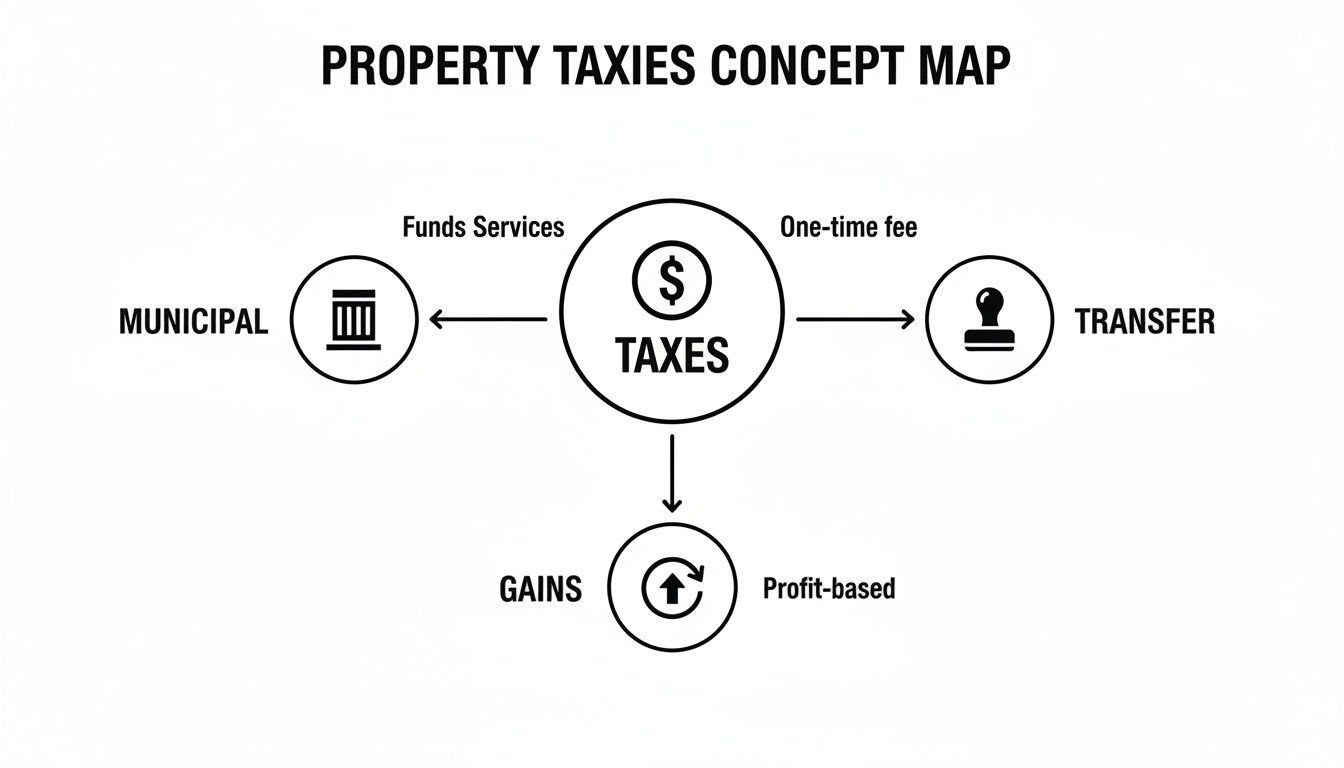
- In Dubai and Abu Dhabi, municipal levies range from 3% to 5%, collected via your DEWA or ADDC bills.
- Transfer fees in the UAE start at 4%, while Indian metros hover between 2% and 6%.
- India taxes rental income up to 42%; in the UAE, there’s no separate federal rental tax.
- VAT is a flat 5% on new developments in the UAE.
For detailed rules and fee structures in each freehold zone, check our guide on Dubai freehold properties.
This roadmap sets the stage for a deeper dive into each tax category. Next, we’ll explore annual municipal levies and how they impact your budget.
Understanding Annual Municipal Levies

Think of municipal levies as a city-service subscription you pay in bite-sized instalments rather than one lump sum. In Dubai, that works out to 5% of your monthly rent tagged onto your utility bill. In Abu Dhabi, tenants see a lighter 3% fee on the same base.
These charges replace traditional ad-valorem taxes tied to property valuations. Instead, they tie directly to what you actually pay in rent. For deeper background, see the Global Property Guide’s Home Price Trends.
Municipal Levies Comparison
Below is a side-by-side look at tenant fees in Dubai and Abu Dhabi, showing rate bases and billing frequency.
Municipal Levies Comparison
| Emirate | Charge Basis | Rate | Frequency |
|---|---|---|---|
| Dubai | Monthly rental amount | 5% | Monthly |
| Abu Dhabi | Monthly rental amount | 3% | Monthly |
This quick snapshot makes it clear why budgeting these fees is straightforward and predictable.
Why Predictable Fees Matter
When rent climbs, your levy climbs in lockstep. That makes forecasting easier compared to surprise levies or spot charges. You’ll avoid end-of-year shocks to your cash flow and keep your expenses aligned with market movements.
Key Insight: Linking levies to rent ensures a stable revenue stream for municipal services like roads, parks and waste collection.
Turning Levies Into Budget Line Items
Treat these charges as a non-negotiable recurring cost. Here’s how to factor them into your model:
- Multiply annual rent by the applicable percentage.
- Divide the result by 12 to get your monthly levy.
- Update figures whenever you renegotiate your lease.
These easy steps normalise the levy, so it sits alongside utilities or maintenance in your spreadsheet, not as a surprise.
Illustrative Case Study
Sarah secures a Dubai flat at AED 8,000 a month. She knows a 5% levy adds AED 400 each month—or AED 4,800 yearly—to her outgoings. With that number built into her projections, she sleeps soundly, no surprises at year-end.
Practical Tips For Tenants And Landlords
- Keep your tenancy agreement accessible to confirm the base rent.
- Cross-check your utility bill each month against your calculations.
- Negotiate “all-inclusive” utility packages to cap extras.
- Bookmark your local municipality portal for policy updates.
Key Takeaways
- Dubai charges 5% of rent; Abu Dhabi charges 3%.
- These levies feed directly into essential city services.
- Simple maths—annual rent × rate ÷ 12—makes budgeting painless.
- Regular review and clear agreements help avoid billing hiccups.
With these insights, what felt like a guessing game becomes a routine line item in your property budget. Plan ahead, model conservatively, and you’ll treat municipal levies not as headaches, but as a fixed cost on your path to smarter real-estate decisions.
Handling Transfer Fees and Stamp Duties

When you transfer property ownership, one-off charges—known as transfer fees and stamp duties—kick in. These levies come due the moment the title passes from seller to buyer, and they fluctuate based on jurisdiction and property type. Factoring in these sums early on keeps your acquisition budget on track.
Predicting Duty Bands
Think of duty bands like tiered shipping fees. As your property’s value climbs into higher brackets, you pay a greater rate on the amount above each threshold.
- You pay the lower rate on the first slice of value, then a higher rate on the remainder.
- Some emirates impose rate caps after certain slabs.
- Always verify the latest band thresholds with the land department.
Comparing Fees Across Regions
Across the UAE, Egypt and major Indian metros, transfer and stamp duties vary widely:
- Dubai: Flat 4% on the sale price.
- Abu Dhabi: Registration levy between 2%–3%.
- Egypt: Fixed 3% transfer fee; stamp duties graded at 1%–2%.
- Mumbai (India): Transfer fees around 5%, plus 1%–2% stamp duty.
Here’s a quick glance at how transfer fees, stamp duties and other levies stack up across key markets:
Transfer and Stamp Duty Rates
| Country | Transfer Fee Rate | Stamp Duty Rate | Other Charges |
|---|---|---|---|
| UAE (Dubai) | 4% | 4% (Stamp Part) | NOL Fee For RTA Card |
| UAE (Abu Dhabi) | 2–3% | 2% Fixed | Admin Handling Fees |
| Egypt | 3% | 1–2% Banded | Registry Service Fee |
| Mumbai (India) | 5% | 1–2% | Premium On High Values |
This snapshot highlights the wide variation in cost structures, so you can see where budget planning makes the biggest difference.
Splitting Transfer Costs Between Parties
Negotiation is everything. You and the seller decide who covers which fees.
- Agree on a percentage split of the transfer levy.
- Pin down the exact payment due on closing day.
- Factor in stamp duty and registry costs upfront.
Key Insight
Equal sharing of fees is common—avoids last-minute haggling.
Budgeting For Acquisition
A little math goes a long way:
- Multiply your agreed sale price by the transfer fee percentage.
- Add fixed stamp duties and any admin levies.
- Include a 5% contingency to cover minor rate changes.
Example
If you buy a AED 1,000,000 home in Abu Dhabi at a 2.5% transfer levy, budget AED 25,000 plus AED 2,000 stamp duty and AED 500 admin fees.
Practical Tips And Next Steps
- Check your local land department’s portal for current schedules.
- Ask your conveyancer or developer for a detailed fee breakdown.
- Verify any rate changes right before signing.
- Keep all invoices and receipts to settle split payments cleanly.
Real-World Analogy For Clarity
Picture each fee band like airline luggage tiers. A small suitcase travels at one rate, but a heavier bag jumps to a higher per-kilo fee. If you know your “baggage weight” in property value, you’ll dodge surprise overage charges at the gate.
Final Considerations For Investors
Cross-border buyers must weigh fee structures, treaty benefits and reclaim rules.
- Build these costs into your exit strategy to safeguard net returns.
- Keep an eye on policy updates to remain compliant.
Check out our guide on Buying Property in Dubai for Foreigners for deeper insights on acquisition, ownership and cross-border compliance.
Navigating Capital Gains and Rental Income Taxation
Selling a property and collecting rent feel like two separate games—each with its own rulebook. In the UAE, you generally face 0% federal capital gains tax, although flipping off-plan units before handover can trigger 5% VAT on the margin. Non-residents can also lean on treaty planning to sidestep withholding at source.
Over in India, your gains fall into short-term or long-term buckets. Anything held under 12 months lands in your slab rate—up to 30%. Hold on longer, and you unlock indexation for a flat 20% after 24 months. In the paragraphs that follow, we’ll map out both regimes and then dive into how rental income is taxed.
Understanding these nuances helps you see real returns, not just sticker price profits. A one-year flip in Mumbai could swallow 30% in tax, while that same deal in Dubai walks away tax-free—apart from VAT surprises if you’re not careful. Treaty planning and compliance checks are your best friends here.
Capital Gains Tax Rules
In the UAE, capital gains on property come in at 0%—no Federal levy, no surprises. That’s a major draw for short-term traders. Yet, if you offload an off-plan unit before completion, expect 5% VAT on the developer’s margin. And yes, treaty provisions often erase withholding for foreign sellers.
Moving to India, gains split down the middle:
- Short-Term Capital Gains
Assets held under 12 months get taxed as regular income—up to 30%. - Long-Term Capital Gains
Properties owned over 24 months benefit from indexation and a flat 20% rate.
| Jurisdiction | CGT Rate | Condition | Additional Charge |
|---|---|---|---|
| UAE | 0% | All properties | 5% VAT on early resale |
| India STCG | Up to 30% | < 12 months | N/A |
| India LTCG | 20% | ≥ 24 months | Indexation adjustment |
Step-By-Step CGT Example
Let’s run the numbers. You buy a Dubai flat for AED 1,000,000 and sell nine months later at AED 1,200,000. No CGT applies, but you owe 5% VAT on the AED 200,000 margin. That’s AED 10,000, leaving you a net gain of AED 190,000.
In India, picture a Mumbai apartment bought for ₹10,000,000 in 2010 and sold in 2024 for ₹15,000,000. With indexation, your cost base climbs to ₹14,000,000. Your taxable gain is ₹1,000,000, taxed at 20%, so you pay ₹200,000 in CGT.
Rental Income Tax Basics
In the UAE, there’s no federal rental tax—but Dubai adds a 5% municipal housing fee (Abu Dhabi sits at 3%), tacked onto your DEWA bill. That’s a fixed drag on your yield.
Contrast that with India, where rent slips into your slab rates. You declare gross rent, deduct a 30% standard allowance plus any municipal taxes, then add the balance to your other income. Depending on your bracket, that can be as high as 42%.
Key deductions in India include:
- 30% Standard Deduction for repairs and maintenance
- Interest Expense on your home-loan interest
- Municipal Taxes you’ve actually paid
- Repairs & Insurance costs if you’ve kept the invoices
Calculating Rental Yield
Your yield is simply net annual rent ÷ property value × 100. That paints a clear picture.
For instance, a Dubai flat fetches AED 120,000 a year. Subtract 5% municipal fees and you land at AED 114,000. Divide by a AED 2,000,000 purchase price and you get a 5.7% net yield.
In Mumbai, ₹600,000 gross rent less ₹180,000 (30%) and ₹60,000 in municipal tax leaves ₹360,000 taxable. At 30%, you pay ₹108,000 tax, so net rent is ₹492,000. On a ₹12,000,000 cost, that’s about 4.1% yield.
Key Insight
A precise yield model can shift your return by 1–2 percentage points—a material difference when you’re chasing high-net-worth targets.
Takeaways
- UAE: 0% CGT on resale, but watch 5% VAT on off-plan margins.
- India: STCG taxed up to 30%, LTCG at 20% with indexation.
- Rental yields in the UAE face municipal fees; in India, allowances plus slab rates apply.
- Use simple formulas—(gain × rate) or (net rent ÷ value)—to forecast after-tax returns.
By layering in compliance planning and running your own scenarios, you turn tax unknowns into predictable line items. That clarity powers smarter acquisition, holding, and exit strategies aligned with your ROI goals.
Implementing Tax Planning Strategies for Investors
Smart investors see property taxes as pieces on a chessboard rather than obstacles. They plan each move carefully, combining the right entity structure with precise timing to lock in savings.

Structural Options For Shielding Gains
Special purpose vehicles (SPVs) isolate real estate assets, so you keep tax outcomes neatly contained.
Joint ventures let you spread both profits and costs in agreed shares.
Trusts preserve wealth across generations and tap into treaty relief.
Key Insight
An SPV works like a sealed envelope: it carries your property’s tax result without mixing into your other holdings.
Each model has distinct benefits:
- SPVs simplify reporting and cap liability.
- Joint Ventures share risk and reward among partners.
- Trusts ensure smooth cross-border transfers and long-term continuity.
When choosing, balance set-up fees against compliance needs and flexibility.
Applying Timing To Unlock Exemptions
Sometimes, when you act is as important as how you act. A well-timed sale can shift you into a lower tax bracket.
In India, holding a property for 24 months instead of 12 months drops your capital gains rate from a slab-based 30% to a flat 20%. It’s like marinating meat: the longer you wait, the richer the outcome.
In the UAE, waiting until after the developer hands over can sidestep 5% VAT on margins.
Plan a simple calendar:
- Mark your 12- and 24-month milestones.
- Align sale dates with treaty renewal periods.
- Factor in indexation benefits for Indian holdings.
A side-by-side chart can highlight the cost gap between immediate and delayed disposals.
Drafting Rental Contracts To Reduce Levies
A few precise phrases can lower municipal charges on rent. In Dubai, listing utilities separately shrinks the base for the 5% housing fee. In Abu Dhabi, clear cost-sharing terms keep the 3% levy from creeping up.
Consider this tweak: David added “Tenant covers DEWA charges exclusive of housing fee.” The result? He trimmed AED 4,800 off his yearly costs.
Best practice lease points:
- Match rent schedules to billing cycles.
- Spell out tenant versus landlord utility duties.
- Assign municipal fee payments clearly.
Building Treaty-Based Relief
Double Taxation Avoidance Agreements (DTAAs) can cut withholding taxes to zero. Some treaties exempt non-residents from repatriation taxes on UAE property gains. Others, like India’s, cap dividend or rent withholdings at 15% instead of full slab rates.
| Treaty Partner | CGT Withholding | Rental Withholding | Applicable Article |
|---|---|---|---|
| India | 0% | 15% | Art. 13, Art. 15 |
| UK | 0% | 10% | Art. 13, Art. 17 |
| Germany | 0% | 10% | Art. 13, Art. 15 |
Always check with your tax advisor to apply these provisions and file the correct forms.
Putting It All Together
When structure, timing, lease terms, and treaties align, your net yield becomes far more predictable—like an orchestra where every instrument hits its note. Run scenarios in your financial model and stress-test them against potential rule changes.
Main Takeaway
A multi-layered strategy turns tax liabilities into forecastable costs rather than surprises.
For guidance on setting up the right entity in Dubai, see our detailed Dubai LLC company guide.
Next Steps For Monitoring And Review
Don’t set and forget. Schedule quarterly reviews for rates and treaty updates.
- Track municipal notices for new levies.
- Use online portals in both UAE and India to monitor deadlines.
- Have legal counsel review lease and entity documents annually.
- Update your cash-flow model with the latest fee figures every six months.
This process keeps you ahead of changes and avoids last-minute scrambles or penalties.
Acquisition Holding And Disposal Checklist
Buying, holding and selling property comes with its share of tax twists. Treat this as your flight manual—pre-flight checks at each stage ensure you land without turbulence.
Start with due diligence: understand local tax regulations and developer fee structures to nail your acquisition budget. Then double-check registration rules and stamp duties so there are no last-minute surprises.
- Review your municipality’s portal for the latest fee schedules and payment windows.
- Spot-check your SPA for developer-payable charges.
- Negotiate transfer-fee sharing with the seller before you sign on the dotted line.
Acquisition Phase Checklist
Building a timeline for deposits, registrations and closing filings is your first task. Digital portals—such as Dubai REST and Abu Dhabi ADEC—make scheduling payments straightforward. Always set aside a 5 percent contingency for minor rate changes.
- File your Title Deed and settle transfer fees by closing.
- Collect stamped deeds and lodge copies with the land department.
- Keep both soft and hard copies ready for audits.
Holding Period Actions
During ownership, staying on top of municipal levies and rental declarations keeps penalties at bay. Create digital folders for invoices, receipts and all correspondence.
- Set calendar reminders for DEWA or ADDC levy deadlines.
- Log rental income and file your returns before year-end.
- Track utility-cost clauses in each lease agreement.
Key Insight A solid record-keeping system is like a flight data recorder for your tax journey.
Give yourself a quarterly check on rate changes and update your cash-flow forecasts accordingly.
Disposal And Exit Checklist
Timing is everything when you plan your sale. Align your disposal window with favourable Capital Gains Tax slabs. Don’t forget to consult any relevant treaty that could lower withholding for non-resident sellers.
- Confirm your sale price on contract date to compute tax liabilities.
- Pay final transfer fees and stamp duties through official digital channels.
- File your CGT return within 90 day of the sale and secure your Tax Clearance Certificate before repatriation.
- Keep sale contracts, tax certificates and bank statements for five years.
- Use the land department’s digital archive to back up transfer deeds.
- Store scanned files in multiple secure locations or a cloud vault.
Review each completed task against your original due-diligence log. Then archive your full tax folder in an immutable format for future reference.
Pro Tip A well-timed sale plus a thorough paper trail can shave 1 to 2 percentage points off your effective tax bill.
Finally, update this checklist as regulations shift across the UAE and major Indian metros. Bookmark it, and run through it before every acquisition, holding or disposal phase. Staying prepared is the key to a smooth landing.
FAQ
Here, we tackle four questions that frequently come up when managing property taxes in the UAE and India.
What Annual Property-Related Fees Should Tenants And Owners Budget For?
If you’re renting in Dubai, expect to see a 5% municipal housing fee tagged onto your DEWA bill. In Abu Dhabi, that jumps a bit lower to 3%.
Owners, on the other hand, should factor in community service charges and property insurance—usually about 1–2% of the property’s value each year. And don’t forget VAT: it applies at 5% on new off-plan and completed projects across the UAE.
- Municipal Housing Fee: 5% (Dubai) or 3% (Abu Dhabi) of annual rent
- Service Charges: Community maintenance and insurance at 1–2%
- VAT Considerations: 5% on off-plan and finished residential projects
How Do I Calculate Transfer Fees And Stamp Duties For A Cross-Border Purchase?
When you move toward closing, transfer fees in Dubai run at 4% of the sale price. In Abu Dhabi, you’re looking at about 2–3%. Indian metros can be steeper—stamp duties of up to 6%, though some states roll out discounts for first-time buyers.
Start by agreeing on your sale price, then:
- Apply the jurisdiction’s percentage.
- Add any fixed stamp duty rates.
- Wrap in registration or admin fees for your final closing costs.
Key Steps For Transfer Calculations
- Confirm the agreed sale price in writing
- Check local government portals for updated fee schedules
- Factor in registration charges and any agent fees
When Does Capital Gains Tax Apply And How Can I Reduce My Liability?
The UAE keeps it simple—0% federal capital gains tax. Do watch out for that 5% VAT on margins if you flip off-plan units early.
In India, things are more layered:
- Short-term gains (under 12 months) hit slab rates up to 30%
- Long-term gains (after 24 months) enjoy a 20% flat rate plus indexation
Smart timing on property sales can trim your tax bill by up to 10% on high-value deals.
Essential Records And Deadlines
Keeping paperwork in order is half the battle. Store tenancy agreements, sale contracts and DEWA/ADDC invoices in a dedicated digital folder. Miss a deadline and you’ll face penalties.
| Record Type | Deadline |
|---|---|
| Tenancy Agreement | On Renewal Date |
| DEWA / ADDC Fees | Monthly Billing |
| CGT Return | Within 90 Days |
| Stamp Duty Payment | Transfer Closing |
Meeting these cut-off dates means no surprise fines—just clean compliance.
Ready to fine-tune your property tax strategy? Book a consultation with Proact Luxury Real Estate LLC at Proact Luxury Real Estate for personalised advice on acquisition, holding and disposal in the UAE and beyond.