

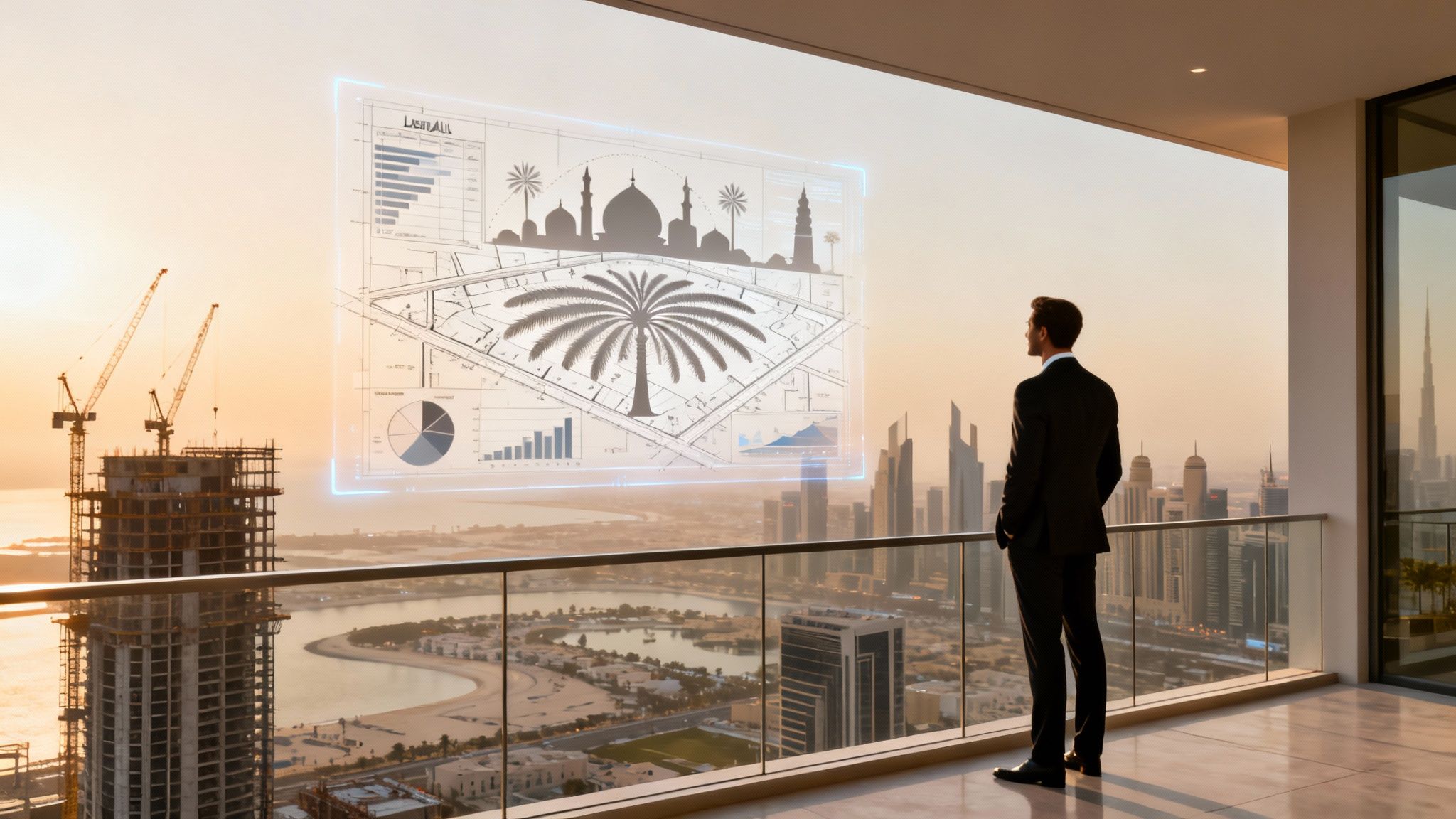
Last year, the 1% monthly payment plan was standard. Entering 2026, major developers are pivoting to 60/40 structures. This shift signals a maturing market, but it changes the entry barrier for new investors, filtering out short-term speculators and attracting committed, long-term capital.
The Market Shift: From Velocity to Value
The Dubai property market has transitioned from the post-Covid boom into a sustainable growth cycle. Last year's record transaction volumes established a new, higher baseline. The core investment thesis has pivoted from short-term velocity to long-term value creation.
This change is most evident in developer payment plans. The once-common 1% monthly structure is being replaced by front-loaded models like the 60/40. This is a structural shift that elevates the entry barrier, reducing market churn and fostering a more stable investment environment.
For a granular breakdown of these financial models, the current dubai real estate market analysis provides essential context.
[Chart: 2026 Payment Plan Breakdown]
Shift in Off-Plan Payment Plan Structures
| Payment Milestone | Last Year's Benchmark (e.g., 1% Monthly) | Current 2026 Structure (e.g., 60/40) | Implication for Investors |
|---|---|---|---|
| Down Payment | 10% - 20% | 20% | Higher initial capital commitment required. |
| During Construction | 40% (1% monthly) | 40% in larger, milestone-based installments | Demands larger capital tranches during the build phase. |
| On Handover | 40% - 50% | 40% | Remains a significant final payment, often financed. |
| Post-Handover | 10% - 20% over 1-2 years | Typically eliminated | Focus is on pre-completion payments, reducing developer risk. |
This move toward front-loaded plans is a clear signal of market maturity. It demands greater financial commitment from buyers, which helps stabilize the market by discouraging purely speculative behavior.
From Speculation to Strategy
For asset managers and HNWIs, the focus has sharpened. The objective is now identifying high-growth corridors with tangible infrastructure projects as catalysts. This requires analysis of metro line extensions, proximity to new economic free zones, and the expansion of logistics hubs like Al Maktoum Airport.
The narrative for 2026 is clear: success in the off-plan sector will be driven by diligent analysis of master community planning and infrastructure roadmaps, not by market timing alone. Asset selection is now more critical than ever.
Last year's data supports this. Between January and November 2025, Dubai's real estate market recorded over 197,000 property transactions, totalling Dh624.1 billion. Off-plan sales constituted 76% of all transactions in Q3 2025—a notable increase from 72% the prior year.
This investor confidence is built on the strict regulatory oversight of RERA, which mandates secure escrow accounts for all off-plan projects. This safeguard provides international capital the confidence to invest.
Key Segments Driving Investor Decisions in 2026
Two specific segments are attracting the most astute capital:
- Mid-Market Luxury: This segment blends premium amenities with an accessible price point, meeting demand from a growing demographic of professionals and young families.
- Branded Residences: Association with global luxury brands like Four Seasons or Armani ensures quality and top-tier property management. These assets often command higher rental yields and hold their resale value well.
This guide is designed to navigate this new market phase, focusing on acquiring assets with intrinsic value in communities poised for long-term growth.
Analysing ROI in New Master Communities
For a strategic play in Dubai's off-plan market, one must look past simple rental yield calculations. For 2026, the primary driver of returns is capital appreciation, found almost exclusively in new master communities with government-backed infrastructure. Surface-level metrics are misleading; true value is unlocked by dissecting the city's growth corridors.
Last year's benchmarks confirmed this trend. While city-wide appreciation is stabilizing, certain zones are outperforming the average. Projects in Dubai South and along new metro lines are key components of a long-term economic vision. Their proximity to assets like Al Maktoum International Airport is directly linked to their future valuation.
[Map: Location relative to Al Maktoum Airport]
Beyond The Brochure Numbers
Every developer markets potential returns, but granular analysis reveals the true drivers. An asset's long-term performance is determined by a specific set of factors that investors must evaluate.
- Unit Mix and Density: Look for communities with a strategic mix of townhouses, villas, and low-rise apartments. This attracts a broader demographic, creating a stable secondary market and solid rental demand, unlike high-density towers that can face oversupply.
- Infrastructure-Linked Growth: The most critical factor for capital appreciation is a project's link to new transport and economic hubs. Proximity to a new metro station or direct access to an expanding free zone are non-negotiable value drivers.
- Developer Reputation for Delivery: A developer's track record is paramount. We analyze handover timelines and the finished quality of amenities from projects completed last year. RERA's escrow account system provides a crucial safety net for investor funds under uae-property-law.
This chart illustrates the current market, showing a strong bias towards assets with high growth potential.
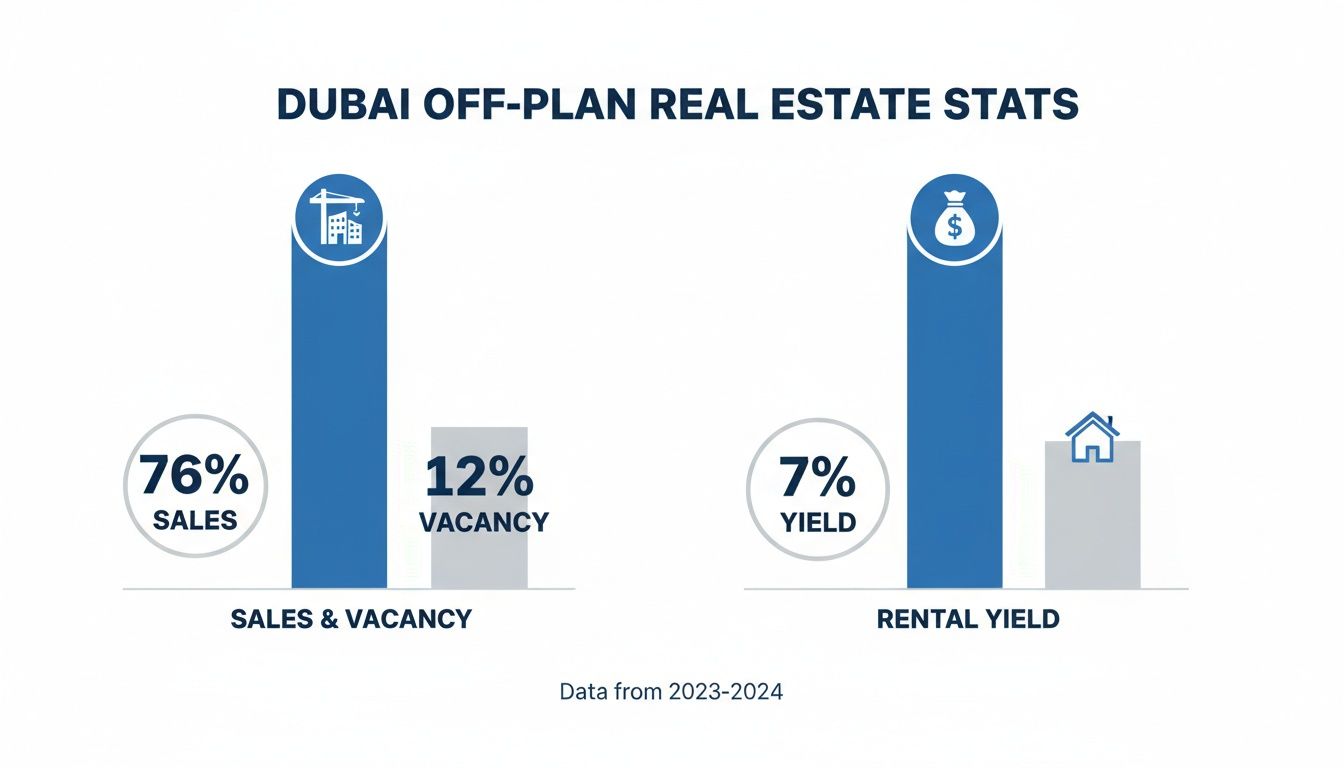
The data confirms investors are overwhelmingly choosing off-plan. They are drawn by the potential for capital uplift before handover, while still able to lock in robust rental yields post-completion.
Projecting Yields and Appreciation
Well-chosen properties are showing stable rental yields around the 7% mark—a competitive return against mature global property markets. This provides a solid income floor. The primary wealth creation, however, will come from capital appreciation realized between the launch price and the property’s value at handover.
DLD data shows that while 30,000 units hit the market in Q1 of last year—doubling 2024's launch rate—demand has remained strong, especially in new, family-focused communities. The off-plan sector's 76% sales share in Q3 2025 speaks to investor confidence in future value. They are prioritizing growth potential over immediate occupancy.
The core investment thesis for 2026 is straightforward: buy into communities where the government is actively investing in the surrounding infrastructure. This de-risks the investment and provides a clear roadmap for appreciation.
Understanding these dynamics is fundamental. While headlines may focus on Downtown or the Marina, strategic capital is flowing towards the city's future economic hubs. For a detailed breakdown of asset performance, review our guide on how to maximise ROI on property investments in Dubai.
The table below contrasts the ROI drivers for established areas versus emerging master communities.
| Metric | Established Communities (e.g., Downtown) | Emerging Master Communities (e.g., The Valley Phase 2) | Investor Focus for 2026 |
|---|---|---|---|
| Primary ROI Driver | Rental Yield (Stable) | Capital Appreciation (High Potential) | Target appreciation first, yield as a secondary benefit. |
| Price Per Square Foot | High, with modest growth | Lower entry point, high growth ceiling | Entry price is key to maximizing future gains. |
| Infrastructure | Mature, fully developed | New and expanding (Metro, airports) | Follow the infrastructure investment. |
| Investor Profile | Yield-focused, risk-averse | Growth-focused, strategic | Suited for investors with a 3-5 year horizon. |
Developer Due Diligence and Project Selection
A successful off-plan investment in Dubai requires a cold, hard analysis of the developer and the asset. Market hype is meaningless if the developer has a history of revised handover timelines or if the project’s design is misaligned with end-user demand. For serious investors, last year's benchmarks on delivery quality and schedule adherence are the only data points that matter.
A developer's calibre is evident in the communities they have already delivered. A history of delivering on time, with the promised quality, is the only asset that counts. We judge performance on their most recent handovers from 2025, not their launch announcements. For a comprehensive look at the market's key players, our list of Dubai's top developers is an essential starting point.
Evaluating Marquee Projects
Two marquee projects commanding institutional attention are Damac Islands and the revitalized Palm Jebel Ali. Each demands a different investment thesis.
Damac Islands is aimed squarely at the ultra-high-net-worth demographic, competing on exclusivity and branded living. The investment play here is scarcity and prestige. The target buyer is less sensitive to market corrections and is focused on acquiring a unique, trophy asset.
Palm Jebel Ali, conversely, is a long-term infrastructure bet. Its revival is a government-backed strategic initiative. The investment thesis is grounded in the future growth of Dubai's southern corridor, making it a powerful capital appreciation play for investors with a five-to-ten-year horizon.
The Due Diligence Checklist
A disciplined due diligence process is non-negotiable. It requires moving past brochures and into the legal and financial realities.
- Investment Pros/Cons
- Pro: RERA Registration Verification: Confirm the project and developer are officially registered with the Real Estate Regulatory Agency (RERA). This is a mandatory requirement.
- Pro: Escrow Account Confirmation: Verify the project’s unique escrow account details. All payments must go into this account, ensuring funds are used exclusively for construction progress—a critical RERA protection.
- Con: SPA Analysis: The Sales and Purchase Agreement (SPA) is the core legal document. Scrutinize clauses related to the completion date, specifications, and delay penalties. Vague language is a major red flag.
An investment decision should only be made after a thorough legal review of the SPA. Any ambiguity in this document introduces an unacceptable level of risk.
Contrasting Asset Types for Portfolio Diversification
Not all luxury off-plan properties are equal. The distinction between a standard luxury apartment and a branded residence impacts its performance as an asset.
A branded residence typically commands a rental premium of 20-30% over a comparable non-branded property. This premium derives from the implicit guarantee of quality, service, and professional management.
A standard luxury apartment in a prime community offers a more accessible entry point. Its value is directly tied to the growth of the surrounding master community.
For institutional investors, structuring the acquisition is a key consideration. Holding assets through a corporate vehicle, such as a Dubai LLC company setup, can offer liability protection and administrative efficiencies. The right asset type and ownership structure are fundamental to aligning a Dubai off-plan property investment with broader financial goals.
Navigating Contracts, Financing, and Tax Implications
Beyond market analysis lies the critical administrative engine of the investment. An incomplete grasp of legal and financial mechanics can erode returns and introduce unnecessary risk. Success demands a forensic approach to contracts, a clear financing strategy, and a transparent picture of all costs involved.
The cornerstone of any off-plan purchase is the Sales and Purchase Agreement (SPA). This is the definitive legal document governing the asset. Legal counsel must scrutinize its key clauses, focusing on the developer's binding commitments.

Scrutinizing The Sales And Purchase Agreement
Focus on three specific areas within the SPA that define the developer's obligations and your protections.
- Anticipated Completion Date (ACD): This date must be clearly defined. The contract needs to be just as clear about the grace period allowed and the precise penalty clauses that activate if the handover is delayed beyond it.
- Material Specifications: Vague descriptions like "high-quality finishes" are red flags. A solid SPA will detail the exact brands and materials for all fixtures, preventing downgrades during construction.
- Payment Schedule and Milestones: This is a RERA mandate. Ensure your payment schedule is explicitly tied to certified construction progress. This prevents paying for work that has not been completed.
The Role of The DLD and Oqood
Investor security is anchored by the Dubai Land Department (DLD). The initial contract for an off-plan property is registered with the DLD through a process called Oqood. This act formalizes ownership rights from day one.
The Oqood certificate is proof of legal title to the property during construction. This registration prevents the developer from reselling the unit and provides the legal foundation to sell your contract on the secondary market.
Financing and Associated Costs
While many off-plan deals are cash-based, mortgage options exist. Banks typically finance up to 50% of the property value for off-plan units, contingent on the project being on their approved list. Eligibility criteria for non-residents are stringent.
The purchase price is only one part of the financial equation. A transparent understanding of all transactional costs is essential for an accurate ROI calculation.
Failing to account for transactional costs is a common oversight. These fees can add up to 7-8% of the property value, impacting both initial capital outlay and final returns.
The table below illustrates the typical costs for acquiring an off-plan asset.
Cost Breakdown For A Typical Off-Plan Investment
| Cost Component | Percentage or Fixed Amount | Governing Body | Notes for HNWI Investors |
|---|---|---|---|
| DLD Registration Fee | 4% of property value | Dubai Land Department | Largest ancillary cost. Developers often offer to split this 50/50 as an incentive. |
| Oqood Registration Fee | AED 5,250 (approx.) | Dubai Land Department | A standard administrative fee to register the initial off-plan contract. |
| Developer Admin Fees | Varies (AED 5,000 - 15,000) | Developer | A fee for the No Objection Certificate (NOC) for future resale. Scrutinize this charge. |
| Mortgage Registration | 0.25% of the loan amount | Dubai Land Department | Applicable only if financing through a UAE-based bank. |
For many international investors, a property purchase is also a strategic move toward residency. For a comprehensive overview of all financial obligations, our breakdown of taxes on property provides critical clarity.
Risk Management And Strategic Exit Planning
The art of an off-plan deal is in the meticulously planned exit. For 2026, the strategy must evolve to deliberately manage an asset’s entire lifecycle. Risk management means viewing variables like revised handover timelines or price adjustments not as catastrophic events, but as factors to be planned for.
The first line of defense is the regulatory framework. RERA’s mandatory escrow account system is a powerful safeguard against developer non-performance. Your funds are tied to construction milestones, protecting your capital.
Beyond developer risk lies market risk. Developers launched over 30,000 new off-plan units in Q1 2025 alone—more than double the previous year's number—creating a massive pipeline of upcoming deliveries. While the market has shown resilience, this supply demands a selective approach to buying. The focus must be on projects within master-planned communities with proven demand drivers.
Evaluating Your Exit Scenarios
Your exit strategy must be determined before signing the Sales and Purchase Agreement. There are three primary routes, each serving a different investment goal.
- The Pre-Handover Flip: This involves selling the Oqood (initial contract) on the secondary market before completion. The goal is to capitalize on price appreciation between launch and handover. This only works for high-demand projects where a clear premium can be realized.
- The Long-Term Rental Yield: After handover, the property is placed on the rental market to generate cash flow. This is an income-focused play, ideal for portfolio diversification. Success hinges on selecting a unit in a community with strong tenant demand.
- The Hold for Capital Appreciation: This strategy involves holding the property for several years post-handover to benefit from the long-term value growth of the master community. It is best suited for assets in areas with significant future infrastructure projects, like the corridors developing around Al Maktoum Airport.
In today's market, the window for quick, speculative flips has narrowed. A successful pre-handover exit now demands a holding period of at least 18-24 months to realize a meaningful premium. This reinforces the shift to a medium-term investment mindset.
The table below breaks down these strategies, contrasting them based on last year's market benchmarks.
| Exit Strategy | Primary Objective | Typical Timeframe | Key Risk Factor |
|---|---|---|---|
| Pre-Handover Flip | Short-term profit | 12-36 months | A shift in market sentiment hurting secondary demand. |
| Rental Yield | Consistent cash flow | 5+ years | Rising vacancy rates or a softening rental market. |
| Capital Appreciation | Long-term wealth growth | 5-10 years | Slower-than-expected infrastructure development. |
Each path requires a different mindset. A pre-handover flip demands active market monitoring, whereas a long-term hold focuses on property management and community growth. Understanding your options for selling properties in Dubai is as crucial as the initial purchase analysis.
Emerging Liquidity Options
Looking ahead, the digitalization of real estate is introducing new exit options. Property tokenization, while nascent, points to a future where an investor could sell a fraction of their off-plan asset without offloading the entire contract. This could bring new flexibility for rebalancing a portfolio.
Final Thoughts: Strategy Over Speculation
The window for 'easy flips' has narrowed. Success in 2026 requires targeting communities with genuine infrastructure growth—specifically those connected to the expanding metro lines and Al Maktoum Airport's logistics corridor. Last year's data was a clear signal: the market now rewards those who treat property acquisition with the discipline of managing a serious investment portfolio.
The sharpest investors are no longer chasing last year's hotspots. They are strategically placing capital along the growth trajectories of tomorrow. This new era demands a proactive, asset-management mindset, focused on forecasting real demand rather than reacting to short-term price swings.
At Proact Luxury Real Estate, we track these infrastructure corridors daily. If you are rebalancing your portfolio for 2026, let's run the numbers.
Frequently Asked Questions
As an advisor to HNWIs, certain questions consistently arise when structuring a Dubai off-plan property investment. Here are direct answers based on current market realities.
Are Off-Plan Properties A Secure Investment For Foreigners?
Yes, security is built into the legal framework. The Real Estate Regulatory Agency (RERA) mandates that all investor funds go into a protected escrow account. Funds are only released to the developer upon hitting verified construction milestones, which reduces project failure risk. Additionally, every project's registration with the Dubai Land Department (DLD) ensures transparency. A property purchase can also be a direct pathway to residency; you can learn more about what-is-golden-visa-uae and its benefits.
What Is The Typical ROI For An Off-Plan Investment?
Return on investment comprises rental income and capital appreciation. In prime Dubai locations, rental yields are holding at a stable 6-8%, outperforming many global hubs. The primary advantage of off-plan, however, is the capital appreciation between the launch price and the property's value at handover. Data from last year's benchmarks confirm that a well-selected unit in a new master community can outperform a ready property over a three-to-five-year period. An accurate projection requires a detailed dubai real estate market analysis.
What Are The Key Differences Between Investing In Villas Versus Apartments?
This depends on your investment goal: cash flow or long-term growth.
Off-plan apartments are effective for generating steady rental income. Their lower price point facilitates portfolio diversification and appeals to a larger tenant pool.
Off-plan villas are primarily a capital appreciation play, especially in communities with limited supply. They attract families and their value grows as the surrounding community matures. While their rental yield as a percentage of value may be lower, the potential for long-term capital growth is often higher.
How Does The Secondary Market For Off-Plan Properties Work?
The secondary market allows you to sell your off-plan property before completion by transferring the purchase contract (Oqood) to another buyer. This enables early investors to realize profits without managing handover or financing. Developers typically permit resale once 30-40% of the property's value has been paid. Your profit is the premium between your purchase price and the current market value. A successful secondary market exit today depends on having selected the right asset in a high-demand project from the outset.