


While many investors track Downtown's off-plan launches, the strategic capital has shifted towards acquiring stable, income-generating assets in proven master communities. Caya at Arabian Ranches 3 is a prime example of this calculated move. It represents a specific asset class: a ready, single-row villa community that bypasses construction risk while being positioned to capture the growth of a maturing neighbourhood.
This is not a speculative play. This is about securing a cash-flow-positive asset within a proven Emaar ecosystem that consistently delivers on infrastructure and community value.
Caya's Strategic Position in the 2026 Market
The Dubai property market has transitioned from the post-Covid boom into a more sustainable growth cycle. Last year's benchmarks were clear: buyer preference has solidified around premium, family-focused villa communities, and that trend is accelerating into 2026.
Unlike the speculative cycle of previous years, the current market rewards assets with robust end-user demand and a limited new supply pipeline. Caya at Arabian Ranches 3 sits at the intersection of these two critical factors.
Benchmarking Against Market Performance
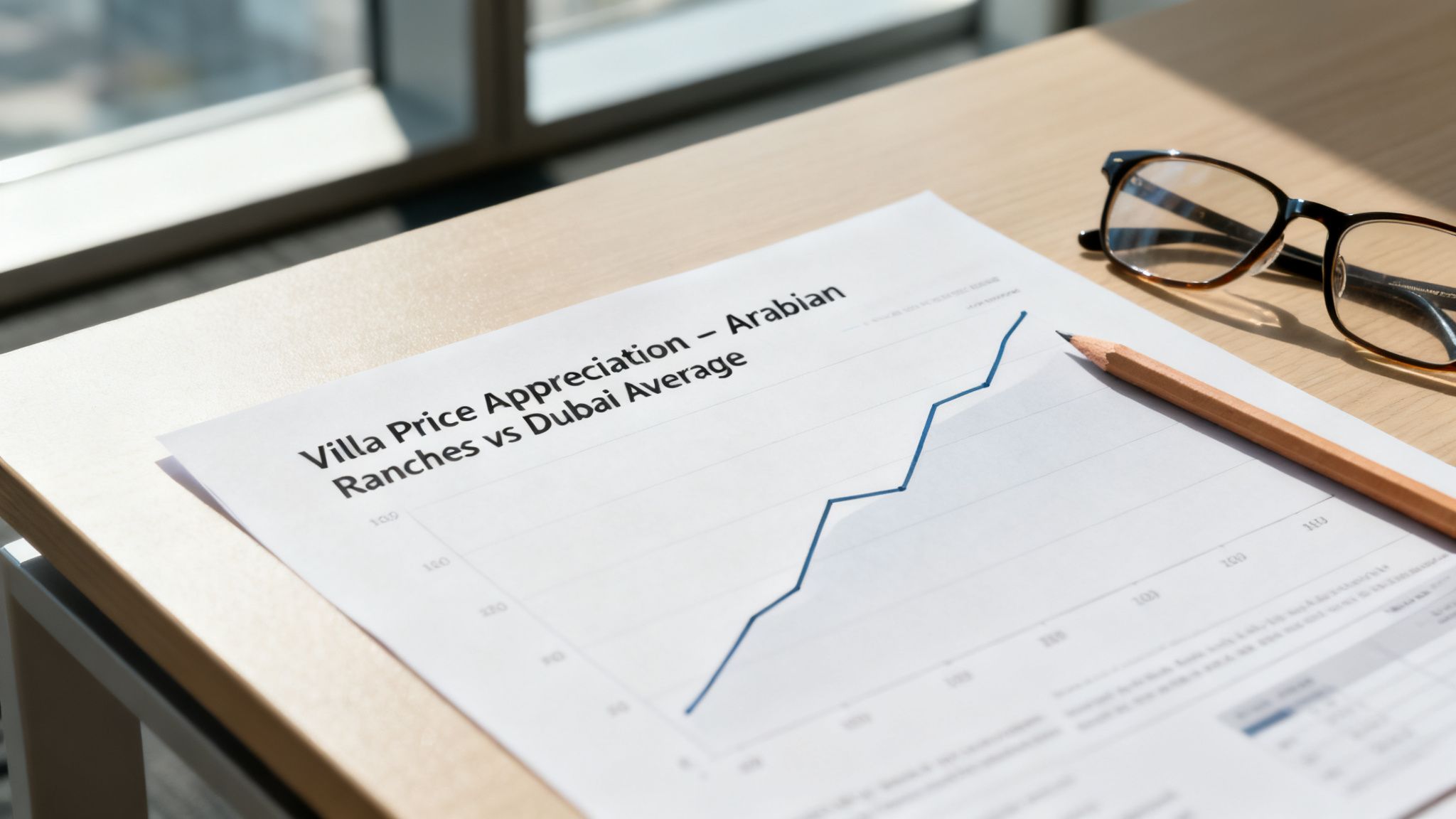
The investment case for Caya is built on its performance relative to the broader market. While city-wide villa appreciation shows signs of stabilization, established communities like Arabian Ranches continue to post strong growth. This performance gap is a key indicator for HNW portfolios seeking assets that consistently outperform market averages.
Data from late 2025 painted a clear picture. While the broader market saw gains, specific REIDIN indices clocked a 17.81% year-on-year jump for villas in prime communities. Projections show Arabian Ranches 3 is set to lead with 15-20% average price gains into 2026, fueled by relentless demand from families prioritizing space and established infrastructure. This highlights the area's resilience and strong underlying fundamentals.
For an asset manager, the question is not just "is the market growing?" but "which segments are leading that growth?" Caya's appeal lies in its decisive answer to the latter question. It represents a flight to quality within the villa segment.
A Shift Towards Sustainable Growth
The market's maturation is evident. The rapid growth between 2022 and 2024 has settled into a more sustainable, end-user-driven phase. This environment heavily favors completed projects in high-demand locations over speculative off-plan ventures in emerging areas.
For investors rebalancing portfolios in 2026, Caya offers a compelling blend of immediate rental yield and proven capital appreciation. Our comprehensive Dubai real estate market analysis provides further context on this macro shift. It’s an asset for a portfolio built on strategy, not speculation.
Deconstructing the Caya Villa as a Financial Asset
When advising a client on an investment property, we look past marketing materials and analyze the physical product as a revenue-generating asset. The villas at Caya in Arabian Ranches 3 are a case study in how architectural design translates directly into financial performance.
Every aspect of these homes—from floor plan efficiency to plot utilization—is engineered to attract and retain a specific, high-value tenant profile.
The individual looking to rent a Caya villa is a senior expatriate executive, likely with a family. This demographic requires functional space: distinct zones for family life, entertaining, and a private home office. Caya's standalone nature and large floor plates deliver precisely that, making the asset more resilient to market swings compared to smaller, generic townhouses.
Architectural Features as Yield Drivers
Certain design elements in Caya villas are not cosmetic; they are functional features that directly command higher rental rates. Understanding these is key to accurately forecasting yield.
- Rooftop Terraces: The 4 and 5-bedroom units include a rooftop terrace, creating a third living space. This is a major draw for the target tenant, offering a private area for outdoor entertaining. This single feature can command a rental premium of 5-8% over comparable villas without it.
- Garden Suites: The ground-floor garden suite in the 5-bedroom layout offers flexibility—it can serve as a guest room, a private office, or separate quarters for domestic staff. This broadens the villa's appeal to the executive rental market.
- Plot-to-Built-Up Area Ratio: Caya villas offer a generous land area relative to the house size. This translates to larger private gardens, a non-negotiable for families and a key differentiator from more densely packed townhouse communities nearby.
These are quantifiable advantages that give the asset an edge in a competitive rental market. Understanding how to leverage these points is essential before buying a villa in Dubai as a pure investment.
Unit Specification and Market Positioning
To properly evaluate Caya as an investment, we must dissect the specifications of each villa type. The total built-up area and layout directly impact rental income and long-term capital growth.
The table below provides a clinical, investor-focused breakdown, zeroing in on the metrics that matter for portfolio performance.
Caya Villa Unit Specification Analysis
| Unit Type | Built-Up Area (Sq. Ft.) | Plot Area (Approx. Sq. Ft.) | Key Features Driving Value | Target Tenant Profile |
|---|---|---|---|---|
| 3-Bedroom | 3,534 | 4,200 - 4,800 | Standalone structure, private garden, en-suite bedrooms | Junior executive, small family |
| 4-Bedroom | 4,097 - 4,440 | 4,800 - 5,500 | Rooftop terrace, double garage, spacious living areas | Mid-to-senior level manager, established family |
| 5-Bedroom | 5,484 | 5,500 - 6,500 | Rooftop lounge, garden suite, corner plot potential | C-suite executive, large family with staff |
Each villa type is calibrated for a specific tier of the corporate rental market. The 5-bedroom unit, with its unique garden suite and large footprint, is positioned as a premium asset built to attract top-tier executive rental contracts often funded by corporate housing allowances.
For an asset owner, this reduces the risk of tenant default and stabilizes rental income. This isn't just a home; it's a financial instrument designed for a specific market segment.
Financial Modelling For A Caya Acquisition
A successful property acquisition requires a precise understanding of the Total Cost of Ownership (TCO), not just the listing price. For a Caya villa, this means getting granular with associated fees and understanding the current payment structures.
We are in a different market now. Unlike the speculative period of 2024, where developers pushed aggressive 1% monthly plans, major players like Emaar have shifted. For ready communities, they have moved towards more robust 60/40 structures, reflecting market confidence. This change attracts committed end-users and long-term investors over short-term flippers and requires a different capital deployment strategy.
Total Capital Outlay Breakdown
The purchase price is just the first line item. A smart investor accounts for all mandatory government fees to calculate the true entry cost. These are non-negotiable and must be factored into any serious financial model.
Here are the key acquisition costs:
- Dubai Land Department (DLD) Fee: A standard 4% of the property's purchase price.
- DLD Registration Fees: An administrative charge of AED 4,200 for properties valued above AED 500,000.
- Real Estate Agency Commission: Typically 2% of the purchase price, plus 5% VAT on the commission.
- Mortgage Registration Fee: If financing, this adds 0.25% of the loan value to the DLD.
For a Caya villa valued at AED 7 million, the immediate upfront costs—excluding the down payment—would be approximately AED 435,000. Neglecting to model these expenses accurately leads to miscalculated ROI projections and potential cash flow issues.
Comparative Market Positioning
To grasp Caya's financial standing, it must be benchmarked against its neighbors within Arabian Ranches 3. While every sub-community benefits from the master community's infrastructure, their launch prices and unit types differ. This analysis reveals Caya’s premium positioning.
The data below shows how Caya's larger, standalone villas command a different market position compared to townhouse-focused clusters.
Comparative Analysis: Caya vs Other AR3 Sub-Communities
The table below breaks down the key differences, illustrating why Caya occupies a distinct, premium tier within the broader Arabian Ranches 3 community.
[Table: Caya vs Other AR3 Sub-Communities]
| Sub-community | Typical Unit Mix | Launch Price (AED/Sq. Ft.) | Current Resale (AED/Sq. Ft.) | Primary Investor Appeal |
|---|---|---|---|---|
| Caya | 3-5 Bed Standalone Villas | ~ AED 900 - 1,100 | ~ AED 1,450 - 1,600 | Premium end-user, executive rental market |
| Joy | 3-4 Bed Townhouses | ~ AED 750 - 850 | ~ AED 2,000 - 2,100 | Entry-level investors, young families |
| Sun | 3-4 Bed Townhouses | ~ AED 700 - 800 | ~ AED 1,900 - 2,000 | High rental yield focus, smaller ticket size |
| Ruba | 3-4 Bed Townhouses | ~ AED 800 - 900 | ~ AED 1,800 - 1,950 | Balance of capital growth and yield |
This table shows that while communities like Joy and Sun offered lower entry points, Caya was designed as a premium asset class. Its value is rooted in larger plot sizes and a standalone nature, which attracts a higher-tier tenant and commands a higher absolute price. For investors wanting to understand the mechanics of buying before completion, it's worth reviewing what off-plan property entails.
The infographic below provides a visual of the distinct villa specifications available within the Caya community.
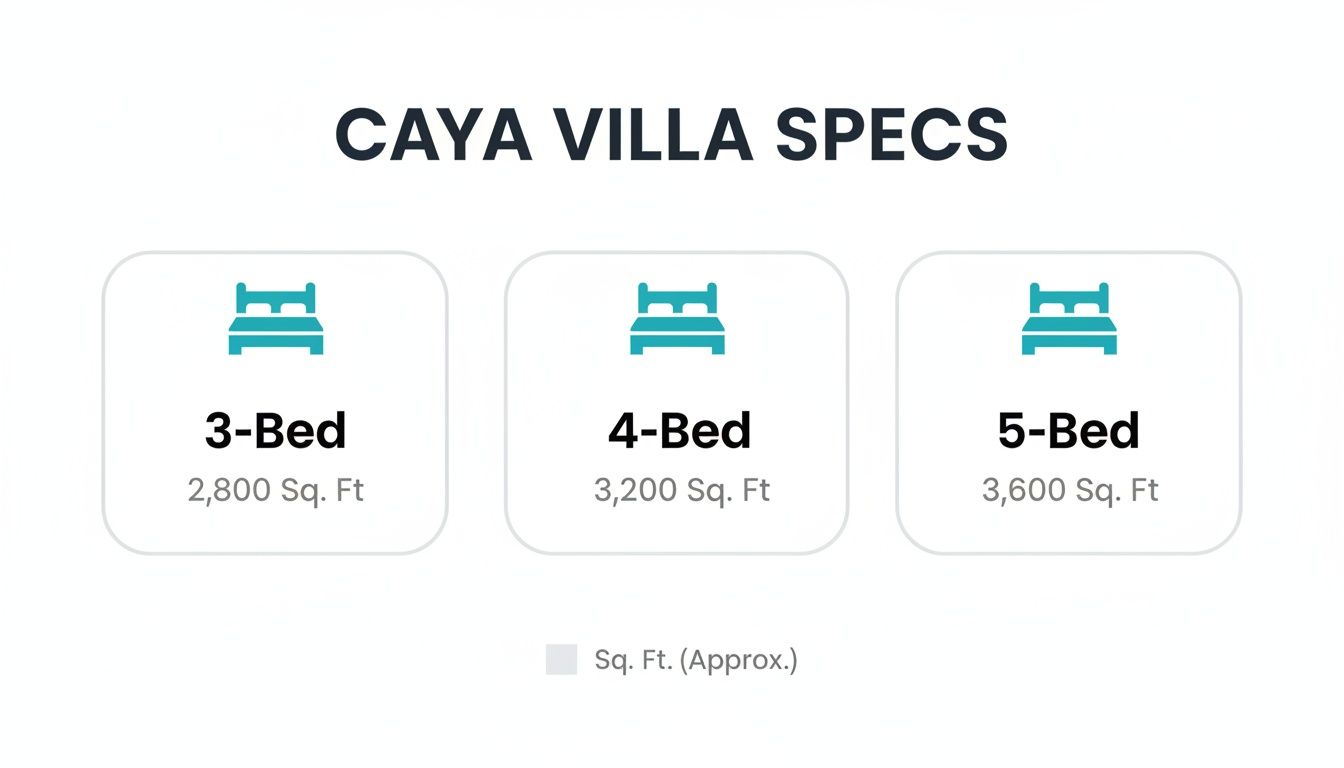
There's a marked jump in built-up area between the unit types, each catering to a distinct segment of the premium family market.
Final Thoughts: Strategy Over Speculation
The financial model for a Caya acquisition in 2026 is built on stability and income generation, not short-term speculation. The shift in payment plans and the clear premium in resale values signal a mature market that rewards quality and genuine end-user demand. This is an acquisition of a high-quality asset with a proven track record in a top-tier master community. If you are rebalancing your portfolio for 2026, let's run the numbers.
Forecasting Yield and Capital Appreciation
Last year's performance is history. The real question is future performance. For Caya, we are modeling its rental yield and capital growth potential out to 2026 and beyond. This analysis is grounded in corporate relocation patterns, major infrastructure projects, and the specific tenant Caya is built to attract.
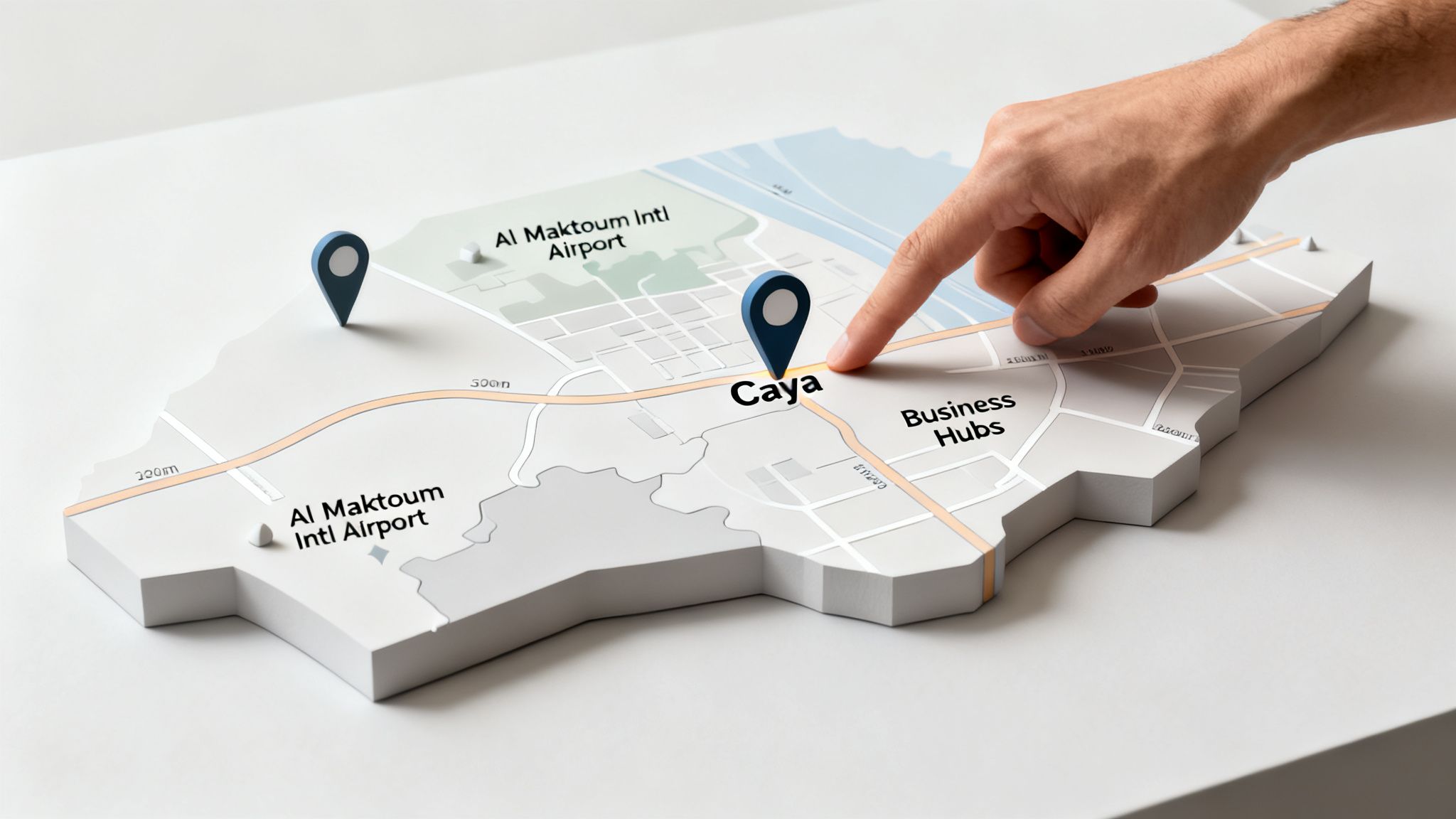
The long-term value story for Caya starts with its location. It is positioned in the path of Dubai's next growth wave, with the expanding Al Maktoum International Airport and major business hubs nearby. As companies establish themselves in Dubai South, the demand for high-quality executive housing within a reasonable commute will intensify, creating a sustainable pipeline of rental demand. [Map: Location relative to Al Maktoum Airport]
Modelling Rental Yields for 2026
Last year's numbers provide a solid baseline. Throughout 2025, Arabian Ranches 3 consistently saw average rental yields between 6-8%. This figure outperforms the city-wide average of 5.5% for apartments. This premium comes from the community's powerful draw for families, pushing occupancy rates past 95%.
Looking ahead to 2026, we project these yields will hold firm, likely increasing for premium units like Caya's 5-bedroom villas. Three key factors support this projection:
- Corporate Relocation: The flow of multinational firms into Dubai continues, bringing senior executives with generous housing allowances.
- Limited Supply: There is a scarcity of new, large, standalone villas inside established, family-focused communities. This lack of supply protects rental values.
- Infrastructure Maturity: As Arabian Ranches 3 develops its own retail and leisure offerings, its desirability increases, giving landlords more leverage.
Projecting Capital Appreciation
While rental yield provides steady income, capital appreciation builds long-term wealth. Our forecast for Caya's capital growth is based on the same fundamentals detailed in our broader Dubai real estate market analysis. We expect a steady, sustainable climb in value rather than the sharp spikes of past cycles.
This growth story is built on two pillars:
- End-User Demand: Caya is a community where people want to live. This creates a strong price floor and protects the asset against sharp market corrections.
- The Emaar Effect: With Emaar as the master developer, you are buying into a proven track record of enhancing community value through maintenance and new amenities. This continuous investment translates directly into asset value growth.
An investor's focus should be on demand-side dynamics. The ideal tenant for a Caya property is a long-term resident. We target C-suite executives, business owners, and professionals with families enrolled in nearby international schools. This demographic values stability and quality—and is willing to pay a premium for it.
Identifying the Target Tenant Profile
Knowing your tenant profile is critical. For a Caya villa, the profile is specific:
- Profession: Senior management or a C-level executive, often with a corporate housing budget.
- Family Structure: A family with two to four children, requiring space, privacy, and access to top-tier schools.
- Lifestyle Needs: Prioritizes community safety, green parks, and high-end recreational facilities.
- Lease Duration: These tenants seek stability and typically sign longer leases (2-3 years), reducing turnover costs and vacancy gaps.
This tenant profile is less sensitive to minor rent increases and more focused on quality of life. By securing this profile, an investor in Caya is managing a stable, income-producing asset with a solid demand base.
The Acquisition Process: Ownership and Legal Framework
For an investor targeting a Caya villa, understanding the purchase process and ownership structure is key. Dubai’s regulatory system, managed by the Dubai Land Department (DLD) and the Real Estate Regulatory Agency (RERA), is a mature and secure framework designed to protect capital.
Every transaction is logged with the DLD, creating an undisputed record of ownership. This transparency and legal certainty are precisely why high-value portfolio investors deploy capital here with confidence.

The Legal Mechanics of a Purchase
The acquisition process is straightforward. The entire system is built on meticulous documentation and strict adherence to DLD protocols, with RERA protections like escrow accounts safeguarding funds.
For Cash Buyers:
- Memorandum of Understanding (MOU): The initial sales agreement that locks in terms.
- No Objection Certificate (NOC): Emaar issues an NOC confirming all service charges are paid.
- Manager's Cheque: Funds are securely transferred via a manager's cheque.
- Title Deed Transfer: The final step at a DLD trustee office where the title deed is officially transferred.
For Mortgage Buyers: The process is similar, with the bank's involvement. The lender conducts its own property valuation before releasing funds at the DLD transfer appointment.
At its core, the process is about security. RERA’s oversight standardizes every step, and the DLD’s digital registry provides an unshakeable record of ownership. This regulatory maturity is a primary reason sophisticated capital is comfortable in the Dubai property market.
Structuring Your Ownership for Asset Protection
How you hold title is as important as the property itself. Investors have options, including individual ownership, joint names, or a corporate structure. Each has different implications for liability and succession planning.
For enhanced asset protection, using a corporate entity is an effective strategy. A dubai-llc-company-setup creates a legal shield, separating the property from personal liabilities. This is particularly useful for clients managing a diverse global portfolio. Understanding the difference between freehold vs leasehold is also a crucial first step.
Tying Property Investment to UAE Residency
A strategic benefit of acquiring a Caya villa is its direct link to UAE residency. An investment of this caliber makes the owner eligible for the 10-year Golden Visa.
This transforms the property from a simple financial asset into a gateway asset. Securing a golden-visa-uae provides stability, unlocks local banking and business opportunities, and offers a secure base. This connection between a prime real estate asset and long-term residency is a major part of the value proposition for international HNWIs.
Answering Key Investor Questions on Caya
How Does Caya's Ready Status Affect My Investment Strategy?
With Caya being a completed community, your approach shifts from speculation to immediate income generation. The risks of construction delays or handover changes are eliminated. A Caya villa is a live asset from day one.
Your focus pivots to securing a quality tenant and optimizing rental income. Based on 2025 benchmarks, yields are in the 6-8% range. This makes Caya a cash-flow-positive anchor for a portfolio, balancing higher-risk, off-plan ventures.
What Are The Primary Service Charges to Factor Into ROI?
This is a critical detail. Budget for Emaar's community service charges, which typically run between AED 3 to AED 5 per square foot of the plot area annually. These fees cover the top-tier maintenance, security, and landscaping that protect your asset's long-term value.
For a 5-bedroom villa on a 6,000 sq. ft. plot, you would budget an annual operational cost between AED 18,000 and AED 30,000. This must be deducted from your gross rental income to calculate your true net yield.
Is Financing A Caya Property Viable For A Non-Resident?
Yes, it is a common path. Non-resident investors can typically secure financing for up to 50-60% of the property's appraised value from major UAE banks. Obtaining a mortgage for a ready asset like Caya is more straightforward than for an off-plan unit.
The bank will require a formal valuation, and your eligibility depends on verifiable income and international credit history. Our guide on buying property in Dubai for foreigners details the required paperwork. Securing pre-approval before making an offer is a non-negotiable step that provides leverage in negotiations.
For a high-quality, completed asset from a Tier-1 developer like Emaar, banks view the deal favorably. The asset itself de-risks the loan from their perspective.
How Liquid Is An Asset Like Caya In The 2026 Market?
The liquidity of a Caya villa is strong, as it appeals to a deep pool of end-users. These villas are exactly what affluent families seek—a constant source of demand.
Transaction data from last year showed a healthy turnover rate for ready villas in Arabian Ranches 3. Well-priced units received offers within weeks. Its premium feel and the Emaar brand ensure it remains a highly desirable asset, underpinning its resale value and marketability.
Final Thoughts: Strategy Over Speculation
The window for 'easy flips' has narrowed. Success in 2026 requires targeting communities with genuine infrastructure and end-user demand. A ready asset like Caya offers immediate cash flow and a proven history of growth within a mature, Emaar-managed community. At Proact Luxury Real Estate, we track these fundamental value drivers daily. If you are rebalancing your portfolio for 2026, let's run the numbers.