


When you're serious about investing in Dubai's property market, setting up a Limited Liability Company (LLC) isn't just an option—it's the smartest strategic play you can make. Think of it as a legal fortress, creating a solid wall between your personal wealth and your business assets. This is absolutely critical when you're dealing with high-value real estate.
And things just got a whole lot better. The recent shift to 100% foreign ownership has completely changed the game, cutting through old complexities and giving international investors the full control they've always wanted.
Why an LLC Is Your Best Bet for Dubai Property Investment
Choosing the right corporate structure is the bedrock of any successful property investment strategy in Dubai. You’ll hear about different options, but for serious real estate investors, the mainland Limited Liability Company (LLC) almost always comes out on top. It offers a blend of asset protection, market access, and operational freedom that other setups just can't match.
The biggest win? An LLC creates a clear legal separation between you and your business. Your personal assets—your home, your savings, your other investments—are protected from any business-related debts or legal troubles. This isn't just a piece of paper; it’s a vital safety net in a fast-moving, high-stakes market.
Gaining Full Control and Market Access
Recent legal reforms have been a massive boost for international investors. The old rule requiring a local sponsor to hold a majority stake is gone for most business activities, thanks to the move allowing 100% foreign ownership. This puts you firmly in the driver's seat, with complete control over your investments and decisions.
The impact has been huge. The UAE's business scene saw a 16% jump in new registrations in Q1 2025 alone, with LLCs being one of the most popular and straightforward structures. You only need 2 to 50 shareholders and 1 to 5 managers, which is perfect for international founders—who now make up over 60% of all new business registrations in Dubai.
Key Takeaway: Full ownership means you have total control over your assets, profits, and long-term strategy. You no longer need to give up a majority share to a local partner.
Unrestricted Investment Opportunities
A mainland LLC gives you something a free zone company can't: total, unrestricted access to the entire Dubai property market. You’re free to buy, sell, rent out, and manage properties in any of the designated freehold areas without being fenced in by jurisdiction.
This flexibility is what allows you to build a truly diverse and resilient portfolio. You can snap up a high-yield apartment in Dubai Marina, invest in a sprawling villa on Palm Jumeirah, or get in on an off-plan project in an up-and-coming community. There are no legal hoops to jump through. To get a better feel for the landscape, check out our guide on Dubai freehold properties.
Let's quickly break down why an LLC is such a powerful tool for property investors.
Key Advantages of an LLC for Dubai Property Investment
This table sums up the core benefits that make an LLC the go-to structure for real estate investment in Dubai.
| Benefit | Impact for Property Investors |
|---|---|
| Asset Protection | Safeguards your personal wealth from business liabilities, a crucial factor when managing expensive real estate assets. |
| 100% Foreign Ownership | Provides complete control over your company and its assets without needing a local majority partner for most activities. |
| Unrestricted Market Access | Allows you to purchase, sell, and manage property anywhere in Dubai's designated freehold zones. |
| Enhanced Credibility | A mainland LLC is a recognised and respected legal structure, making it easier to open corporate bank accounts and secure financing. |
| Perpetual Succession | The company continues to exist even if ownership changes, ensuring long-term stability for your property portfolio. |
Ultimately, by choosing a Dubai LLC company setup, you’re doing more than just registering a business. You’re building a secure, scalable foundation for your real estate ambitions, giving you the legal framework and market access needed to succeed in one of the world's most dynamic property markets.
Your Action Plan for Setting Up a Dubai LLC
Moving from theory to action is where the rubber meets the road in your Dubai LLC company setup. This isn't just a paper-pushing exercise; it's a series of strategic decisions that build on each other. For property investors, the first move has to be precise: selecting the right business activities.
You have to get this right from the start. Your licence must clearly cover real estate investment, buying and selling properties, and property management or leasing. Nailing this down at the beginning saves you from a world of compliance headaches and operational hurdles later. Once you’ve defined your activities, the next immediate steps are reserving your trade name and getting initial approval from the Dubai Department of Economy and Tourism (DED). Think of this as the green light for your entire venture.
Defining Your Corporate Blueprint
With that initial approval in your back pocket, your focus will shift to the legal foundation of your company: the Memorandum of Association (MoA). A generic, off-the-shelf MoA simply won't do for a serious property investor. This document needs to be carefully crafted to detail the company's purpose—specifically holding, managing, and renting out properties. It should also spell out shareholder responsibilities and how profits will be distributed, creating a rock-solid framework for your operations.
Consider the MoA the constitution for your real estate enterprise. When done right, it not only ticks a legal box but also helps head off potential disputes between partners down the road. This is one area where I always recommend getting professional legal advice to ensure every clause aligns perfectly with your investment goals. Many investors I've worked with also find it useful to detail the process for buying and selling assets right within the MoA for extra clarity.
Securing Your Physical Presence
Here's a non-negotiable for a mainland LLC: a physical office space. This isn't just a formality; it's a legal must-have to get your trade licence. You'll need to lease a commercial property and get the tenancy contract registered through the Ejari system.
The Ejari certificate is the golden ticket for your final submission to the DED. Without it, your application hits a brick wall. This step proves your company has a legitimate physical address in Dubai, which goes a long way in establishing credibility with banks and government agencies.
It’s a step that many new investors overlook. They might find the perfect investment property but forget that the LLC itself needs its own registered office—and no, your residential address doesn't count. The smoothest way to handle this is to sort out the office lease and Ejari registration as soon as you get that initial nod from the DED.
The infographic below really drives home why this entire process is worth the effort for property investors.
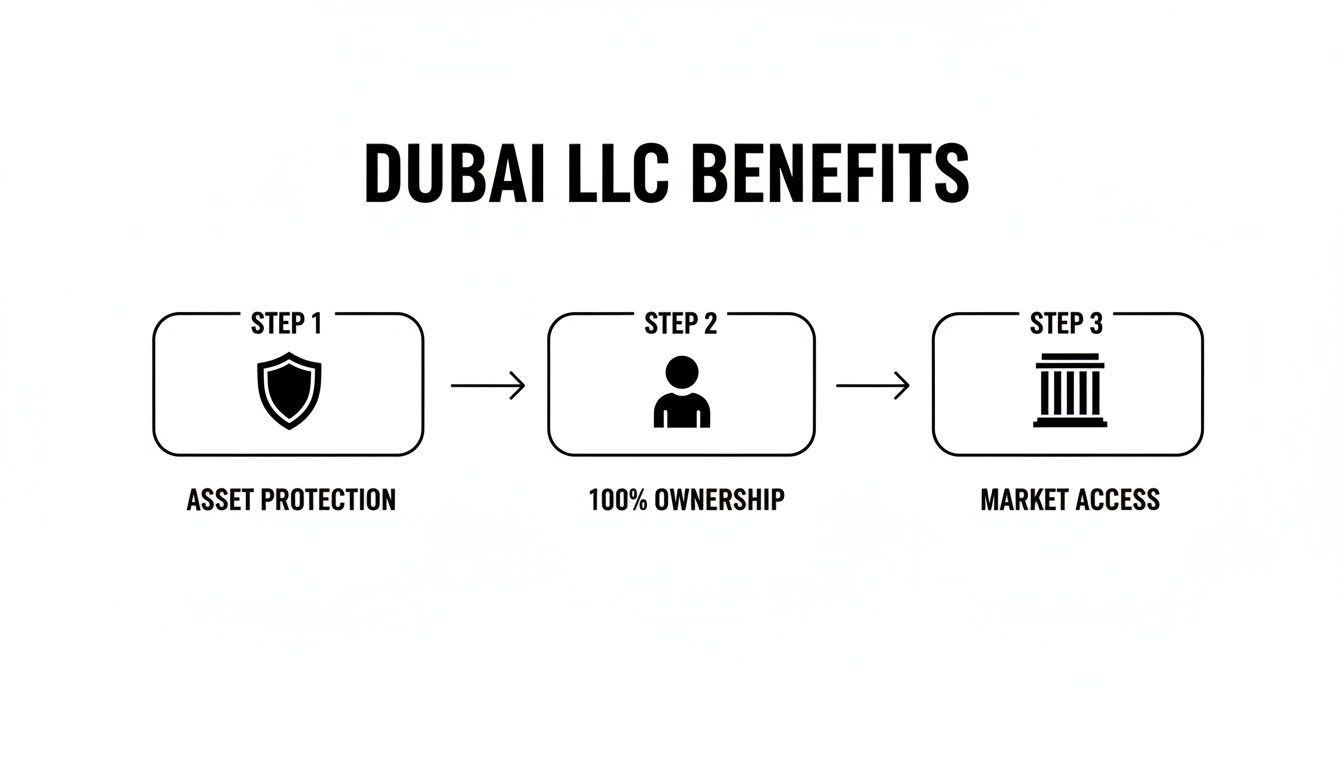
This visual shows exactly how the LLC structure is built to protect your investments while giving you maximum freedom in the market. Every step you take in the setup process is designed to unlock these powerful advantages.
The Final Submission and License Issuance
Alright, you've got your trade name, initial approval, a notarised MoA, and that all-important Ejari certificate. Now you're ready for the final push. All the required documents, along with passport copies for every shareholder, get submitted to the DED. The system is incredibly efficient these days, and once your paperwork is checked and the final payment is made, the DED will issue your official trade licence.
This licence is the key that unlocks everything. It allows you to:
- Open a corporate bank account, which is absolutely critical for managing rental income and property transactions.
- Apply for investor visas for yourself and any partners, giving you UAE residency.
- Start buying properties under the company's name, officially separating your business assets from your personal wealth.
While the process is detailed, this structured path is the most secure way to establish your real estate investment company in Dubai. Foreign investors, especially, will find the process more straightforward than ever. For a closer look at the specifics of purchasing property, our guide on buying property in Dubai for foreigners offers great insights that pair well with this setup process. Getting these stages right ensures your Dubai LLC company setup is built on a solid, compliant foundation, ready for you to start building your portfolio.
Budgeting for Your Dubai LLC Formation

Alright, let's talk numbers. Planning your budget is one of the most critical steps in a successful Dubai LLC company setup. When you're dealing with investment capital, vague estimates just won't cut it. You need a clear, itemised picture of where every dirham is going. This clarity is key to avoiding the kind of surprise costs that can derail even the most solid ventures.
The total cost to get your LLC off the ground is a mix of several government and third-party fees. Each fee aligns with a specific stage of the formation process, from locking down your company name to getting that final trade licence in hand.
Core Government and Administrative Fees
The biggest slice of your initial setup costs will go to government bodies like the Dubai Department of Economy and Tourism (DED). These fees are mostly fixed, so they form the bedrock of your budget.
Here’s a look at the mandatory costs you can expect:
- Trade Name Reservation: This secures your company's unique name. Expect to pay between AED 620 and AED 1,000, depending on whether it's a standard name or includes personal names.
- Initial Approval Certificate: Think of this as the DED's preliminary nod for your business activities. It's a smaller fee, usually around AED 120 to AED 300.
- Memorandum of Association (MoA) Notarisation: Your MoA needs to be legally attested. This notarisation typically costs between AED 1,500 and AED 2,500.
- Trade Licence Issuance: This is the big one, giving you the legal right to operate. It can range from AED 10,000 to AED 15,000, heavily influenced by your specific business activities.
Variable Costs That Shape Your Final Budget
Once you have the government fees locked down, other expenses come into play. These are the variables that can swing your total investment one way or the other. For a property investor, the most significant variable is almost always the office space.
A mainland LLC requires a physical office address, and the cost of leasing that space and registering it with Ejari is a major budget item. A modest office might run you AED 12,000 to AED 25,000 annually, but if you want a prime location, that figure can climb much higher. The number of business activities on your licence and the number of visas you need will also nudge the final costs up.
Expert Insight: Don't underestimate the impact of your chosen office. While a smaller, more affordable space is fine for compliance, a premium address can significantly boost your credibility with banks and high-value partners—a crucial factor for anyone in the luxury property game.
To give you a clear financial roadmap, here's a detailed table breaking down the typical costs.
Estimated Cost Breakdown for Dubai LLC Company Setup
| Expense Item | Estimated Cost (AED) | Notes |
|---|---|---|
| Trade Name Reservation | 620 - 1,000 | Fee varies based on name type (e.g., standard vs. personal). |
| Initial Approval Certificate | 120 - 300 | A small but mandatory DED fee. |
| MoA Notarisation | 1,500 - 2,500 | Legal attestation of your company's founding document. |
| Trade Licence Issuance | 10,000 - 15,000 | The primary government fee; depends on business activities. |
| Office Rent (Annual) | 12,000 - 25,000+ | Required for mainland LLCs; price varies by location and size. |
| Local Sponsor/Agent Fee | 5,000 - 15,000 | Annual fee for the mandatory local partner or service agent. |
| Establishment Card | 2,000 | Required for visa processing. |
| Total Estimated Range | 31,240 - 60,800+ | This is a general guide; final costs will vary. |
This table should help you budget more accurately and avoid surprises. When you add it all up, the total setup costs for a Dubai LLC typically land somewhere between AED 35,000 and AED 65,000. This range covers everything from the initial approvals right through to your first year's office rent. For more context on business growth in the region, you can discover more insights about Dubai's economic expansion.
Mapping Out the Timeline
Time is just as valuable as money in any investment plan. The good news? The Dubai LLC company setup process is remarkably efficient. If all your documents are in order, you can expect the entire journey—from application to licence in hand—to take about 2 to 4 weeks.
Here’s a realistic timeline to keep in mind:
- Initial Approvals (2-3 working days): This covers reserving your trade name and getting that first green light from the DED.
- MoA and Office Lease (3-5 working days): You can work on drafting and notarising your MoA while you finalise your office lease and get the Ejari certificate.
- Final Submission and Licence Issuance (5-7 working days): Once everything is submitted, the DED will review, process the payment, and issue your trade licence.
This clear timeline allows you to plan your next moves, like opening a corporate bank account and starting visa applications, without missing a beat. By budgeting for both the financial and time commitments, you're setting your new venture up for a smooth and successful launch.
Finalizing Your Setup with Bank Accounts and Visas

Getting your official trade licence is a huge milestone in your Dubai LLC company setup. It feels like the finish line, but it’s really the gateway to the final operational phase. With your company now legally on the map, two critical pieces remain before you can start transacting and truly live in the UAE: opening a corporate bank account and sorting out your residency visas.
These final steps are non-negotiable. A corporate bank account is a legal must-have for any LLC, and it's how you’ll manage everything from rental income to service charges. The visa, on the other hand, formalises your status as a resident investor, giving you the legal right to live and work in Dubai.
Opening Your Corporate Bank Account
Let’s be clear: trying to run your property investment LLC through a personal bank account is a major compliance no-go. You absolutely must open a dedicated corporate account, and Dubai’s banks have pretty robust due diligence processes. The key to a smooth approval is showing up prepared.
The bank will want to see a complete file of your new company's legal documents. Trust me, being organised here makes a world of difference in how fast your account gets activated.
Here’s what you’ll typically need to have ready:
- Trade Licence: Your official licence from the DED.
- Memorandum of Association (MoA): The notarised document that outlines your company’s structure.
- Shareholder and Manager Documents: Passport copies, visa copies (if you have them), and Emirates ID copies for all partners.
- Office Tenancy Contract (Ejari): This is the proof of your company's physical address.
- Company Profile: A simple document explaining what your business does—in your case, real estate investment.
Pro Tip: Banks in the UAE are laser-focused on compliance. Be prepared for detailed questions about where your funds are coming from and the kinds of transactions you plan to make. Full transparency is your best friend here and will seriously speed things up.
Navigating the Visa Application Process
Once the trade licence is in hand, it's time to secure your residency. This all kicks off by applying for an Establishment Card from the immigration authorities. Think of it as registering your new company with them; it’s the prerequisite that allows you to start applying for visas.
The visa journey, whether for you as an investor or for an employee, follows a very specific path. Each stage has to be completed in the right order to avoid frustrating delays.
The Investor Visa Pathway
- Entry Permit Issuance: First, your company applies for an entry permit for you as the investor. This document lets you enter the UAE to complete your residency paperwork. If you’re already in the country, you can do what’s called a "status change."
- Medical Fitness Test: With the entry permit processed, you’ll head to a government-approved health centre for a mandatory medical test. It’s a standard screening for certain communicable diseases.
- Emirates ID Application: At the same time, you'll visit a Federal Authority for Identity & Citizenship (ICA) centre. Here, they'll take your biometrics (fingerprints and a photo) for your Emirates ID card, which will become your main identification document in the UAE.
- Visa Stamping: Once you've passed the medical test and your biometrics are done, your passport is submitted to get the residency visa stamped inside. This stamp is the final, official confirmation of your residency status, and it's usually valid for two years.
From start to finish, this whole process—from the entry permit application to the final visa stamp—typically takes about 7 to 14 working days, assuming all your documents are correct.
For high-net-worth investors making a significant contribution, it's also worth exploring long-term residency. To get a better handle on these advanced options, you can learn more about the UAE Golden Visa in our detailed article. Once you’ve navigated these final steps, you’re officially an operational and resident investor, ready to start building your property portfolio in Dubai.
Staying Compliant with UAE Tax and Regulations
Getting your head around the local rules is the secret to keeping your company in good standing and seeing your property portfolio flourish long-term. While the UAE’s tax and compliance landscape is famously business-friendly, you absolutely cannot afford to ignore your obligations. For any investor finalising their Dubai LLC company setup, understanding Corporate Tax and Value Added Tax (VAT) from day one isn't just important—it's essential.
The regulatory system here is refreshingly direct, especially when you compare it to other global investment hubs. But don't mistake simplicity for laxity. Diligence is key. Keeping meticulous records and hitting your registration deadlines are the bedrock of running a profitable real estate business while staying on the right side of the law.
Understanding the UAE Corporate Tax Regime
The introduction of Corporate Tax was a huge step for the UAE, but it was designed with small and medium-sized businesses in mind. The system is incredibly straightforward and far more favourable than what you'll find in most other countries.
For your LLC, it breaks down like this: you'll pay a 0% tax rate on annual net profits up to AED 375,000. That's right, zero.
Only when your profits cross that generous line does the competitive 9% tax rate kick in, and it only applies to the amount above the threshold. This setup is a massive advantage for property investors, particularly when you're just starting to build a rental portfolio and profits are still growing.
This tax structure is a core part of what makes the UAE so attractive. A 9% corporate tax only on net income over AED 375,000, a 0% rate below that, no personal income tax, and zero withholding on dividends create a powerful financial incentive. Just remember, all onshore LLCs must prepare annual financial statements. In Dubai, these audited accounts are submitted through the DED portal to ensure tax compliance. For a closer look at this, you can learn more about LLC formation and tax benefits on movingo.ae.
Registration and Record-Keeping Essentials
Every single mainland LLC is required to register for Corporate Tax with the Federal Tax Authority (FTA). This applies to you regardless of your income level. Let me be clear: this is not optional. Registering gets your company on the FTA’s radar and ensures you're ready to file when the time comes.
Just as critical is the legal requirement to maintain proper accounting records and have your financial statements audited. This isn't just about good business hygiene; it's the law. These records need to paint an accurate picture of every transaction and your company's financial position, which is vital for calculating your tax liability correctly.
Key Insight: Think of proper bookkeeping as your first line of defence. It not only gets you ready for tax season but also gives you the hard data you need to make smarter investment decisions with your properties.
Navigating Value Added Tax (VAT)
Beyond Corporate Tax, you also need to have Value Added Tax (VAT) on your radar. VAT is a consumption tax that applies to most goods and services, and that includes commercial property transactions and leases.
For a real estate LLC, the rules are quite specific:
- Mandatory Registration Threshold: If the value of your taxable supplies and imports tops AED 375,000 over the last 12 months, your LLC is legally required to register for VAT.
- Voluntary Registration Threshold: If your taxable supplies are below that mark but exceed AED 187,500, you can choose to register voluntarily. This can sometimes be a strategic move.
- VAT on Commercial Property: The sale or lease of a commercial property is subject to the standard 5% VAT rate.
- VAT on Residential Property: This is where it gets nuanced. The first supply of a brand-new residential property is zero-rated, while any subsequent sales or leases are exempt. Understanding this distinction is crucial for property investors.
Once you’re registered for VAT, your LLC must charge it on relevant services (like commercial rent), file regular VAT returns with the FTA, and keep VAT-compliant records for a minimum of five years. Staying on top of these duties will ensure your Dubai LLC company setup operates without a hitch inside the UAE’s clear and predictable regulatory world.
Got Questions About Setting Up a Dubai LLC?
Even with a solid plan, you're bound to have questions when setting up a Dubai LLC company for the first time. For property investors like you, these questions usually circle back to ownership, market access, and what the future holds.
I get it. That's why I've rounded up the most common questions I hear from investors. Think of these as the final details to iron out, giving you the clarity you need to move forward with confidence.
Do I Still Need a Local UAE Sponsor for My Dubai LLC?
This is the big one, and the answer has completely changed the game for international investors. For almost all business activities, including real estate investment, the answer is a firm no.
Thanks to major reforms in the Commercial Companies Law, 100% foreign ownership is now the standard for most mainland LLCs. You no longer need an Emirati sponsor holding a majority stake. This means you have direct and total control over your company, your assets, and your profits. A few strategic sectors still have specific ownership rules, but they almost never apply to property investment.
Can My Dubai LLC Own Property Anywhere in Dubai?
Yes, absolutely. This is probably the single biggest reason to choose a mainland LLC over a free zone company. A Dubai mainland LLC gives you the legal power to buy, sell, and manage property in any of Dubai's freehold areas.
That means the entire market is open to you. Whether you're eyeing a villa on Palm Jumeirah, a high-yield flat in Downtown Dubai, or an off-plan townhouse in a developing community, your LLC can legally hold the title deed. This is a crucial advantage, as many free zone companies are stuck with geographic restrictions that can seriously limit your investment strategy.
Investor Takeaway: With a mainland LLC, your investment strategy dictates your property choices, not your company's jurisdiction. This freedom is essential for building a diversified and resilient real estate portfolio across Dubai.
What Happens If I Want to Close My LLC Down the Road?
Smart question. Planning your exit is just as critical as planning your entry. Shutting down a Dubai LLC isn't as simple as just closing the doors; it's a formal process called liquidation. You have to officially dissolve the company to avoid any future fines or legal loose ends.
The process has a few clear steps:
- Appoint a Liquidator: You’ll need to hire a registered liquidator to handle the dissolution and file the final paperwork.
- Go Public: A notice about the liquidation has to be published in local newspapers to give any creditors a heads-up.
- Get Your Clearances: You'll need to get clearance certificates from various government bodies, like the DED, Ministry of Human Resources, DEWA, and your telecom provider.
- Final Sign-Off: Once all debts are paid and clearances are in hand, the liquidator submits the final report to the DED to officially cancel your trade licence.
It's a methodical process, and it’s always best to have a professional handle it. This ensures every box is ticked and you're protected from any lingering liabilities.
What’s the Minimum Share Capital for a Dubai LLC?
Here’s another area where things have gotten much easier for investors. Gone are the days of strict minimums. The Dubai DED no longer requires you to deposit a specific, hefty amount of share capital into a bank account for most business activities.
While your company's Memorandum of Association (MoA) still needs to state a share capital figure, the rule of thumb now is that the amount should simply be "sufficient" to meet your business goals. For a property investment LLC, this gives you massive flexibility. It lowers the financial barrier to entry and frees up your capital to be used for what really matters: acquiring properties. This shift makes the Dubai LLC company setup more accessible than it has ever been.
Ready to build your Dubai real estate portfolio on a solid legal foundation? Proact Luxury Real Estate LLC specialises in guiding global investors through every step, from company formation to identifying high-yield luxury properties. Let our two decades of financial expertise and deep market insights work for you. Book a one-on-one consultation with us today and start your investment journey with confidence.