


In the world of institutional investment, no capital is deployed without a rigorous risk mitigation framework. In Dubai real estate, your tenancy contract performs exactly this function. It is not merely an administrative formality to be signed and filed; it is the primary instrument that governs the yield, liquidity, and legal safety of your asset.
For high-net-worth investors, particularly those managing portfolios from overseas, the tenancy contract acts as the "operating system" of the property. A well-structured agreement ensures consistent cash flow and asset preservation. A poorly drafted one is a liability that can lead to protracted vacancies and legal gridlock.
As we look toward the 2026 market cycle, regulatory compliance is tighter than ever. This guide dissects the tenancy framework not just as a legal requirement, but as a strategic tool to safeguard your ROI.A tenancy contract in Dubai is the legally binding document that maps out all the terms and conditions between a landlord and a tenant. You can think of it as the architectural blueprint for your rental investment—a critical tool regulated by the Real Estate Regulatory Agency (RERA) to protect everyone involved.
What Every Investor Should Know About Tenancy Contracts

For any high-net-worth individual or overseas investor, getting to grips with the tenancy contract Dubai framework is fundamental. This isn't just about dotting i's and crossing t's; it's about safeguarding your property asset. It's far more than a simple rental agreement—it's the very foundation of your landlord-tenant relationship.
A well-drafted contract brings stability and clarity. A sloppy one? That’s a fast track to costly disputes and headaches you just don't need.
The whole point of this document is to eliminate ambiguity. It meticulously defines every rule, responsibility, and financial obligation, ensuring both you and your tenant are on the same page from day one.
The Blueprint Analogy for Investors
Imagine you're building a luxury villa. You wouldn't pour a single bag of cement without a detailed architectural blueprint specifying every material, dimension, and structural detail. A tenancy contract serves the exact same purpose for your rental investment.
- The Foundation: The legal names of all parties, property details (including the crucial Makani number), and the contract duration form the solid base.
- The Framework: The rent amount, payment schedule, and security deposit details create the essential structure of your financial agreement.
- The Finishing Touches: Clauses on maintenance, renewals, and property use are the finishing details that ensure the property is managed correctly and holds its value.
Without this blueprint, the entire investment is vulnerable. The contract is your legal fallback, the tool that protects your income stream and the physical condition of your asset.
Quick-Reference Checklist for Your Tenancy Contract
For investors, certain elements of a tenancy contract are simply non-negotiable. This table breaks down the absolute must-haves for a legally sound agreement in Dubai.
| Essential Component | Why It's Critical for Investors |
|---|---|
| Full Legal Names & IDs | Verifies the identity of all parties (landlord, tenant, agent) and ensures legal enforceability. |
| Complete Property Details | Includes the full address, DEWA premise number, and the unique Makani number for precise identification. |
| Contract Duration | Clearly states the start and end dates, which is vital for managing renewals and terminations. |
| Rent Amount & Payment Schedule | Defines the total annual rent and the exact dates and method for each payment (e.g., 1, 2, or 4 cheques). |
| Security Deposit | Specifies the amount and the conditions under which it can be withheld, protecting your asset from damages. |
| Ejari Registration Clause | A clause mandating Ejari registration is essential, as this makes the contract legally binding and admissible in court. |
Getting these basics right from the outset prevents the vast majority of potential disputes down the line.
A Market Built on Contracts
The sheer scale of Dubai’s rental market underscores just how important these contracts are. Throughout 2025, the market recorded over 244,000 registered contracts. What's telling is that renewal agreements made up about 66.8% of this total, highlighting a clear tenant preference for stability in a competitive city.
With gross rental yields holding strong at 7.2% for apartments and 5% for villas, a rock-solid tenancy contract is the mechanism that ensures you can actually capitalise on these returns.
As an investor, your tenancy contract is your primary risk management tool. It codifies expectations and provides a clear path for dispute resolution, turning a potential liability into a predictable, high-performing asset.
Of course, the contract is just one piece of the puzzle. To get the full picture, you need to understand the wider financial landscape. For more on that, take a look at our comprehensive guide on property taxes for investors. Ultimately, this legal document is the single most important instrument for securing your investment in Dubai's dynamic property market.
The Building Blocks of a Legally Sound Contract
A strong tenancy contract isn't just a piece of paper; it’s a carefully built structure made from essential legal components. Think of each clause as a foundational block. If even one is missing or poorly defined, the whole agreement becomes unstable, leaving your investment dangerously exposed.
This isn't about ticking boxes or filling in blanks. It’s about building a legal fortress around your asset. Every detail, from names to numbers, must be precise, clear, and perfectly aligned with Dubai's regulatory framework.
Identifying the Parties and the Property
The very first layer of any contract is getting crystal clear on who is involved and what property is being leased. Any vagueness here is an open invitation for future disputes.
Full Legal Names of All Parties: The contract needs the full legal names of both landlord and tenant, exactly as they appear on their Emirates ID or passport. This is non-negotiable. It ensures the people signing are legally accountable, because any discrepancy can make the contract a nightmare to enforce.
Precise Property Identification: Simply writing down an apartment number just won't cut it. A proper tenancy contract Dubai must include the full address, the DEWA premise number, and, most critically, the unique Makani number. This 10-digit code is Dubai's official geo-addressing system, which completely eliminates any confusion about the property's exact location.
Getting this level of detail right from the start means there's no question about the specific asset and the individuals bound by the agreement.
Defining the Financial Framework
Once you’ve locked down the who and the what, the next set of building blocks defines the money. This is where most disagreements start, so absolute clarity is everything. The goal is to leave zero room for interpretation when it comes to the flow of funds.
A tenancy contract's financial terms should function like a precise ledger. Every dirham—from rent to deposit—must be accounted for with clear instructions on its purpose, payment schedule, and conditions for return. Ambiguity here is a financial liability.
Here are the core financial pieces you must get right:
- Total Rent Amount: The total annual rent has to be clearly stated in both figures and words. This simple step helps prevent silly but costly clerical errors.
- Detailed Payment Schedule: How is the rent being paid? The contract must spell out the number of payments (e.g., one, two, or four cheques), the exact due date for each one, and the details of the post-dated cheques provided.
- Security Deposit Terms: The agreement must state the security deposit amount—typically 5% of the annual rent for unfurnished properties. More importantly, it must outline the exact conditions under which deductions can be made when the tenant moves out, specifying issues that go beyond normal wear and tear.
- Contract Duration: The lease's start and end dates have to be explicitly defined. This period is the foundation for renewal notices and termination rules, making it a cornerstone of the agreement’s entire lifecycle.
Each of these elements fits together to create a predictable and enforceable financial structure for your investment. Grasping the details of these components is a massive part of mastering UAE property law.
This knowledge empowers you to manage your assets proactively and sidestep the common traps that eat into profitability. A single poorly written clause can quickly escalate from a small misunderstanding to a formal case at the Rental Dispute Settlement Centre. That's why meticulous attention to these building blocks isn't just good practice—it's essential protection for your investment in Dubai's dynamic market.
Understanding Ejari: Your Contract's Official Stamp
Once you have a perfectly drafted tenancy contract, there's one final, non-negotiable step to make it legally powerful: Ejari registration. Think of Ejari as the official government stamp that transforms your private agreement into a legally recognised document within the Emirate.
Without it, your contract is effectively invisible to the Dubai Land Department (DLD) and all associated legal bodies.
Imagine purchasing a luxury car but never registering it with the authorities. You might have the keys and a sales receipt, but on the road, your ownership has no legal standing. The Ejari system functions in the exact same way for your tenancy contract in Dubai, providing the official validation required to enforce your rights.
Why Ejari Is More Than Just Paperwork
Ejari, which means "my rent" in Arabic, is a state-of-the-art system designed to regulate Dubai's rental market. Its main job is to ensure all rental agreements are fair, transparent, and fully compliant with the legal framework set by the Real Estate Regulatory Agency (RERA).
This registration isn't optional; it's a legal requirement under Dubai law. The responsibility for registration typically falls on the landlord or their designated property manager. For you as an investor, ensuring this is done promptly is a critical part of protecting your asset.
The process creates a standardised, accessible record of your lease agreement. This is absolutely essential for a variety of official transactions, like sponsoring family visas or setting up DEWA (Dubai Electricity and Water Authority) accounts.
This visual breaks down the essential elements that form the foundation of the contract you'll register.
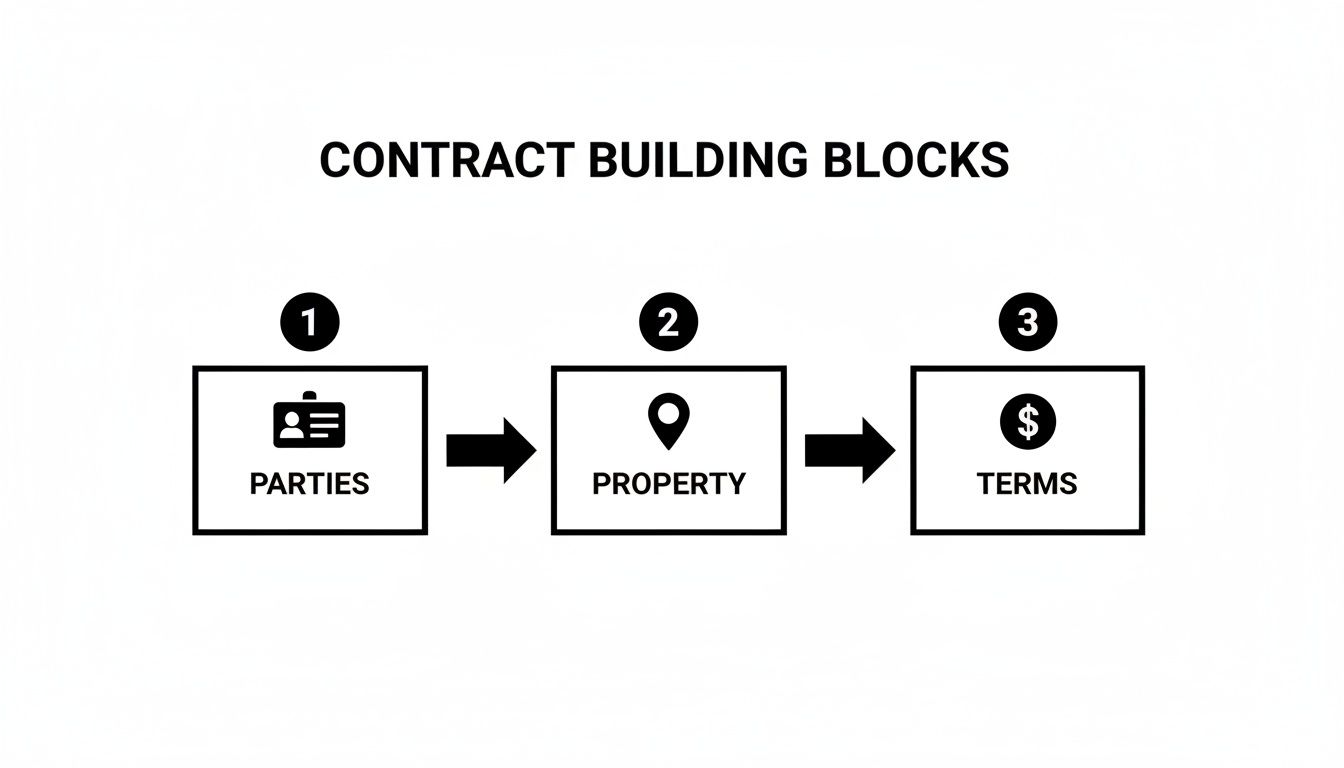
This flow highlights how clear identification of the parties, property, and terms creates the solid foundation needed for a successful Ejari registration and a dispute-free tenancy.
The Registration Process Step-by-Step
Getting your tenancy contract registered with Ejari is a straightforward process that can be handled online or through an approved typing centre. You’ll just need a clear, organised set of documents to ensure a smooth transaction.
- Gather the Required Documents: Prepare digital or physical copies of all necessary paperwork. This is the most crucial step, as any missing documents will only delay the process.
- Submit Your Application: You can upload the documents via the official DLD REST app or visit an approved Ejari typing centre. The system is designed to be efficient for both local and overseas landlords.
- Pay the Associated Fees: The registration fees are modest, generally around AED 220. This small investment is invaluable for the legal protection it provides.
- Receive Your Ejari Certificate: Once processed, you'll get an official Ejari certificate. This document contains a unique Ejari ID number and is your definitive proof of legal registration.
Keep this certificate somewhere safe. You will need it for any official matters related to the tenancy, including renewals or, if it comes to it, dispute resolution.
The Unforgiving Consequence of Non-Registration
So, what happens if you neglect this crucial step? The consequences are severe and can completely undermine your position as a landlord.
The most critical repercussion of not registering your contract with Ejari is that you lose all legal recourse. You cannot file a case at the Rental Dispute Settlement Centre (RDSC) without a valid Ejari certificate. Your contract, no matter how well-drafted, simply holds no weight in the eyes of the law.
This means if your tenant stops paying rent, damages your property, or refuses to vacate after the contract ends, you have no legal path to seek resolution. The door to the RDSC is firmly shut.
Essentially, Ejari is the key that unlocks all the legal protections and rights afforded to you as a landlord under RERA. Overlooking it is a risk no serious investor can afford to take.
Balancing Landlord Rights and Responsibilities
Think of your tenancy contract not just as a legal document, but as a carefully balanced scale. On one side, you have your rights as an investor, designed to protect your asset and its returns. On the other, you have your responsibilities, which ensure the tenant’s right to a peaceful and safe home.
Getting this balance right is the secret to a smooth, profitable tenancy. It's what keeps friction low, relationships positive, and your investment operating well within the legal lines drawn by Dubai's property laws. When both sides feel secure, disputes rarely happen.
Your Rights as a Landlord and Investor
As the property owner, the law grants you specific rights to safeguard your financial stake and the physical state of your asset. The tenancy contract Dubai framework isn't just about rules; it’s about giving you the legal backing you need to manage your investment effectively.
Of course, these rights aren't a one-way street—they come with corresponding duties.
Right to Timely Rent Payments: This is the bedrock of your investment. The contract clearly outlines when rent is due, and you are legally entitled to receive it on those dates. Any delay or non-payment is a direct breach of the agreement.
Right to Implement Legal Rent Increases: You have the ability to increase the rent when the contract is up for renewal, but you can't just pick a number out of thin air. The increase must be in line with the RERA Rental Index calculator, which sets the permissible hike based on how your property’s rent compares to the market average. Crucially, you must provide a 90-day notice before the contract expires to make any changes.
Right to Property Access: You can enter your property for legitimate reasons, like maintenance or viewings if you're selling, but you can't just show up unannounced. The law requires you to give at least 24 hours' notice, respecting the tenant's privacy and right to quiet enjoyment.
Right to Reclaim the Property: In certain specific situations, you can end the tenancy. These reasons are clearly defined by law and include selling the property or needing it for your own personal use (or for a first-degree relative). This isn't a quick process—it requires a formal 12-month written notice, delivered via registered mail or a notary public.
Your Responsibilities to the Tenant
On the other side of the scale are your duties to the tenant. Fulfilling these obligations is more than just a legal box-ticking exercise; it's smart business. Happy tenants tend to stay longer and take better care of your property.
A landlord's primary duty is to hand over a property that is fit for its intended purpose. This responsibility extends throughout the lease term, covering major repairs that affect the tenant's ability to live comfortably and safely in the home.
Here are the key responsibilities you need to uphold:
Property Maintenance: Dubai Law No. 26 of 2007 places the responsibility for all major maintenance squarely on the landlord, unless your contract explicitly states otherwise. This covers the big-ticket items—think AC compressors, water heaters, and significant plumbing or electrical issues. While the law doesn't define "major," the unwritten market standard often considers any repair over AED 500 to fall into this category.
Handover Condition: At the beginning of the lease, you must deliver the property in a clean, safe, and liveable state. This usually means it’s been freshly painted and all major systems and appliances are confirmed to be in good working order.
Respect for Privacy: A tenant’s right to "quiet enjoyment" is fundamental. This means no surprise visits or any form of harassment. You must always provide proper notice before entering the property, reinforcing the tenant's sense of security and privacy in their home.
Security Deposit Refund: Once the tenancy ends, the security deposit must be returned. You can make deductions for damages that go beyond normal wear and tear, but you must provide an itemised list with receipts to justify the costs. You can't, for example, deduct for a routine end-of-tenancy paint job unless it was a specific clause in the contract.
For investors who manage their properties through a corporate entity, these legal distinctions are even more critical. Proper asset management must align with the operational rules that govern your business. If you're considering this investment structure, our guide on the Dubai LLC company setup can help ensure your investment vehicles are established correctly from the start.
By truly understanding and respecting this legal balance, you can operate with confidence, build a reputation as a fair landlord, and protect your Dubai real estate portfolio from easily avoidable conflicts.
Mastering Contract Renewals and Terminations
Effectively managing the lifecycle of your tenancy contract is crucial for protecting your cash flow and ensuring long-term portfolio performance. The end of a lease term isn't just an endpoint; it's a strategic decision point that requires foresight and a firm grasp of the rules set by the Real Estate Regulatory Agency (RERA).
Whether you're renewing a lease with a valued tenant or terminating an agreement to reposition your asset, following the correct legal procedure is non-negotiable. Think of this as your playbook for navigating these critical phases, helping you plan ahead and avoid the common, costly legal missteps that can eat into your returns.
Navigating Contract Renewals
Renewing a tenancy contract in Dubai is a formal process governed by clear timelines. If you want to propose any changes to the existing agreement—most commonly a rent adjustment—the law is firmly on the side of proactive communication.
You are legally required to give your tenant a mandatory 90-day written notice before the current contract expires. This isn't a friendly suggestion; it's a legal prerequisite. If you miss this window, the contract automatically renews under the existing terms and conditions, leaving you with no legal grounds to increase the rent for another year.
Think of the 90-day notice period as your legal window of opportunity. It is the only time you can introduce changes to the tenancy contract. Missing this window means the terms of the old agreement are locked in for another year.
Justifying a Rent Increase with the RERA Index
You can't just pick a new rental price out of thin air. Any adjustment must be justified by the official RERA Rental Index calculator. This tool is the sole legal benchmark for determining permissible rent hikes in Dubai, providing a transparent, data-backed basis for any change.
It works by comparing your property's current rent against the average market rate for similar properties in your specific area. The rules are clear:
- If your rent is 10% or less below the market average: You cannot increase the rent.
- If your rent is 11-20% below the market average: You may be entitled to a 5% increase.
- If your rent is more than 40% below the market average: You could be eligible for a maximum increase of 20%.
Using this calculator is essential. It provides a solid justification for your proposed increase and significantly reduces the likelihood of a dispute.
The Strict Rules for Terminating a Tenancy
As a landlord, your ability to terminate a tenancy contract is limited to a handful of legally valid reasons. You can't simply end a lease because you found a tenant willing to pay more. RERA has established specific, narrow conditions under which a landlord can reclaim their property, and all of them require a strict 12-month written notice.
To be legally valid, this notice must be delivered via registered mail or a notary public. An email or a text message won't cut it.
Legally Valid Reasons for Landlord Termination
Here are the primary grounds upon which you can legally terminate a tenancy contract, provided you adhere to that crucial 12-month notice period:
- Selling the Property: If you intend to sell your asset, you have the right to ask the tenant to vacate.
- Personal Use: You can reclaim the property for your own personal use or for a first-degree relative (like a spouse, child, or parent), but only if you do not own another suitable property for that purpose.
- Major Renovations: If the property needs extensive renovations or demolition that would make it uninhabitable, you can terminate the lease. This often requires technical reports from Dubai Municipality to prove the necessity.
- Government Directives: In rare cases where a government body requires the demolition of the property for urban development.
Understanding these specific scenarios is critical. Attempting to terminate a lease for any other reason simply won't hold up if challenged at the Rental Dispute Settlement Centre.
Early Termination by the Tenant
So, what happens if your tenant needs to break the lease early? While the law doesn't specify a fixed penalty, most tenancy contracts include an early termination clause. This is your safety net.
Typically, this clause requires the tenant to pay a penalty equivalent to one or two months' rent. It’s also standard to require 60 days' notice. This gives you, the landlord, adequate time to find a new tenant and minimise any potential loss of rental income. A clear, well-defined early termination clause is a vital part of protecting your investment.
How to Handle Rental Disputes Like a Pro

Even with the most iron-clad tenancy contract Dubai has ever seen, disagreements can still pop up. It happens. But how you manage these moments is what separates a savvy investor from a stressed-out one. The key is to see disputes not as a crisis, but as a process to be managed with a clear head and a solid strategy.
Your first move, always, should be to find a peaceful solution. You'd be surprised how often a simple, open conversation can clear up a misunderstanding before it spirals. A well-worded email that calmly outlines the issue, points to the specific clause in your contract, and suggests a fair way forward is infinitely more powerful than a heated phone call.
But when talking it out just doesn't work, Dubai has a dedicated body to step in: the Rental Dispute Settlement Centre (RDSC). This is the moment all your diligent paperwork—that solid contract and, most importantly, your Ejari certificate—transforms from a formality into your greatest ally.
Navigating the Rental Dispute Settlement Centre
The RDSC isn't some intimidating, complex court system; it's designed to be a streamlined and efficient path to justice for both landlords and tenants. Knowing the steps involved demystifies the whole thing, giving you the confidence to act decisively when you need to.
So, what kind of issues typically end up at the RDSC? They usually fall into a few common categories:
- Unpaid Rent: This is, by far, the most frequent reason landlords initiate a case.
- Maintenance Disagreements: Arguments over who foots the bill for major repairs, like a broken AC unit in the peak of summer or a serious plumbing leak.
- Unlawful Eviction: This is when tenants file a complaint because a landlord tried to terminate a contract without giving the legally required notice.
- Security Deposit Deductions: Disputes over how much of the deposit is withheld after a tenant moves out.
The Roadmap for Filing a Case
If you find yourself needing to take formal action, the path is straightforward. It all starts with getting your ducks in a row to build a case that's impossible to ignore.
- Gather Your Evidence: Your claim is only as strong as the paperwork backing it up. Before you do anything else, assemble every relevant document. This is your arsenal.
- File the Complaint: You can do this at one of the RDSC's authorised typing centres. You'll present your documents along with a clear, concise summary of your complaint.
- Pay the Fees: The filing fee is 3.5% of the annual rent. It has a minimum charge of AED 500 and is capped at a maximum of AED 20,000.
- Attend the Hearing: Both you and the tenant will be called in for a hearing. An arbitrator will hear both sides, review the evidence, and then deliver a legally binding judgement.
Your Ejari-registered tenancy contract is not just another piece of paper; it's the primary evidence that validates your entire position. Without it, the RDSC won't even hear your case. This one registration is your ticket into the legal system.
The documentation you'll need is fairly standard: copies of your passport and Emirates ID, the tenant's details, the original tenancy contract, your Ejari certificate, recent DEWA bills, and any communication (like emails or formal notices) related to the dispute. Having this organised and ready to go shows you mean business and dramatically strengthens your position, ensuring you handle any rental issue like a seasoned pro.
Got Questions? Let's Get Them Answered
When you're dealing with a tenancy contract in Dubai, especially from overseas, a few questions always seem to pop up. Think of this as your quick-reference guide to the most common queries we hear from investors just like you.
Can I Increase the Rent Every Year?
While you can propose a rent increase upon renewal, it's not a given. The process is tightly regulated to keep things fair.
Any rent hike must be justified by the official RERA Rental Index calculator, which sets the permissible increase based on current market averages. More importantly, you must give your tenant a 90-day written notice before the contract ends if you plan to change any terms, including the rent. If you miss that window, the contract automatically rolls over on the same terms. No exceptions.
Who Is Responsible for Property Maintenance?
This is a classic point of confusion, but the rules are actually quite clear and have become standard practice in the market.
It breaks down like this:
- Major Maintenance: Big-ticket items are on you, the landlord. Think of anything that affects the fundamental liveability of the property—the AC compressor failing, a busted water heater, or a serious plumbing leak.
- Minor Maintenance: The tenant handles the day-to-day upkeep. A very common clause you'll find in Dubai tenancy contracts states that any repair costing less than AED 500 is the tenant's responsibility.
Always double-check the contract's addendum, as this is where these responsibilities will be explicitly laid out.
What Happens If My Tenant Breaks the Lease Early?
If a tenant needs to move out before the contract is up, an early termination clause is your best friend. This is a standard, must-have feature in virtually all modern tenancy agreements.
Typically, this clause requires the tenant to provide 60 days' notice and pay a penalty, usually equal to one or two months' rent. Without this clause in place, your only recourse would be to file a case at the Rental Dispute Settlement Centre (RDSC) to claim compensation for your financial losses.
This contractual safety net is crucial—it gives you the time and financial cushion needed to find a new tenant, ensuring your income stream isn't badly disrupted.
Can I Use the Security Deposit for Repainting?
This is probably one of the most frequent sources of landlord-tenant disputes, so it pays to know the rules. You can only deduct the cost of repainting from the security deposit if the damage goes beyond "normal wear and tear."
What does that mean in practice? If you find large holes in the walls, unapproved paint jobs in bright colours, or deep, excessive scuff marks, then a deduction is perfectly justified.
However, you can't use the deposit to pay for a standard, end-of-tenancy refresh if the property is otherwise in good shape. To avoid ambiguity, many contracts now include a specific clause requiring the tenant to restore the property to its original condition, which often explicitly includes repainting. If you do make deductions, always be prepared to show receipts for the work done.
Final Thoughts: Governance is Good Business The difference between a passive income stream and a distressed asset often comes down to governance. In Dubai, the laws are clear, balanced, and strictly enforced. The investors who encounter friction are usually those who treated the legal framework as an afterthought rather than a foundation. Your tenancy contract is a living document that dictates the health of your investment for 12 months at a time. Getting it right requires looking beyond the template and understanding the mechanics of the market.At Proact Luxury Real Estate LLC, we help discerning investors navigate every aspect of the Dubai property market, from contract negotiation to dispute avoidance. If you're ready to secure high-yield assets with expert guidance, let's build your portfolio together. Learn more and connect with us at https://ritukant.com.