


While many investors fixate on Downtown or the Marina, the smart money has moved. In Q4 2025, off-plan transactions outpaced ready units, not due to speculative fever, but as a direct response to a structural shortage of new villa supply. This signals a market that has matured beyond the post-Covid boom into a sustainable growth cycle, driven by fundamental demographic demand.
The 2026 Market Shift: From Velocity to Value
Entering 2026, the narrative of Dubai's real estate market is one of strategic recalibration. The high-velocity, speculative trading of 2023-2024 has given way to a more measured environment. The core demand for high-quality villas remains robust, creating a clear investment case for specific off-plan projects, with last year's benchmarks providing a solid baseline for this new phase.
The primary driver is Dubai's relentless population growth. By the end of 2025, the official population reached 3.65 million, with projections showing a cross over the 4 million mark within the next year. This demographic pressure creates a persistent strain on existing housing stock, particularly for family-oriented villas.
Demographics: The Bedrock of Demand
Market dynamics have inverted. Where the secondary market once led, off-plan sales now represent the primary source of new inventory. In the first half of 2025, total home sales increased 46% year-on-year to AED 151.8 billion. Off-plan transactions accounted for a commanding 61% of this volume, reaching over AED 92.6 billion.
This data confirms the demand is real, rooted in the genuine housing needs of an expanding resident base. For HNWIs, this translates into a more predictable path for capital appreciation, detached from the volatility of speculative cycles. The following snapshot provides a data-backed perspective on this momentum.
Dubai Real Estate Market Snapshot: Q4 2025 vs. Q4 2024
A comparative analysis of key performance indicators from last year, establishing the baseline for 2026's strategic decisions.
| Metric | Q4 2024 | Q4 2025 | Year-Over-Year Change |
|---|---|---|---|
| Total Transaction Volume | AED 85.2 Billion | AED 101.4 Billion | +19.0% |
| Off-Plan Transaction Volume | AED 43.5 Billion | AED 62.1 Billion | +42.8% |
| Ready Property Transaction Volume | AED 41.7 Billion | AED 39.3 Billion | -5.8% |
| Average Villa Price (Freehold) | AED 3.8 Million | AED 4.4 Million | +15.8% |
This table clearly illustrates the surge in off-plan investment, driven by both price growth and a strategic buyer shift toward securing future assets. It underscores a market that is not just growing but evolving.
From Speculation to Long-Term Holdings
The profile of the typical off-plan buyer has evolved. The era of quick flips has been replaced by a more sophisticated class of investor focused on long-term asset accumulation, supported by forward-thinking government policies.
Key drivers for this new mindset include:
- Golden Visa Eligibility: The ability to secure a 10-year residency with a property purchase over AED 2 million incentivizes investors to establish a long-term presence. This aligns with the value of most new off-plan villas and is a key pillar of the current Dubai real estate market analysis. The rules around this are detailed in our guide to the Golden Visa UAE.
- RERA Protections: Regulations enforced by the Real Estate Regulatory Agency (RERA), particularly the mandatory use of escrow accounts, have built enormous investor trust. This is a core tenet of the UAE property law framework.
- Infrastructure-Led Growth: The government's commitment to the Dubai 2040 Urban Master Plan ensures new villa communities are integrated into a wider economic grid, guaranteeing future value through planned infrastructure.
This combination of demographic pressure and stable governance creates a compelling investment thesis for 2026, focused on securing quality assets where demand structurally outstrips supply.
Deconstructing ROI: Capital Appreciation vs. Rental Yield
Viewing off plan villas in Dubai through the lens of rental yield alone misses the larger picture for the 2026 market. Astute investors have shifted their focus to the primary engine of returns: capital appreciation. Understanding this balance is critical to correct portfolio allocation.
The core advantage of off-plan property has always been its entry price. Developers typically launch projects at prices 10-20% below the prevailing market rate for equivalent ready units. This built-in equity is the first wave of capital growth, realised long before handover.
The Appreciation Advantage in Off-Plan Villas
Data from last year confirms this trend. While apartments can offer respectable rental returns, the powerhouse performance for villas is derived from the growth in the asset's value. This is a structural feature of the market, tied to the scarcity of new, well-located villa plots and sustained demand from end-users.
Last year’s numbers were telling. While apartments averaged a 7% rental return, off-plan villas delivered a potent 14.7% in capital appreciation. Combined with rental yields, total returns pushed past 15.5%. For 2026, forecasts indicate solid yields in communities like Dubai Hills at 5.8-6.1% and Dubai South at 6.5%, with the latter poised for further growth from infrastructure like the Dubai Metro Blue Line—a project that could increase values by up to 15% in connected areas.
The infographic below illustrates the market drivers fueling this appreciation-led model.
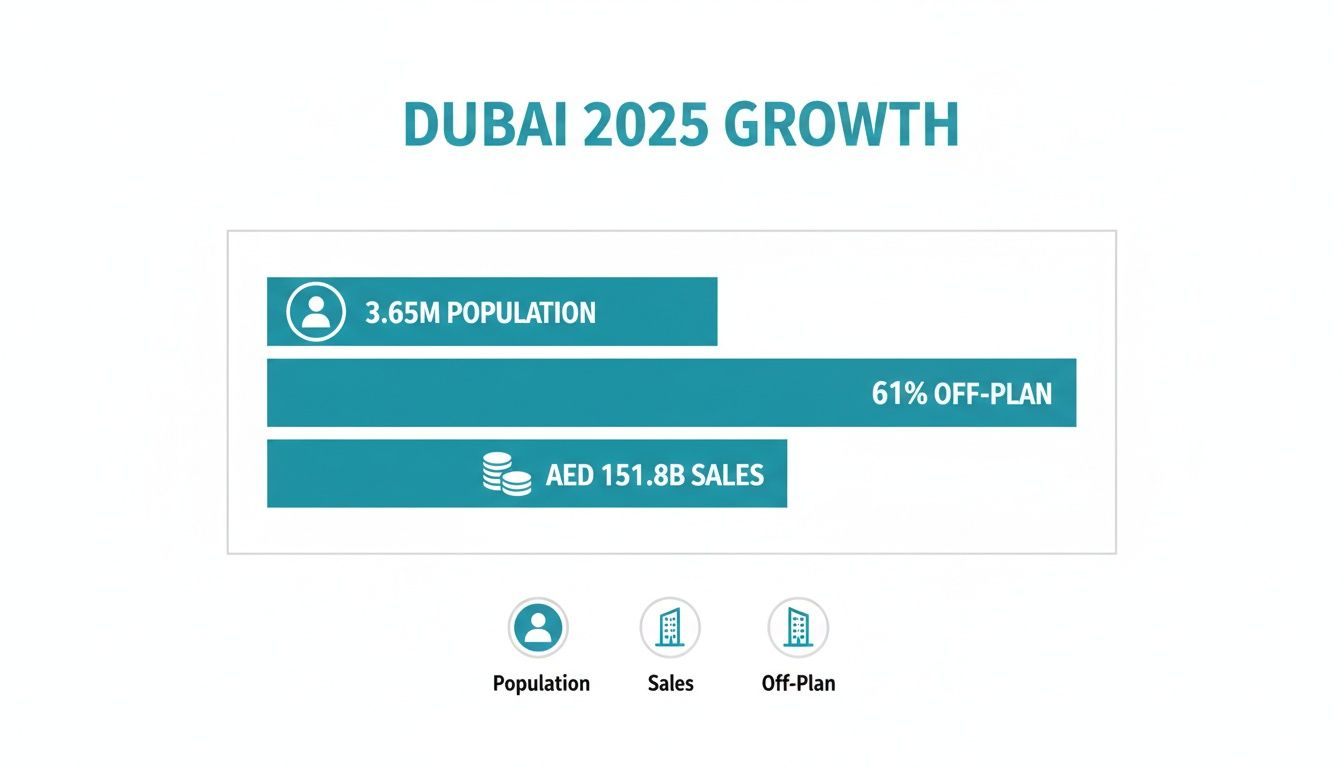
The data is undeniable. The market's fundamentals are sound: a growing population fuels massive sales volume, with the majority of buyers selecting off-plan assets. This combination creates sustained upward price pressure on new inventory.
Projecting Yields in Key Communities
Even in an appreciation-focused strategy, rental yield remains a key metric for holding power and long-term cash flow. A community-level analysis is more useful than city-wide averages. For 2026, our analysis projects the following yield performance for new villa stock post-handover.
| Master Community | Projected 2026 Gross Rental Yield | Key Drivers for Yield |
|---|---|---|
| Dubai Hills Estate | 5.8% - 6.1% | Established infrastructure, premium schools, proximity to Downtown Dubai. |
| Dubai South | 6.5% - 7.0% | Proximity to Al Maktoum Airport, Expo City, rapid commercial expansion. |
| Arabian Ranches III | 5.5% - 5.9% | Strong family-oriented demand, community amenities, proven developer track record. |
| The Valley | 6.0% - 6.4% | Mid-market luxury positioning attracting a wide tenant base; developing infrastructure. |
These figures demonstrate that even within an appreciation-first strategy, the underlying rental potential is robust. It provides a stable income floor that supports the asset during its growth phase. For a deeper breakdown, review our guide on how to maximise ROI on property investments in Dubai.
The core thesis for 2026 is that an investor's total return on an off-plan villa is a composite metric, heavily weighted toward capital growth during construction, followed by a stabilizing rental yield post-handover. Viewing it through only one lens provides an incomplete performance picture.
Identifying Prime Master Communities for 2026
While some investors watch established neighborhoods, astute capital is flowing into the next generation of Dubai's master-planned communities. Last year's data made it clear: volume in off-plan villa sales is now a calculated bet on the city's future infrastructure corridors. Success in 2026 means securing positions in these growth zones before they become fully priced.
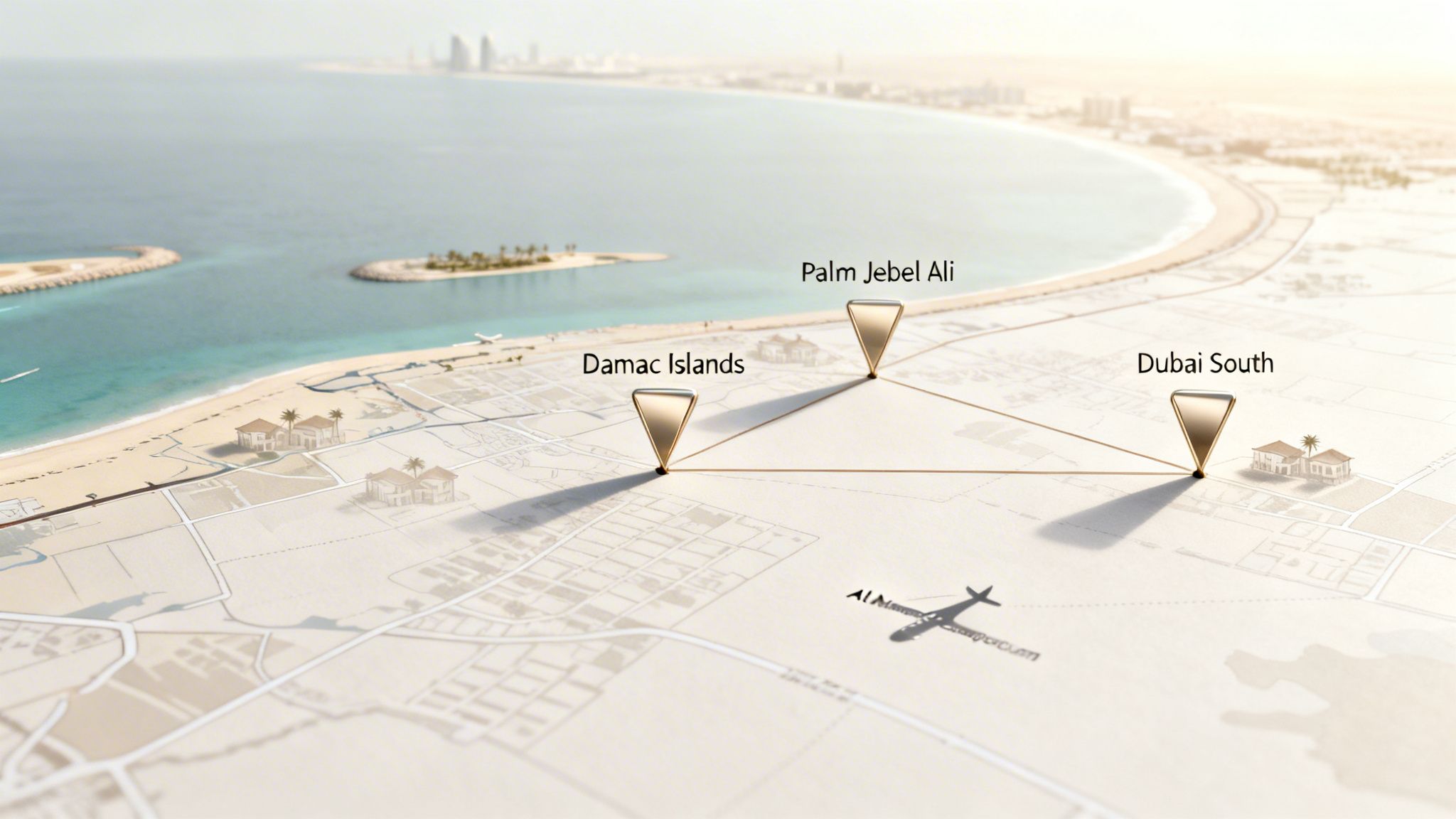
The most reliable guide for long-term capital appreciation is the Dubai 2040 Urban Master Plan. This is the government's official roadmap, detailing where new economic hubs and transport links will emerge. [Map: Location relative to Al Maktoum Airport]
The New Epicenters of Growth
For 2026, our analysis identifies three key zones where the risk-reward profile for off-plan villas is strongest. These locations are underpinned by massive government investment and clear demographic trends.
- Dubai South: This area is rapidly becoming the city's new economic core. Its direct link to Al Maktoum International Airport and Expo City makes it a strategic titan. New villa projects here are designed for the influx of professionals drawn to the area.
- Palm Jebel Ali: Nakheel's relaunch has positioned this as a long-term trophy asset. The villas here offer more generous plot sizes and beachfront than the original Palm Jumeirah, targeting the UHNW segment. The investment thesis is simple: scarcity and unmatched brand prestige.
- The Valley & Damac Hills 2 Expansions: These communities along the Al Ain Road corridor target the mid-market luxury segment. They offer an accessible entry point into the villa market while sitting in the path of Dubai’s eastward expansion.
These areas represent a clear break from older, saturated communities, offering a ground-floor opportunity to invest in sync with the city's growth plans. For further analysis, see our guide on the best villa communities in Dubai.
Capital Appreciation Forecasts for 2026
Market projections show a clear performance split between established areas and new hubs. The average villa price increase of nearly 25% since 2023 was just the initial phase.
The table below breaks down expected capital growth across different community types.
| Community Type | Representative Projects | 2026 Projected Capital Appreciation | Investment Rationale |
|---|---|---|---|
| Emerging Ultra-Luxury | Palm Jebel Ali, The Oasis | 18% - 25% | Scarcity of new waterfront plots, trophy asset status, high global demand. |
| Established Luxury | Dubai Hills Estate, Al Barari | 12% - 15% | Mature infrastructure, premium amenities, proven resale market stability. |
| Growth Corridor | The Valley, Dubai South | 10% - 14% | Infrastructure-led growth, accessible pricing, strong end-user demand. |
[Chart: 2026 Payment Plan Breakdown] The data confirms the greatest appreciation potential lies in new master plans, where entry prices have not yet factored in the full impact of future development.
For portfolio managers in 2026, the strategy is to align asset location with macro-economic drivers. An off-plan villa purchase is a direct stake in the infrastructure and economic future of a specific Dubai corridor.
Navigating 2026 Payment Plans and Financing Structures
Last year, the 1% monthly payment plan was ubiquitous. Entering 2026, major developers are pivoting to more traditional 60/40 or 70/30 structures. This shift signals a maturing market, but it changes the entry barrier for new investors.
This is a positive indicator. It reflects a healthier, more stable market that favors serious end-users over short-term flippers. The aggressive plans of 2024-2025 drove volume; today's plans, which require more capital upfront, are a deliberate filter. They ensure buyers have the financial depth to complete the purchase, reducing volatility and protecting asset value.
The Evolution from Speculative to Sustainable Models
New payment structures for off-plan villas signal deep market confidence. Developers no longer need to offer highly leveraged schemes to secure sales. Instead, they are aligning cash flow with construction milestones—the hallmark of a sustainable development cycle.
For a HNWI, this means a higher initial capital outlay, but the investment is more secure. The market is less prone to shocks from overleveraged buyers who might default. Understanding what is off-plan property involves recognizing how these financial structures impact project stability.
The table below illustrates the shift from last year's benchmark plans to the 2026 standard.
Payment Plan Evolution: 2025 Benchmark vs. 2026 Structure
| Milestone | Typical 2025 Plan (% Due) | Standard 2026 Plan (% Due) | | :--- | :--- | :--- | :--- | | Booking Deposit | 10% - 20% | 20% | | During Construction | 40% (Often 1% monthly) | 40% - 50% (Linked to milestones) | | On Handover | 40% - 50% | 30% - 40% | | Post-Handover | Common (1-3 years) | Rare |
The focus has moved from post-handover plans designed for speculators to milestone-based payments that fund construction progress.
Financing for Non-Resident Investors
Mortgage financing for non-residents remains straightforward, provided the correct criteria are met. Most UAE lenders will finance up to 50% of the property’s value for foreign investors, but this financing typically becomes available only upon handover. You must have the cash to cover payments during the construction phase.
Key considerations:
- Pre-Approval: Secure pre-approval from a UAE-based bank before signing the SPA to clarify borrowing power.
- Documentation: Organize all required documents—proof of income, bank statements, passport copies—early to avoid delays.
- Developer-Bank Partnerships: Investigate tie-ups between developers and banks, as these can sometimes offer more favorable terms.
RERA and the Security of Escrow Accounts
Underpinning this entire process is the regulatory framework managed by RERA. Its most critical component is the mandatory use of escrow accounts for all projects.
An escrow account is a secure holding account for your funds. The developer does not receive your money directly. Your payments are held by an approved trustee, who releases funds to the developer only after specific construction milestones are independently verified. This mechanism ties your capital to tangible progress, mitigating the risk of fund mismanagement.
A Professional Checklist for Risk Mitigation and Due Diligence
Investing in off-plan property requires a data-driven, not emotional, approach. For HNWIs, due diligence must extend beyond a developer's brochure. It is about capital preservation first, then growth.
The foundation of any secure investment in off plan villas in Dubai is regulatory compliance. Before committing capital, the first step is to verify the project's credentials with the Dubai Land Department (DLD) and RERA. This is non-negotiable.

Core Verification Steps
Your advisory team must run a detailed check on these critical items.
- RERA Project Registration: Confirm the project has a valid RERA registration number, ensuring it is legally sanctioned for sale.
- Escrow Account Verification: Verify the project’s official escrow account number and the trustee bank, confirming your payments are protected.
- Developer Track Record: Analyze the developer’s history of delivering projects, focusing on adherence to timelines and quality standards.
Scrutinizing the Sales and Purchase Agreement
The Sales and Purchase Agreement (SPA) is the most important document in the transaction. It is a binding contract that must be analyzed with legal precision. Key clauses to dissect:
- Handover Date and Grace Period: The SPA must state the anticipated completion date and specify a grace period—typically 6-12 months—during which the developer can deliver without penalty.
- Delay Penalty Clause: If handover extends beyond the grace period, the terms of compensation must be clearly defined and fair.
- Quality and Specifications: The agreement must detail finishing specifications, materials, and fixtures to avoid disputes over final quality.
An off-plan investment is only as secure as its legal framework. The SPA is not a formality; it is the primary instrument of risk management. A weak or ambiguous SPA exposes an investor to unnecessary risks related to revised handover timelines and final product quality.
Assessing Total Cost of Ownership
The purchase price is only one part of the financial equation. A proper due diligence process requires a full accounting of all associated costs to project the true ROI. An accurate financial model must include:
- DLD Fees: The Dubai Land Department fee is a standard 4% of the property value, a material cost to be factored into your initial outlay. Information about taxes on property is essential.
- Service Charges: Obtain the developer’s projected annual service charges per square foot. These ongoing fees directly impact net rental yield.
- Financing Costs: If using leverage, account for all bank processing fees, valuation charges, and interest payments.
Running these numbers upfront allows for a realistic financial trajectory for the asset. For a detailed breakdown of the process, our guide on buying off-plan property in Dubai offers more insights.
Final Thoughts: Strategy Over Speculation
The window for 'easy flips' has narrowed. Success in 2026 requires targeting communities with genuine infrastructure growth—specifically those connected to expanding metro lines or new economic zones. The market's maturity demands a shift from short-term bets to long-term asset management.
A resilient portfolio is built by targeting projects where future value is intrinsically linked to the tangible, government-backed growth of Dubai itself, not just market sentiment. At Proact Luxury Real Estate, we track these infrastructure corridors and policy shifts daily.
If you are rebalancing your portfolio for 2026, let's run the numbers.
Frequently Asked Questions
Even with a solid strategy, key questions arise when evaluating the off-plan villa market. Clear answers build the confidence needed to make the correct portfolio decision.
Is a Golden Visa guaranteed with an off-plan villa purchase?
No, it is not automatic. The 10-year Golden Visa is tied to a property value of at least AED 2 million. While most new off-plan villas meet this threshold, the application process can only begin after a substantial portion of the price (typically 30-50%) has been paid and the property is registered in your name with the DLD via the Oqood system. We guide clients on the payment milestones required to initiate the Golden Visa application process.
What happens if a developer delays my villa's handover?
Your SPA, governed by RERA regulations, controls this scenario. Most SPAs include a grace period of 6 to 12 months beyond the estimated completion date. If delays exceed this period, the SPA outlines your recourse, which may include compensation or, in extreme cases, termination of the agreement. A legal review of the SPA's "revised handover timelines" clause is critical before signing. A firm grasp of UAE property law is non-negotiable.
Can I sell my off-plan villa before completion?
Yes, this is known as an assignment sale. However, your ability to sell is dictated by the developer's rules in the SPA. Most major developers require 30% to 50% of the original price to be paid before issuing a No Objection Certificate (NOC) for the sale. The new buyer assumes the remaining payment plan. The DLD's 4% transfer fee applies to this secondary transaction, a key component of understanding all property-related taxes.
What are the primary risks in the 2026 off-plan market?
The primary risks have shifted from developer default (largely mitigated by RERA's escrow laws) to market-related factors.
- Market Correction: The risk of a price adjustment exists. This is mitigated by focusing on projects in master communities with strong infrastructure growth and real end-user demand.
- Construction Quality: Ensure the finished villa matches the SPA specifications. A professional snagging company should inspect the property before the final handover payment.
- Infrastructure Delays: The villa may be ready, but delays in surrounding roads or amenities can impact rental yields. Research the master developer's delivery track record.
The speculative period has passed. The 2026 market is about strategic entry and exits based on economic cycles and portfolio objectives. Risk is managed through meticulous due diligence, not market timing.
At Proact Luxury Real Estate LLC, we provide data-driven advisory to help you navigate Dubai's dynamic property market with confidence. Book a one-on-one consultation to align your investment strategy with the city's future growth.