


While last year's headlines fixated on waterfront mega-projects, a distinct asset class was quietly gaining traction among strategic portfolio managers. Nad Al Sheba Gardens, a Meraas community, is not just another development; it represents a deliberate pivot from speculative high-rise towers toward masterplans engineered for long-term value.
This community is the market’s answer to escalating demand for low-density, prime-location living, but without the logistical friction common in Dubai's established districts.
An Investor's-Eye View of the Asset
Transaction data from 2025 confirmed a clear market shift toward communities offering sustainable value. While substantial capital chased familiar postcodes in Downtown and the Marina, the strategic money began reallocating to masterplans backed by superior infrastructure and developer credibility. Nad Al Sheba Gardens became a focal point for this reallocation.
The investment thesis is direct and built on three core pillars: its strategic location, the developer's financial standing, and the intelligence of the masterplan itself.
A Rare Blend of Seclusion and Access
Nad Al Sheba Gardens achieves a rare balance in Dubai: it offers the feel of secluded, low-density living while being minutes from the city's economic engine.
- Proximity to Key Hubs: The community is positioned a short drive from Downtown Dubai, DIFC, and the Meydan Racecourse. This provides immediate access to the city’s commercial heart while insulating residents from associated traffic and noise.
- Effortless Connectivity: Its location near major arteries like Sheikh Mohammed Bin Zayed Road and Al Ain Road ensures fluid city-wide transit—a critical factor for the executive tenants and high-net-worth families this community attracts.
This is not a distant suburban outpost. It is a central enclave engineered for privacy and convenience, a combination that consistently commands a rental premium and supports sustained capital growth. Its alignment with the Dubai 2040 Urban Master Plan further cements its relevance in the city’s future.
The Meraas Factor: Developer Credibility
The project is delivered by Meraas, a subsidiary of Dubai Holding. In off-plan acquisitions, this is a primary risk mitigation factor. Meraas has a documented track record of delivering high-quality, design-led communities such as City Walk and Bluewaters Island.
For any investor, a developer's balance sheet and delivery history are as critical as a property's floor plan. The involvement of Meraas provides a level of assurance that is essential in today's market, ensuring project milestones are met and quality standards are maintained.
This market confidence is visible in transaction data. The prime segment showed robust activity, with Dubai Land Department records confirming high transaction volumes in Nad Al Sheba Gardens. This aligns with a wider trend that saw over 1,300 units transacted above AED 10 million in Q1 2025 alone—a 31% year-on-year increase.
The community’s design intentionally avoids the uniform aesthetic found in many large-scale villa projects. By featuring distinct architectural styles and emphasizing green, open spaces, it attracts a more discerning demographic willing to pay for quality and exclusivity. This focus on fundamentals is why Nad Al Sheba Gardens is a core asset for a well-diversified Dubai property portfolio. As you evaluate opportunities, understanding the top 10 best areas to buy property in Dubai for 2026 is the first step toward securing real asset growth.
Analysing Project Phases And Delivery Timelines
For any forward-looking investor, analysing construction velocity and delivery schedules is fundamental to managing capital allocation. Meraas has mapped out a phased rollout for Nad Al Sheba Gardens, designed to control supply and build value incrementally rather than flooding the market with inventory. This staggered approach is the signature of a mature, well-capitalised developer focused on sustainable growth.
Understanding this delivery pipeline is the foundation for structuring entry and exit strategies. The timeline dictates capital calls, rental income commencement, and when the secondary market for a specific phase will activate.
This timeline offers a high-level view of the key market shifts that have shaped the investment landscape, leading to the current development cycle for Nad Al Sheba Gardens.
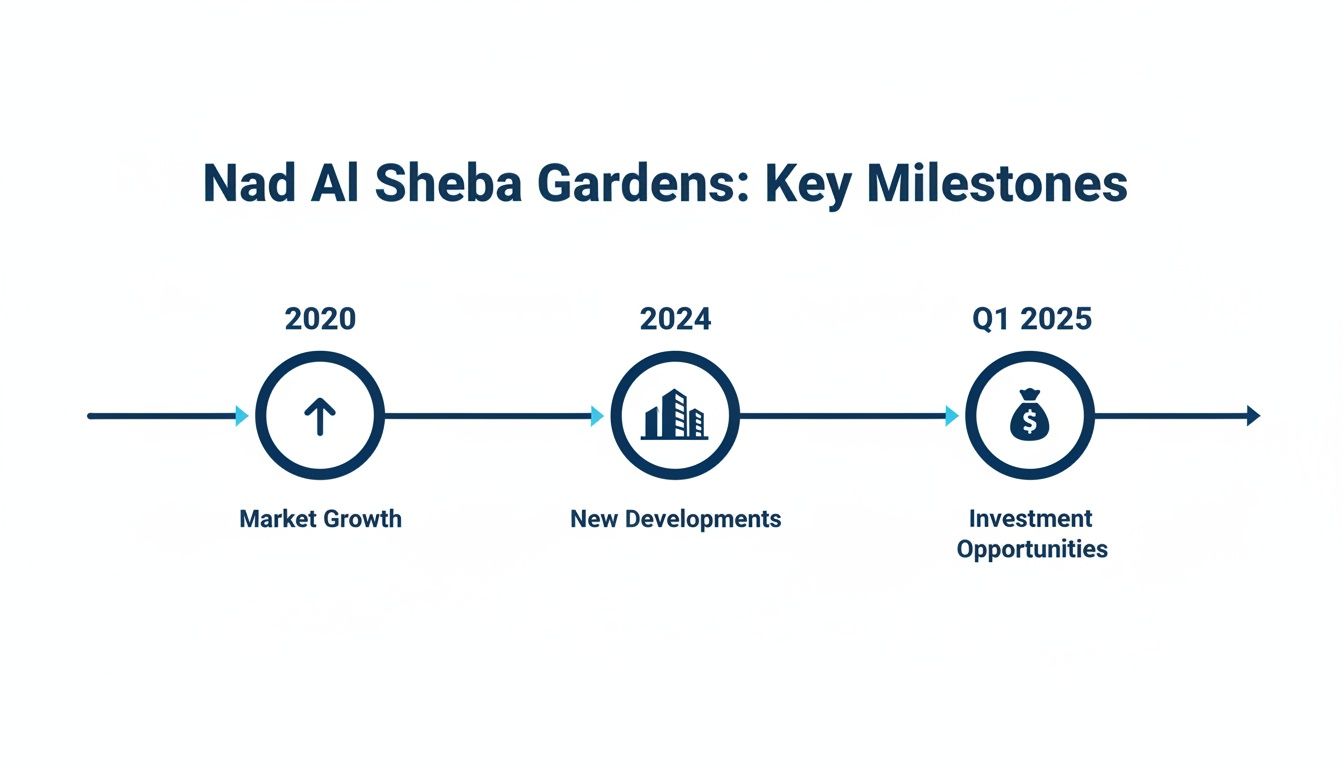
As shown, the market has progressed from the post-2020 recovery into the robust development and investment activity that set last year's benchmarks.
Deconstructing The Handover Schedule
The delivery schedule for Nad Al Sheba Gardens is a multi-year strategy. The table below breaks down the phased completion schedule, providing a clear view of supply delivery and strategic market entry points.
Nad Al Sheba Gardens Phased Handover Schedule
| Project Phase | Anticipated Handover Date | Key Features And Unit Mix | Strategic Implication For Investors |
|---|---|---|---|
| Phase 3 | As early as April 2026 | Initial mix of villas and townhouses, setting the community's premium tone. | First-mover advantage. Early investors can set benchmark rental yields and resale values. |
| Earlier Phases | Broader completion by Q3 2027 | Larger release of various unit types, establishing the core community fabric. | A more mature, stable market upon handover with established community infrastructure. |
| Phase 8 | October 2028 | Later release of premium units, likely at adjusted, higher price points. | Opportunity for investors with longer-term capital deployment timelines to enter an established community. |
| Phase 11 | Beyond 2028 | 201 new units catering to sustained demand, potentially with updated designs. | Capitalises on the proven success of earlier phases; a lower-risk entry into a known quantity. |
This schedule shows a deliberate, staggered approach that prevents the logistical issues that can affect single-handover mega-projects. For an investor, this means a more stable and predictable rental market upon unit completion. Later launches, like Phase 8 targeting an October 2028 handover, offer multiple entry points for investors with different timelines.
This gradual release of supply is designed to support price stability. Analysing why off-plan payment plans shifted in 2026 provides more context on how developers are managing these long-term projects.
A phased delivery is a strategic tool. It allows the developer to adjust pricing for later phases based on the proven market performance of earlier ones. For early investors, this often translates directly into built-in equity.
Financial Commitment And Construction Velocity
A developer's commitment is measured in financial data. The AED 690 million construction contract awarded for Phase 4 is a solid data point confirming Meraas's financial capacity and dedication to maintaining construction pace.
For HNWIs, this is a critical risk mitigator. This level of investment signals confidence in the project's viability and market demand. It ensures work progresses on schedule, backed by a capital outlay protected by RERA's mandatory Escrow account rules.
This multi-phase rollout, including the 201 units in Phase 11, is calibrated to meet demand from global buyers. These investors are drawn to Dubai's potential for 7%+ yields as the city's population continues its growth trajectory. This calculated release of inventory, which can be explored on platforms like Property Finder, is designed to align with that demographic growth, ensuring new properties are absorbed efficiently.
Digging into Property Setups and Investment Levels
Proper asset selection requires analysis beyond a community's reputation. Returns are found in the breakdown of the properties on offer. Nad Al Sheba Gardens presents a curated mix of villas and townhouses, from 3-bedroom layouts to 7-bedroom estates.
Meraas has deliberately moved away from uniform designs, focusing on two distinct styles: a minimalist Arabian-contemporary look and a classic Mediterranean aesthetic. This is a strategic move to appeal to a wider range of high-net-worth buyers and renters, which helps future-proof the community.
A Numbers-Based Look at the Different Units
Each property type represents a different investment level and target buyer. Townhouses typically start at around 2,600 sq. ft., while standalone villas begin from about 3,292 sq. ft.
3 & 4-Bedroom Townhouses: These are the community's workhorses, ideal for executive families and senior managers requiring proximity to Downtown with the space a townhouse offers. From an investment perspective, they offer a balanced risk-reward profile and consistently strong rental demand.
4 & 5-Bedroom Villas: This category targets an established demographic—C-suite executives, business owners, and families with children in nearby top-tier schools. These homes typically sit on larger plots, command higher rents, and show excellent potential for price growth.
6 & 7-Bedroom Mansions: These are trophy assets, designed for UHNWIs and focused on capital preservation and long-term legacy value over monthly rental yields. The potential buyer pool is smaller, but sale prices are higher.
Here is a breakdown of how the different property classes compare. These prices reflect the current market and will shift based on phase, location, and layout.
| Unit Type | Typical BUA (sq. ft.) | Starting Price (AED - Approx.) | Primary Investment Objective |
|---|---|---|---|
| 3-Bed Townhouse | 2,600 - 3,000 | 3.8M | High Rental Yield |
| 4-Bed Townhouse | 3,000 - 3,500 | 4.5M | Balanced Yield & Growth |
| 4-Bed Villa | 3,800 - 4,500 | 5.5M | Capital Growth |
| 5-Bed Villa | 5,500 - 6,500 | 8.0M | Capital Growth / End-User |
| 6/7-Bed Villa | 7,000+ | 12.0M+ | Capital Preservation |
Finding the Sweet Spot for Your Portfolio
For most investors we advise, the optimal allocation is within the 4 and 5-bedroom villa categories. These units offer the best balance of initial cost, strong rental demand from a reliable tenant profile, and potential for capital growth.
A key factor is the generous plot sizes associated with these villas—a feature increasingly rare in new, centrally located developments. Our analysis of the 7 best villa communities in Dubai consistently shows that communities with larger plot-to-built-up-area ratios tend to perform better on the resale market.
The decision is not merely "townhouse versus villa." It is about matching the property type to a clear investment goal. A 3-bedroom townhouse is a yield-generating machine; a 5-bedroom villa is a growth-focused asset. They perform different functions.
Across all unit types, the floor plans are designed for modern living, emphasizing open-plan spaces, natural light, and privacy. This contemporary approach helps ensure these properties will remain in demand, protecting the asset's long-term income potential.
Tracking The Growth: From Launch Prices To Market Value
To project where Nad Al Sheba Gardens is headed, we must analyze its price journey. The trajectory shows steady, sustainable growth—not the speculative frenzy seen in the wider market post-Covid. This is mature appreciation, anchored by location and the credibility of a top-tier developer.
The clearest metric is price per square foot (PSF). Early phases were priced competitively. As the community has taken shape and Meraas has met construction milestones, both new launches and secondary market sales have shown a material uplift in valuations.
From Early-Bird Prices To Current Premiums
The price evolution reflects rising market confidence. Early investors have already realized substantial on-paper gains. The secondary market is now providing hard evidence, with completed or near-complete homes commanding premiums over their original off-plan prices.
A transaction recorded on June 20, 2025, for a ready villa in Phase 1 is a clear case study. The 10,013 sq. ft. property sold for AED 12.5 million. This represented a 309% appreciation from its original purchase price, setting a benchmark of AED 1,250 PSF.
Around the same time, another 5-bedroom residence sold for AED 30.6 million, translating to AED 3,060 per sq. ft. and a 51% price jump from its previous valuation. These are not isolated sales; they are data points confirming a healthy resale market is already active.
This performance is a direct result of Meraas's phased rollout. By managing the supply of new units, they have allowed organic demand to drive up values. Each new phase launched at a price reflecting the community's growing maturity effectively lifts the value of preceding phases.
How Does This Stack Up Against The Broader Market?
This growth must be placed in the context of the wider Dubai real estate market. Last year, the market began to stabilize after the gains of 2023-2024. While some secondary areas saw price adjustments, prime, well-located masterplans like Nad Al Sheba Gardens continued their upward trajectory.
The community is outperforming many established villa communities. The combination of its central location, modern design, and green spaces has created a value proposition that is increasingly difficult to find. For a deeper dive, our detailed Dubai property market forecast offers a more granular analysis.
The key takeaway is that capital growth in Nad Al Sheba Gardens is not theoretical. It is validated in real-time by DLD-recorded transactions. This provides a data-backed foundation for modeling future returns.
The investment case remains strong. While the opportunity for early-phase pricing has passed, the potential for continued capital appreciation is clear. As the community’s retail centre, school, and other amenities become fully operational, we anticipate another uplift in both rental yields and resale values.
What To Expect For Rental Yields And Tenant Profile
An asset’s value is tied to the demand it commands. For Nad Al Sheba Gardens, modeling rental yields requires an analysis of the target tenant: a senior, affluent demographic. Understanding this tenant base is key to forecasting stable, long-term income.
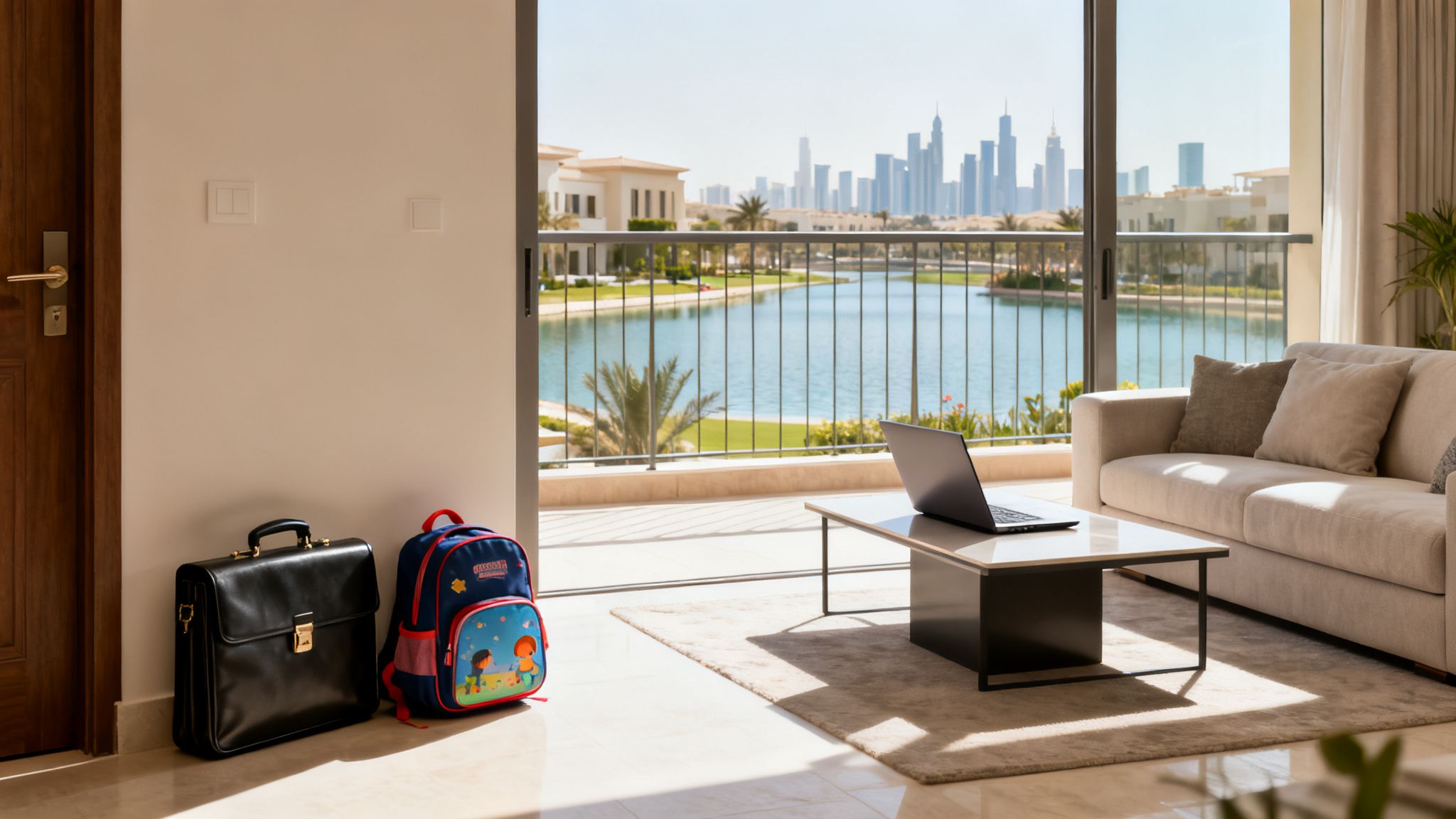
The primary rental demographic is not transient. It comprises established C-suite executives, entrepreneurs, and senior partners at professional services firms. These individuals require proximity to business hubs like DIFC and Downtown but will not compromise on living space, privacy, and community infrastructure. As Dubai's population continues its growth, the demand for this specific type of low-density luxury will intensify.
Defining The High-Value Tenant Profile
The specific tenant profile for Nad Al Sheba Gardens translates directly to higher rental premiums and lower vacancy risk.
- Executive Families: A significant portion of potential tenants will be families with children in nearby top-tier international schools. For this group, proximity to quality education is a primary driver, and they will pay a premium for the convenience and security of a gated community.
- Business Owners & Entrepreneurs: This segment values the community's access to major road networks. The larger villa layouts are also suitable for dedicated home offices—a feature that has become standard in the post-2023 market.
- Long-Term Expatriates: The target tenants are established expatriates on long-term employment contracts, often with substantial housing allowances. This profile ensures reliable rental payments and longer tenancy periods, reducing turnover costs for landlords.
How Amenities Drive Rental Premiums
In the 2026 prime rental market, amenities are essential drivers of rental yield. The facilities in Nad Al Sheba Gardens are strategically designed to attract the target demographic. The inclusion of lagoons, wellness centres, jogging tracks, and high-end retail hubs directly supports higher rental valuations. These features create a self-contained ecosystem, justifying rental rates that can be 5-10% higher than in communities with standard facilities.
For an investor, every premium amenity is a tangible asset. It translates directly into higher achievable rent and a more stable tenant base. The focus is on lifestyle infrastructure that supports both family life and executive wellness.
A direct comparison of Nad Al Sheba Gardens against other prime villa communities provides a framework for benchmarking potential returns.
Comparative Analysis Of Prime Villa Communities
| Metric | Nad Al Sheba Gardens (Meraas) | Dubai Hills Estate (Emaar) | Tilal Al Ghaf (Majid Al Futtaim) |
|---|---|---|---|
| Typical Gross Yield | 5.5% - 7.0% | 4.5% - 6.0% | 5.0% - 6.5% |
| Primary Tenant Profile | Senior Executives, Entrepreneurs | Established Families, Professionals | Young Families, Tech Executives |
| Key Value Driver | Proximity to Downtown, Modern Design | Championship Golf Course, Central Park | Crystal Lagoon, Community Hub |
| Capital Growth (2025) | Strong (Emerging Community) | Stable (Mature Community) | Strong (High Demand) |
This analysis confirms Nad Al Sheba Gardens is positioned to deliver competitive yields, driven by its unique location and premium infrastructure. The community bridges the gap between the established prestige of Dubai Hills and the lifestyle-centric appeal of Tilal Al Ghaf. For investors seeking a blend of strong rental income and solid capital growth potential, its metrics are compelling.
A look at apartments for rent in Al Furjan provides a useful contrast in tenant profiles and yield expectations. The data shows Nad Al Sheba Gardens was engineered for the high-end of the rental market.
Final Thoughts: Strategy Over Speculation
Entering 2026, the market signals a clear shift: the era of speculative plays has ended. It is now a market for strategic asset acquisition. Last year's data showed that while quick flips became more difficult, communities with solid fundamentals delivered consistent capital growth. Nad Al Sheba Gardens exemplifies this opportunity, backed by a top-tier developer, a smart masterplan, and alignment with Dubai's long-term growth.
Success in this mature market cycle requires precision—sharp analysis of entry points, financing structures, and a viable exit strategy from day one. The window for flipping contracts for a quick profit has narrowed. The focus must be on securing assets that promise sustainable value, bolted directly to infrastructure development and demographic shifts.
The advantage for portfolio managers now lies in understanding the infrastructure corridors and population movements that will drive demand for the next decade.
At Proact Luxury Real Estate, our approach is built on identifying these fundamental value drivers. We track growth corridors to pinpoint assets positioned for sustained, long-term performance.
Investor FAQs: The Bottom-Line Details
Here are direct answers to the most common questions from portfolio managers and private investors regarding Nad Al Sheba Gardens.
What’s the Payment Plan Structure for the Newer Phases?
The market has matured. The standard for a premium community like Nad Al Sheba Gardens has shifted toward more conservative structures. For recent launches, Meraas is typically offering 60/40 or 70/30 plans.
This means a more significant initial payment, with subsequent installments tied to tangible construction milestones and the final balance due upon handover. This shift is deliberate, designed to filter for serious, well-capitalised buyers and reduce speculative activity. Every SPA is specific; it is critical to review the fine print. We can structure these payments to align with your capital flow and long-term goals, such as eligibility for the UAE Golden Visa.
How Do RERA Protections Actually Work for Off-Plan Investments?
Every off-plan investment in Nad Al Sheba Gardens is secured by the legal framework of Dubai’s Real Estate Regulatory Agency (RERA). The cornerstone of this protection is the mandatory use of Escrow accounts.
Payments are made directly into a RERA-approved Escrow account managed by an independent trustee bank. The developer, Meraas, can only draw funds from this account to cover construction costs after submitting certified proof of hitting pre-agreed project milestones.
Governed by comprehensive UAE property law, this mechanism ensures your capital is ring-fenced and used only for the completion of your property. It mitigates project delay risks and other developer-side financial issues, providing a layer of security that institutional investors demand.
This system enforces transparency and holds developers accountable, making Dubai's off-plan market a viable and secure option for global investors.
What Are the Typical Service Charges and Ownership Costs?
Post-handover, annual community service charges are applicable. These fees cover the upkeep of common areas, landscaping, 24/7 security, and community amenities, protecting the asset's long-term value.
While exact figures are finalised by RERA closer to handover, a realistic budget range is between AED 4 to AED 6 per square foot of your property’s built-up area (BUA) annually.
Standard transactional costs during purchase include the 4% Dubai Land Department (DLD) transfer fee and other registration fees. A complete financial projection must account for these ongoing liabilities, which fall under Dubai’s framework for property-related taxes. Accurately forecasting these numbers is critical for determining net rental yields and overall portfolio performance.
At Proact Luxury Real Estate LLC, we focus on strategic asset management, not just transactions. Our analysis is built on the financial rigour required for sound investment decisions in a competitive market.
If you are rebalancing your portfolio for 2026 and require a data-driven approach to asset selection in Dubai, let's run the numbers. Schedule a consultation with our advisory team today.