


Entering 2026, the structure of Dubai real estate acquisitions is shifting. Last year's benchmarks saw a market dominated by straightforward off-plan sales; now, we are observing a rise in sophisticated, structured agreements. A lease-to-own property in Dubai is one such instrument, moving from a niche product to a mainstream strategy for astute investors locking in assets at current valuations while phasing capital deployment.
The Market Rebalancing Fuelling Lease-to-Own Deals

The speculative velocity of the post-Covid boom has now transitioned into a sustainable growth cycle. This market maturation, coupled with a substantial delivery pipeline for 2026, is altering supply-and-demand metrics. This creates a strategic opening for structured deals like lease-to-own.
Last year's data confirmed market normalization, but the forward-looking narrative is the inventory wave from master communities like The Valley Phase 2 and Dubai South. This supply shifts negotiation leverage, presenting a challenge for developers concerned with absorption rates and an opportunity for informed investors.
Supply Dynamics and Developer Strategy
Developer strategy is pivoting. Rather than relying solely on aggressive payment plans, they are now incentivized to convert stable, long-term tenants into end-users. A lease-to-own property in Dubai serves this dual purpose effectively.
- For Developers: It secures a committed future buyer, reduces vacancy risk in newly handed-over stock, and maintains cash flow via rental income. RERA-mandated escrow accounts further protect buyer funds.
- For Investors: It provides a method to acquire assets with managed entry costs, functioning as a long-term call option on the property while rental income partially offsets holding costs.
This market environment is not a downturn but a strategic price adjustment. It favours well-capitalized investors who can leverage supply-side pressure to negotiate favourable long-term ownership contracts.
The groundwork for today's lease-to-own culture was laid between 2018 and 2025 with Dubai's massive freehold stock expansion. With a projected increase in total housing stock from the 2025-2027 pipeline, developers are using these schemes to lock in occupancy, particularly in sub-markets facing potential price corrections. The focus for 2026 has shifted from chasing rapid capital gains to strategic acquisitions. Understanding the current Dubai real estate market trends is essential for identifying which communities hold potential for these structured deals.
Deconstructing the Core Mechanics of Lease to Own Contracts

A lease-to-own agreement is a hybrid financial instrument, not merely an enhanced tenancy contract. Its value to a portfolio depends on a granular understanding of its two primary structures: the Lease Option and the Lease Purchase.
The distinction between them defines the line between flexibility and obligation. A Lease Option grants the tenant the right, but not the obligation, to purchase the property at a predetermined price. A Lease Purchase legally binds the tenant to acquire the property upon lease termination.
For the strategic investor, the Lease Option is typically the superior instrument. It functions as a long-term call option on the asset, providing control and exposure to appreciation while capping downside risk to the initial fees paid.
The Financial Levers: Option Fees and Rent Credits
Two financial components define the economics of these agreements: the Option Fee and Rent Credits. Miscalculating these can convert a sound strategy into a costly error.
The Option Fee is a non-refundable upfront payment, typically 2% to 5% of the agreed purchase price. It compensates the seller for removing the property from the market. For an investor, this fee is the cost of securing the exclusive right to buy the asset at a fixed price, hedging against market appreciation during the lease term.
Rent Credits are the mechanism by which a portion of the monthly rent is allocated toward the down payment. A higher credit percentage reduces the final capital outlay and improves the deal's internal rate of return. However, these credits are forfeited if the tenant defaults or elects not to purchase.
Lease Option vs Lease Purchase: A Comparative Analysis
The decision between a Lease Option and a Lease Purchase depends on the investor's certainty and risk tolerance. The table below outlines the core differences from an asset manager's perspective.
[Chart: 2026 Payment Plan Breakdown]
| Attribute | Lease Option Agreement | Lease Purchase Agreement |
|---|---|---|
| Buyer's Obligation | Optional. The tenant holds the right, not the duty, to purchase. Maximum risk is the loss of the option fee and rent credits. | Mandatory. The tenant is legally obligated to purchase the property. Failure to do so can result in legal action. |
| Flexibility | High. Allows an exit if market conditions shift unfavourably. Suited for market entry testing. | Low. A committed acquisition strategy for investors certain about the asset and future financing. |
| Seller's Obligation | Required. The seller must sell at the agreed price if the option is exercised. | Required. The seller is locked into the sale, providing certainty for both parties. |
| Ideal Investor Profile | An investor seeking asset control with limited upfront capital, while retaining the flexibility to walk away. | An investor with a clear path to financing who wants to lock in a purchase price in an appreciating market. |
A Lease Option is a tool for strategic positioning; a Lease Purchase is a tool for deferred acquisition. A thorough Dubai real estate market analysis is necessary before committing to the binding nature of a Lease Purchase.
Navigating the Legal Framework and DLD Registration
Executing a lease-to-own agreement in Dubai requires strict adherence to the regulations of the Dubai Land Department (DLD) and the Real Estate Regulatory Agency (RERA). This is a structured, deferred sale, and its contractual integrity is critical.
For off-plan properties, the initial step is Oqood registration, which pre-registers the title deed with the DLD. For ready properties, a detailed Sale and Purchase Agreement (SPA) outlining the lease-to-own terms is drafted and must be registered for legal recognition.
RERA Protections and Contractual Integrity
Investor security is reinforced by the mandatory use of RERA-approved escrow accounts. Any funds related to the purchase component of the agreement must be deposited into a designated project escrow account, ensuring capital is used only for project-related expenses.
The contract must be drafted with precision. A standard tenancy agreement is insufficient. A purpose-built agreement must clearly define:
- The non-refundable Option Fee.
- The exact percentage of rent allocated as Rent Credits.
- The final, pre-agreed Purchase Price.
- The Exercise Period for the purchase option.
- Default consequences for both parties.
Under the prevailing uae-property-law, a poorly drafted agreement can invalidate the 'option to purchase', reducing the tenant's position to one of simply overpaying rent.
DLD Registration and Title Deed Transfer
Upon exercising the purchase option, the final step is registering the ownership transfer with the DLD. This involves payment of DLD transfer fees—currently 4% of the property’s purchase price—plus administration fees. This is when a new Title Deed is issued, formalizing ownership.
This process solidifies the asset as a freehold or leasehold property. Understanding this distinction, as detailed in our guide on freehold vs leasehold ownership, is vital for long-term portfolio strategy.
Impact on Residency and Golden Visa Eligibility
A lease-to-own agreement can be a pathway to long-term residency. Investors considering the golden-visa-uae should note that eligibility is typically tied to paid equity, not the property's total value.
For the 10-year Golden Visa, requiring an investment of AED 2 million or more, the DLD often requires proof that this amount has been paid. Strategically structuring the option fee and accumulated rent credits to meet this threshold is a key consideration. The registered agreement must be presented to validate the investment claim, as specified under the rules governing what-is-golden-visa-uae.
Building a Financial Model for Your Acquisition
In real estate asset management, data drives returns. Any lease-to-own proposal must be deconstructed and rebuilt within a financial model to reveal its true economic structure. An appealing monthly payment can obscure a disadvantageous total acquisition cost.
The analysis begins by comparing the total cash outflow against a conventional mortgage. This requires a rigorous model to stress-test the deal under various market scenarios. For guidance on the mechanics, resources exist on how to build robust financial models in Excel.
Calculating the Net Effective Purchase Price
The first step is to determine the Net Effective Purchase Price (NEPP). This is the actual cost after accounting for all components of the lease-to-own deal.
The formula is:
NEPP = Agreed Purchase Price - Total Rent Credits + Option Fee
This calculation reveals the premium or discount relative to a direct purchase. A high Option Fee or low Rent Credit percentage can inflate the NEPP, converting an apparent bargain into an overpriced asset.
The infographic below illustrates the legal and registration steps that secure these financial commitments.
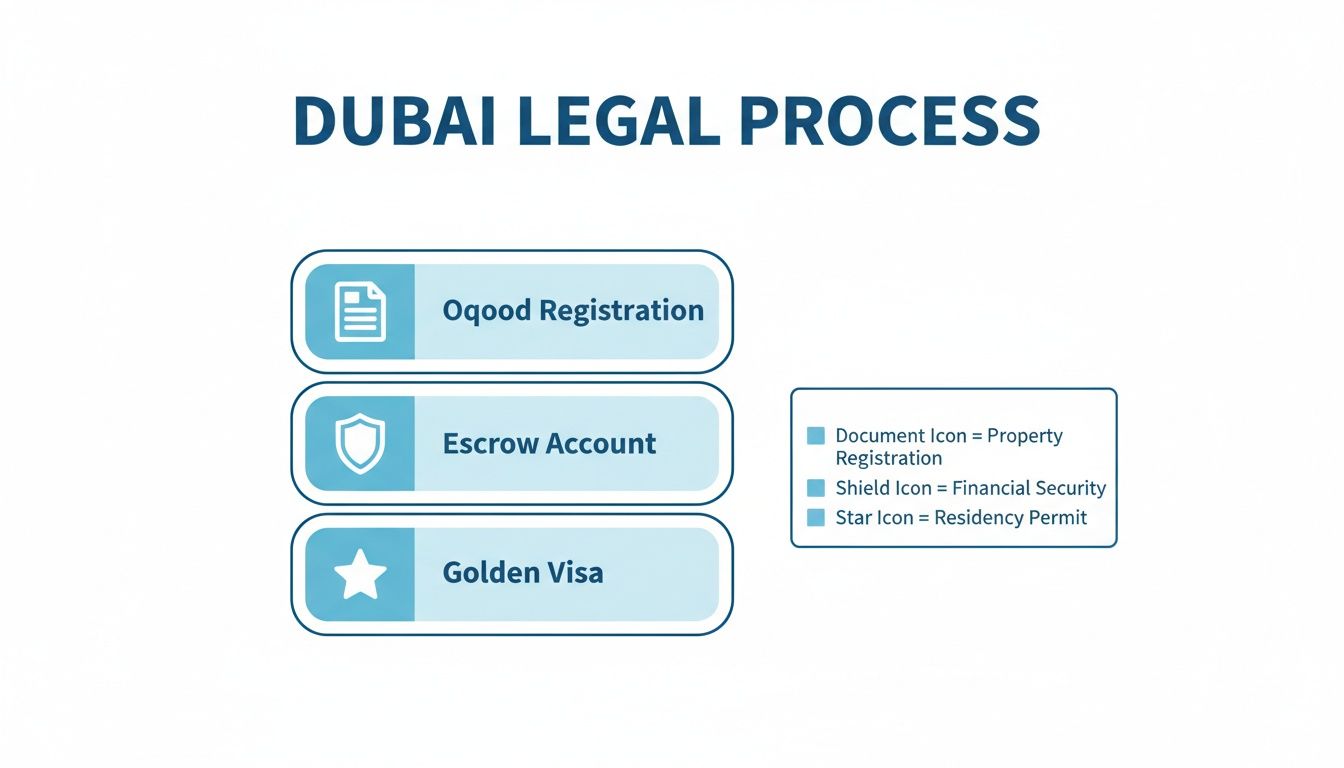
This visual reinforces the compliance stages—from Oqood registration to escrow protection—that underpin the agreement's financial integrity.
Breakeven Analysis and Cash Flow Comparison
Next, a breakeven analysis is required. The monthly rent in a lease-to-own deal is typically higher than the market rate. The breakeven point is the month where accumulated Rent Credits equal the total rental premium paid over standard market rent.
Exiting the deal before this point means you have effectively paid above-market rent with no return.
At Proact, our due diligence includes modelling the total cash outflow of a lease-to-own agreement against a traditional 25% down mortgage over a five-year horizon. This model must incorporate DLD fees, agent commissions, and all related closing costs for a true comparison of capital deployment.
Transaction fees must also be factored in. Our guide on taxes on property details the DLD fees and other costs essential for an accurate ROI projection.
Stress-Testing for Market Fluctuations
A financial model must include scenario planning. With a notable pipeline of new supply in 2026, variables must be tested.
We model for three primary scenarios:
- Bull Case: Capital appreciation exceeds forecasts; rental yields remain strong.
- Base Case: The market follows current projections for moderate growth.
- Bear Case: A price correction occurs; rental demand softens.
As of early 2026, average apartment rents in Dubai show a year-on-year increase of 4–6%. While this is a deceleration from the 2023-2024 period, it represents steady growth. With many communities delivering gross rental yields of 6–8%, landlords are motivated to reclassify a portion of that yield as a future purchase credit.
By running these simulations, we can assess the deal's resilience and identify market conditions that would render the pre-agreed purchase price unattractive. This data-first approach removes speculation and provides a clear assessment of the asset’s potential.
Key Negotiation Points and Risk Mitigation Strategies
Every investment contains risk. The objective is to identify, measure, and mitigate it. A lease-to-own property in Dubai carries a unique risk profile managed through tactical negotiation. The primary threats are market risk and default risk.
Market risk involves a market correction that makes the locked-in purchase price appear inflated. Default risk is the loss of the Option Fee and all accumulated Rent Credits if lease terms are breached or financing cannot be secured.
Fortifying Your Contractual Position
Negotiations with a developer or landlord are a strategic exercise to shift contract terms in your favor. Vague agreements are a liability; every detail must be legally defined.
Focus on these critical leverage points:
- Minimise the Option Fee: While standard, its size is negotiable. Aim for 1-2% of the purchase price, framing it as a good-faith deposit rather than a down payment. This reduces initial cash outlay and potential loss.
- Maximise Rent Credits: This is a pivotal negotiation point. A landlord may offer 20-30%, but negotiating for 40-50% can substantially improve the deal's internal rate of return and accelerate equity building.
- Define Maintenance Responsibilities: A clear line must be drawn between major and minor maintenance. While routine upkeep is reasonable for the tenant, major system failures must remain the landlord's financial responsibility during the lease term.
Advanced Clauses for Investor Protection
Sophisticated investors should insist on specific clauses that function as a safety net. These are not standard boilerplate but strategic tools.
A 'Right of First Refusal' clause ensures that if the owner receives another purchase offer, you have the first opportunity to match it. A clear 'Financing Contingency' is also non-negotiable, allowing you to exit the purchase obligation without total forfeiture upon documented inability to secure a mortgage.
The most overlooked negotiation point is the Valuation Clause. Insist on a clause triggering a final, RERA-approved valuation before purchase. If the valuation is lower than the agreed price, it should activate a pre-defined price adjustment mechanism, protecting you from overpaying in a falling market.
Whether a lease to own property in Dubai becomes a strategic asset or a gamble depends on the contract quality. This contrasts with the more rigid process of buying off-plan property in Dubai, where developer contracts offer limited flexibility.
Where to Find the Best Lease-to-Own Deals in Dubai
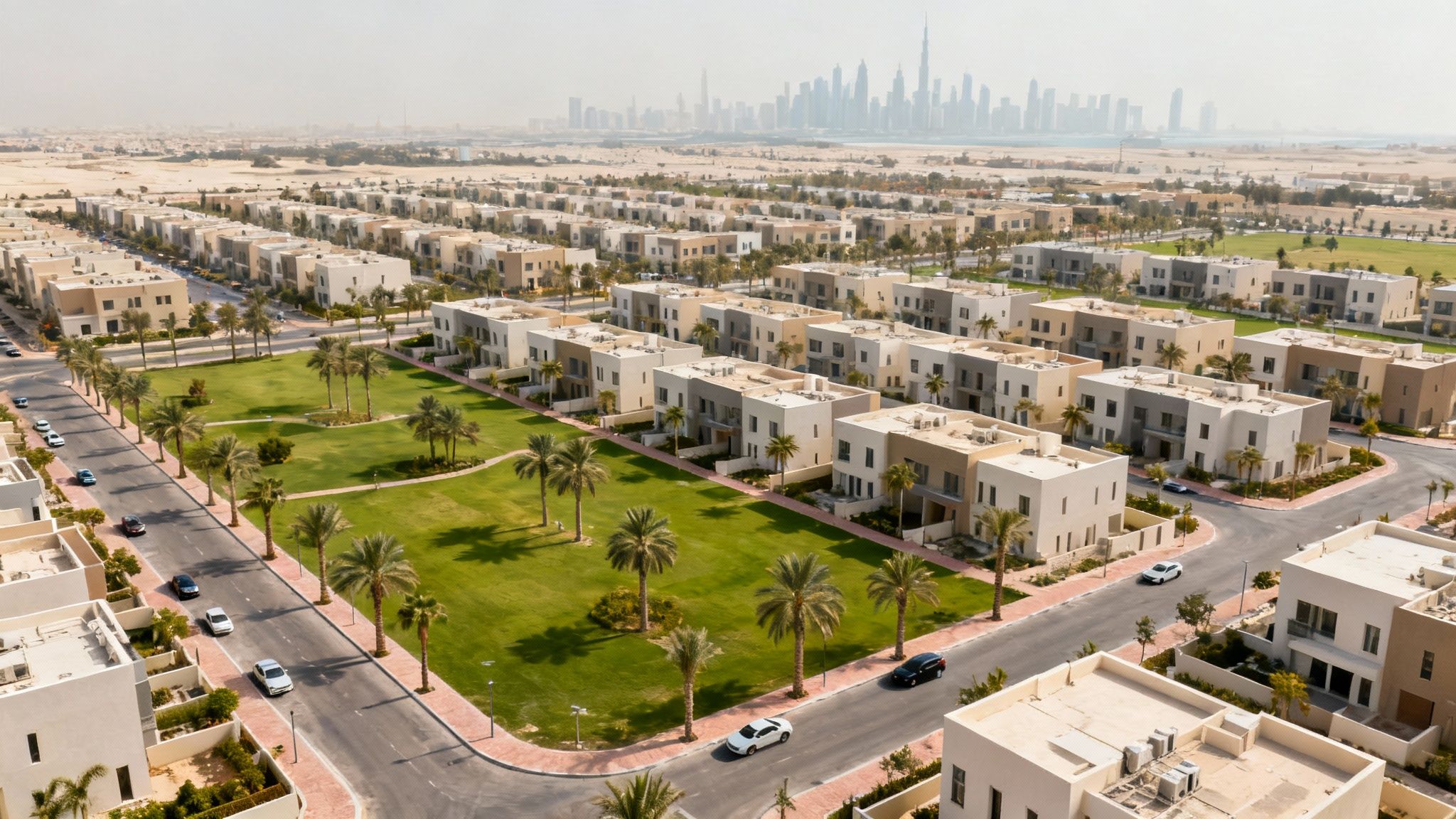
Not every Dubai community is suited for a lease-to-own strategy. The model performs best in micro-markets with stable rental demand, a high concentration of professionals, and a new property pipeline that compels landlords to be creative.
Entering 2026, the opportunity has shifted from saturated prime areas to emerging growth corridors. Developer-led schemes are increasingly common in new master-planned communities where moving inventory is a priority. Areas like Dubai South, benefiting from proximity to Al Maktoum International Airport, and new phases of The Valley are prime examples.
[Map: Location relative to Al Maktoum Airport]
Mid-Market Luxury and Established Areas
This strategy is not confined to off-plan projects. In established, mid-market luxury neighborhoods, private landlords now use lease-to-own as a competitive tool. As the market normalizes from the rental spikes of last year, landlords in communities with available stock must differentiate.
A lease-to-own option helps secure a high-caliber tenant for a multi-year term, reducing vacancy risk and creating a predictable income stream. The data shows a rise in end-users and first-time buyers who find the traditional 20-25% down payment a barrier. With new units entering the market, developers and landlords must offer creative schemes to secure these buyers.
Communities to Watch in 2026
For investors structuring these deals, the following areas offer the right mix of demographic drivers, infrastructure growth, and supply-demand dynamics.
- Dubai South & Expo City: Continuous expansion is creating a new economic hub, driving sustained housing demand from logistics, aviation, and tech professionals. Its master-planned layout is ideal for structured developer offerings.
- The Valley (Phases 2 & 3): These villa and townhouse communities target families, aligning with the "tenant-to-owner" journey. The developer's incentive is to build a stable, long-term community.
- Jumeirah Village Circle (JVC): The consistent supply and appeal to the mid-market segment make it a prime location for private, landlord-led deals to retain good tenants.
- Damac Hills 2 & Lagoons: These communities offer a compelling price-per-square-foot that attracts first-time buyers. Developers use lease-to-own to make a luxury lifestyle accessible to a broader audience.
Location is critical. Our guide on the best areas to buy property in Dubai provides a wider framework for identifying investment-grade communities. The key is matching the property to the demographic most likely to benefit from a structured path to ownership.
Final Thoughts: Strategy Over Speculation
The rise of lease-to-own schemes indicates the Dubai real estate market's maturation. As we move through 2026, the era of speculative gains that defined last year's market is over. A new cycle rewarding methodical strategy and asset management is underway.
A lease-to-own property in Dubai is a long-term call option on a physical asset, structured to align owner and end-user interests. Success is a product of due diligence, financial modeling, and a working knowledge of the legal framework.
Portfolio Construction Over Shortcuts
For High-Net-Worth Individuals (HNWIs), these agreements are a sophisticated tool for acquiring prime real estate with phased capital deployment. This tactic is effective for shielding a portfolio from short-term market fluctuations and price corrections, allowing an investor to control a high-value asset without full upfront capital commitment.
This instrument should be treated as a precision tool for portfolio construction, not a shortcut. It requires a forward-looking analysis of a community's infrastructure, rental yield sustainability, and the economic drivers of its micro-market.
If you are rebalancing your portfolio for 2026 and this disciplined approach to acquiring assets aligns with your objectives, let's run the numbers.
At Proact Luxury Real Estate, we provide the data-driven analysis required to turn market complexity into clear investment decisions.
Let's connect and discuss your investment strategy