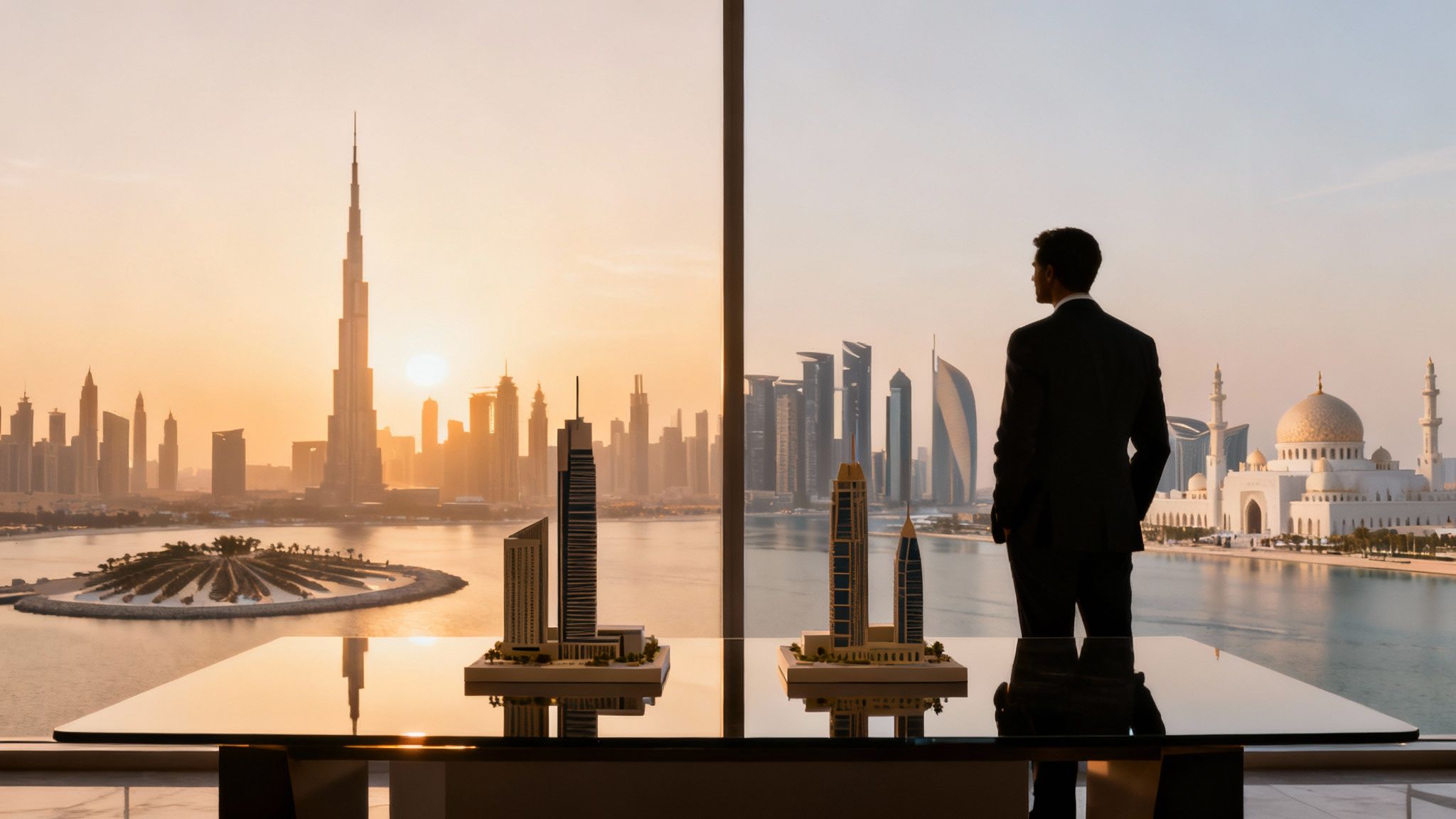
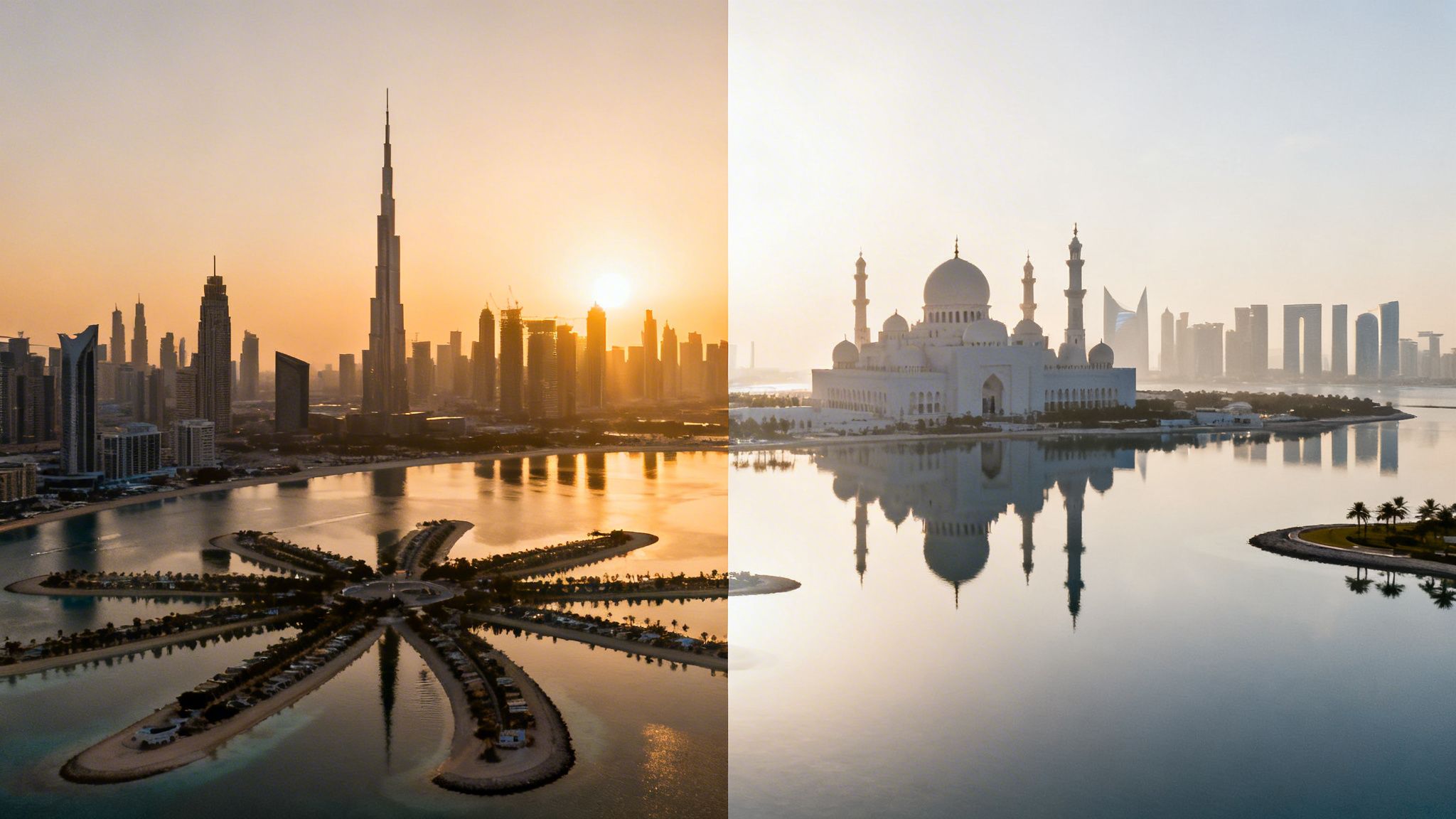
Last year's benchmarks confirmed a critical divergence for portfolio managers: off-plan transactions in Dubai outpaced ready units by nearly a 2-to-1 ratio, while Abu Dhabi's market remained anchored by end-user demand for prime, completed assets. This isn't a simple lifestyle choice; it's a fundamental decision on asset allocation. Dubai offers aggressive capital appreciation potential, while Abu Dhabi provides stable, long-term rental yields for wealth preservation.
Your portfolio’s objective must dictate the choice of emirate.
A Strategic Comparison for the HNW Investor
The market has matured from the post-Covid boom into a sustainable growth cycle. Last year's benchmarks showed a clear split: Dubai's transaction volumes were dominated by international investors targeting off-plan assets in emerging master communities like The Valley Phase 2. Abu Dhabi’s market held a steadier pace, with a higher concentration of institutional capital acquiring prime, ready inventory.
This split creates two distinct sets of opportunities entering H2 2026. Before allocating capital, an investor must analyze the economic engines driving each city.
Contrasting Economic Foundations
Dubai's GDP is built on the non-oil sectors of trade, logistics, and tourism, which fuels a dynamic, demand-driven real estate cycle. This environment is structured for higher-risk, higher-reward off-plan investments where the primary goal is capital appreciation.
Abu Dhabi operates on a different model. Its economic stability is underwritten by sovereign wealth and strategic industrial projects, creating predictable, long-term demand for high-quality residential assets. This foundation appeals to conservative investors who prioritize asset stability and consistent income streams.
The core differentiator for an investor in 2026 is velocity versus stability. Dubai represents market velocity, with higher liquidity and faster appreciation potential. Abu Dhabi represents economic stability, offering lower volatility and predictable yields backed by government-led initiatives.
This table provides a top-level summary for portfolio allocation:
| Investment Thesis | Dubai Real Estate | Abu Dhabi Real Estate |
|---|---|---|
| Primary Goal | Capital Appreciation | Wealth Preservation & Yield |
| Asset Focus | Off-Plan & Branded Residences | Prime Ready Villas & Apartments |
| Economic Driver | Diversified Non-Oil Sectors | Sovereign Wealth & Hydrocarbons |
| Investor Profile | Growth-Oriented, Higher Risk Tolerance | Conservative, Income-Focused |
| Market Liquidity | High Transaction Volume | Moderate, Stable Transaction Volume |
Before making a final decision, a thorough review of the current Dubai property market forecast is essential to align strategy with the latest market dynamics. The choice between these emirates is a fundamental decision about how to grow and protect capital.
Understanding The Economic Engines: Dubai vs. Abu Dhabi
To make an informed allocation between Dubai and Abu Dhabi, one must look past the skylines to the macroeconomic engines. The fundamental makeup of their economies directly shapes property demand, transaction velocity, and the ultimate risk-reward profile for a portfolio.
These are not similar markets. For an investor, they represent two different asset classes driven by distinct economic philosophies.
Dubai's model is high-growth, non-oil sectors. Its resilience comes from a deliberate pivot towards logistics, global trade, financial services, and tourism. This diversification creates a magnet for foreign capital and expat talent, fueling constant demand for new homes, especially in the branded and mid-market luxury segments.
Abu Dhabi’s strategy is anchored by the stability of its sovereign wealth funds and a focus on large-scale industrial and cultural projects. This state-led approach creates measured and predictable demand, mostly for high-end communities catering to a stable base of government-affiliated professionals and long-term residents.
Divergent Paths to Prosperity
The economic paths of Dubai and Abu Dhabi offer a sharp contrast. Abu Dhabi's GDP reflects its oil-backed strength, while Dubai's non-oil diversification is its core advantage. Oil now makes up less than 1% of Dubai's GDP, a structural shift that has fueled powerful growth.
Last year's economic data confirms this trend. For HNWIs, this means Abu Dhabi offers deep-rooted stability for long-term holds. The current Dubai property market analysis shows its non-oil boom creates opportunities for higher capital appreciation.
For an investor, the key takeaway is this: Dubai's economic activity directly translates into real estate demand from a global demographic. Abu Dhabi's strategic investments create pockets of concentrated, high-quality demand within specific, government-endorsed master plans.
The Impact of FDI and Government Policy
Recent government initiatives have amplified the unique strengths of each market. The expansion of the golden-visa-uae programme has been a demand driver, but its effect differs by emirate.
In Dubai, it has accelerated interest in the off-plan market. Investors can now secure long-term residency while their assets are under construction, a match for a growth-focused strategy. This is a significant factor in how policy directs investment flows.
In Abu Dhabi, the Golden Visa has mainly boosted the prime ready-property market, attracting established HNWIs looking for a stable base and immediate rental income. Changes to uae-property-law have further opened both markets, but the investor profile drawn to each remains distinct.
The choice in the Dubai vs. Abu Dhabi debate comes down to aligning capital with the right economic engine. Dubai’s diversified economy supports strategies focused on capital growth, while Abu Dhabi’s state-driven economy provides a foundation for wealth preservation.
Crunching The Numbers: An Investor's Look At The Metrics
An investor's decision between Dubai and Abu Dhabi is a numbers game. Last year's performance benchmarks paint a picture of two different market personalities: one built for aggressive capital growth, the other for steady, long-term income. Analyzing these metrics builds a clear framework for allocating capital in 2026.
The economic engine of each emirate sets the stage. This chart gives a sense of the scale, pitting Abu Dhabi's state-backed economy against Dubai's more nimble, trade-driven model.
This fundamental difference has a direct impact on returns. Abu Dhabi's oil-rich GDP provides a foundation of stability, while Dubai’s diversified economy fuels faster transaction speeds and higher growth potential.
Rental Yields Vs. Capital Appreciation
Rental yields offer the clearest distinction. In Dubai, prime apartment communities like those in Business Bay and Dubai Marina averaged yields of 6.5-7.5% last year. In Abu Dhabi, prime assets on Saadiyat and Yas Islands delivered stable yields, typically in the 5.5-6.5% range, with lower tenant turnover.
Capital appreciation tells the reverse story. Off-plan communities in Dubai, especially those along the E611 corridor like The Valley, posted appreciation rates well into the double digits by handover. Abu Dhabi’s ready market saw more controlled, single-digit growth, reflecting its maturity and focus on end-user demand.
For an HNWI, the metric to watch is the yield-to-growth ratio. Dubai offers a lower initial yield but a higher capital growth ceiling, especially in off-plan assets. Abu Dhabi provides dependable income with more predictable asset value growth.
This is why selecting the right freehold areas in Dubai is critical; performance varies dramatically between established districts and emerging growth corridors.
Price Per Square Foot And Market Velocity
A look at the price per square foot (PSF) benchmarks from Q4 2025 highlights market segmentation. Prime waterfront apartments in Dubai commanded a 15-20% premium over comparable luxury units on Abu Dhabi's Saadiyat Island. That said, the entry point for luxury villas in Abu Dhabi remains competitive.
Transaction volumes signal market energy. Dubai's off-plan market consistently outpaced its ready market last year, with a transaction ratio of nearly 60:40. This is a strong indicator of investor confidence in future project delivery. Abu Dhabi's market was the mirror image, with ready properties dominating sales.
Dubai Vs Abu Dhabi Investment Matrix: 2026 Outlook
[Chart: 2026 Payment Plan Breakdown]
| Investment Metric | Dubai (Prime/Off-Plan Focus) | Abu Dhabi (Prime/Ready Focus) | Investor Profile Suitability |
|---|---|---|---|
| Average Rental Yield | 6.5% - 7.5% (apartments) | 5.5% - 6.5% (apartments) | Income-focused but accepts higher turnover for higher yields. |
| Capital Appreciation (2025) | High (double-digit potential in off-plan) | Moderate (stable single-digit) | Growth-oriented investors with higher risk tolerance. |
| Prime PSF (Waterfront Apt.) | ~AED 3,200 - 4,500 | ~AED 2,800 - 3,800 | Value-driven luxury buyers seeking more space for capital. |
| Transaction Velocity | High (dominated by off-plan sales) | Moderate (dominated by ready sales) | Investors seeking high market liquidity and faster exits. |
This data-driven view moves beyond the simple "Dubai vs. Abu Dhabi" debate. By dissecting these core metrics, you can align capital with the emirate that matches your financial goals.
Navigating Regulatory And Financing Environments
Capital moves where it is treated best. Understanding the distinct regulatory and financing frameworks in Dubai versus Abu Dhabi is non-negotiable. While both emirates operate under federal laws, their application on the ground creates two different operational realities.
In Dubai, the Real Estate Regulatory Agency (RERA) has cultivated a transparent, investor-first system. The mandatory use of escrow accounts for off-plan projects is a cornerstone of this approach, providing a safety net that ties developer funds to construction milestones. This mechanism fueled last year's record-breaking off-plan transaction surge.
Abu Dhabi's regulatory environment, overseen by the Department of Municipalities and Transport (DMT), is secure but operates with a more conservative mindset. The market’s focus on ready inventory means fewer investors interact with off-plan safeguards.
Accessing Finance And Structuring Your Investment
The financing landscape reveals a practical difference for non-resident investors. Banks in Dubai are accustomed to a high volume of international buyers and offer more flexible mortgage products.
- Investment Pros: In Dubai, non-residents can typically secure Loan-to-Value (LTV) ratios up to 50% for off-plan and 75-80% for ready properties.
- Investment Cons: Major Dubai developers frequently offer post-handover payment plans, a form of developer-led financing that reduces the immediate need for a large mortgage.
Abu Dhabi’s mortgage market is more cautious. LTVs for non-residents are often capped at lower rates, and post-handover payment plans are far less common. This reflects a market geared more towards cash buyers or residents with established local credit histories.
The core financial distinction is leverage. Dubai's market facilitates leverage for qualified international investors. Abu Dhabi’s market dynamic favours equity-heavy investments, aligning with a strategy of stability over leveraged growth.
Corporate Structuring and Transaction Costs
For portfolio investors, a dubai-llc-company-setup is a common strategy for liability management. While processes are efficient, transaction costs differ slightly. A detailed breakdown of the taxes on property is essential before modeling final returns.
| Financing/Regulatory Metric | Dubai | Abu Dhabi |
|---|---|---|
| Typical Non-Resident LTV (Ready) | Up to 80% | Up to 70% |
| Off-Plan LTV Accessibility | Widely available (up to 50%) | Limited / Case-by-case basis |
| Post-Handover Plans | Common from major developers | Rare |
| Primary Regulator | RERA (with strong escrow protections) | Department of Municipalities and Transport (DMT) |
| Regulatory Focus | High-volume transaction transparency | Master-plan integrity & stability |
Dubai’s environment is engineered for transactional velocity. Abu Dhabi’s framework is built for stability and long-term asset security.
Evaluating Off-Plan Opportunities And Marquee Developments
The period of easy, speculative flips is over. Success in this market cycle demands a strategic eye, looking past renderings to analyze the economic and infrastructural catalysts that will drive capital appreciation. Data from last year shows serious capital flowing into large-scale master communities with long-term, phased delivery schedules.
Dubai High-Growth Corridors
[Map: Location relative to Al Maktoum Airport]
In Dubai, the investment thesis is tied to infrastructure expansion. The theatre of operations for any growth-focused portfolio is along the city's growth corridors, specifically the axis around Al Maktoum International Airport and new coastal megaprojects.
- Investment Pros: Dubai South & Expo City form a logistical and residential ecosystem that represents the most significant long-term play in the emirate. New off-plan launches here are plugged into organic, sustainable demand.
- Investment Pros: Projects like The Valley phases are a masterclass in integrated community building. Upcoming phases attract capital for the lifestyle infrastructure—schools, retail, and green spaces—being delivered in parallel.
- Investment Pros: Branded residences continue to expand beyond traditional prime postcodes. They offer a premium product that attracts a specific high-net-worth tenant and buyer.
For a deeper dive, our guide on buying off-plan property in Dubai provides an operational breakdown. The key is aligning a purchase with projects where the developer's track record is impeccable and RERA escrow protections are transparent.
The most compelling opportunities are not in standalone towers but in communities where the developer is building an entire ecosystem. Asset value is driven by the delivery of promised infrastructure, not just the completion of the residential unit.
Abu Dhabi Strategic Mega-Projects
Abu Dhabi’s off-plan market is more curated, methodical, and aligned with the government's long-term economic vision. Here, opportunities are concentrated in state-backed mega-projects on its prime islands. The approach is about creating destinations, not just residential stock.
- Investment Pros: Saadiyat Island continues its expansion as the cultural heart of the nation. New residential launches are positioned to benefit from proximity to institutions like the Louvre and Guggenheim.
- Investment Pros: Yas Island's focus is entertainment and leisure. Upcoming projects complement existing assets like the F1 track, targeting investors who want a resort-style environment with strong short-term rental potential.
This strategic development is underpinned by a robust economic framework. When comparing Dubai vs. Abu Dhabi, it often boils down to economic drivers. Tourism and trade data show why Dubai maintains its edge for high-ROI potential.
| Development Focus | Dubai | Abu Dhabi |
|---|---|---|
| Primary Driver | Infrastructure-led expansion (e.g., airports, metro) | Government-led destination creation (e.g., museums) |
| Project Scale | Multiple large-scale master communities | Fewer, highly curated mega-projects |
| Investor Target | Growth-focused, international capital | Wealth preservation, institutional & end-user capital |
| Appreciation Model | Phased growth tied to infrastructure delivery | Value uplift linked to island master plan completion |
| Market Velocity | High volume of launches and transactions | Lower volume, more controlled inventory release |
Choosing between these opportunities is a matter of aligning with the right growth narrative. Dubai offers a faster-paced environment tied to city-wide expansion, while Abu Dhabi presents a measured approach focused on creating exclusive destinations.
Final Thoughts: Strategy Over Speculation
This is not a 'Dubai vs. Abu Dhabi' debate. It is a question of strategic capital allocation within a portfolio. The market has moved on from the post-pandemic speculative cycle and now demands a data-led approach.
For portfolios geared towards aggressive capital growth, Dubai’s off-plan market remains the primary arena. Success here requires zeroing in on infrastructure-led master communities where payment plans are tied to phased delivery of roads, schools, and retail. This is how real value is created.
For portfolios built around wealth preservation and steady income, Abu Dhabi's prime ready market is the choice. It offers a lower-risk environment heavily backed by the government. The returns are predictable, the tenant base is stable, and the asset class is underpinned by a methodical, state-led economic vision.
Your allocation strategy must mirror your objectives. Dubai is your play for growth, fuelled by market velocity. Abu Dhabi is your anchor for stability, secured by sovereign wealth.
The window for easy wins has narrowed. Success in 2026 requires targeting communities with genuine infrastructure growth. At Proact Luxury Real Estate, we track these infrastructure corridors daily.
Frequently Asked Questions
Which Emirate Offers Better Long-Term Residency Prospects Through Property Investment?
Both Dubai and Abu Dhabi provide a clear path to the what-is-golden-visa-uae for property investments over AED 2 million. The strategic difference is in the type of asset you will buy to qualify.
In Dubai, a broad spectrum of qualifying off-plan projects exists. This creates multiple entry points for an investor looking to secure residency while the asset is still appreciating. You can link your visa application to a property under construction, aligning residency with a growth-focused strategy.
Abu Dhabi’s qualifying inventory is more concentrated in established, high-value ready properties. The choice hinges on your objective: Dubai lets you tie residency to a future growth asset, while Abu Dhabi connects it to a stable, income-generating property.
How Do Exit Strategies Differ Between Dubai And Abu Dhabi Real Estate?
Your exit strategy is a direct result of market liquidity and buyer profile. Dubai’s real estate market is defined by speed and volume, with a deep, diverse pool of international buyers creating greater liquidity. This environment supports more agile exit strategies.
Abu Dhabi’s market operates with a smaller, more concentrated buyer base, often end-users and long-term institutional investors. The result is lower liquidity but superior price stability. An exit strategy here is typically a longer-term hold, designed to capitalize on steady appreciation and rental income.
A Dubai exit is often timed with market cycles and infrastructure milestones. An Abu Dhabi exit is planned around long-term portfolio rebalancing and wealth preservation goals.
Are Branded Residences A Better Investment In Dubai Or Abu Dhabi?
Dubai has a more mature and extensive market for branded residences. A wide selection of premier global brands provides more historical performance data to analyze. These assets typically command a 20-30% premium over comparable non-branded properties.
This sub-market attracts a global tenant and buyer base seeking hotel-level amenities, making it very liquid. Abu Dhabi’s branded residence segment is emerging, primarily focused in ultra-exclusive locations like Saadiyat Island. For an investor, Dubai offers more variety and a proven track record, while Abu Dhabi presents a ground-floor opportunity in a growing luxury segment where supply is intentionally limited.
At Proact Luxury Real Estate, we believe success in 2026 requires precise, data-driven asset selection over broad market speculation. If you are rebalancing your portfolio for the current cycle, let's run the numbers. Schedule your confidential consultation at https://ritukant.com.