

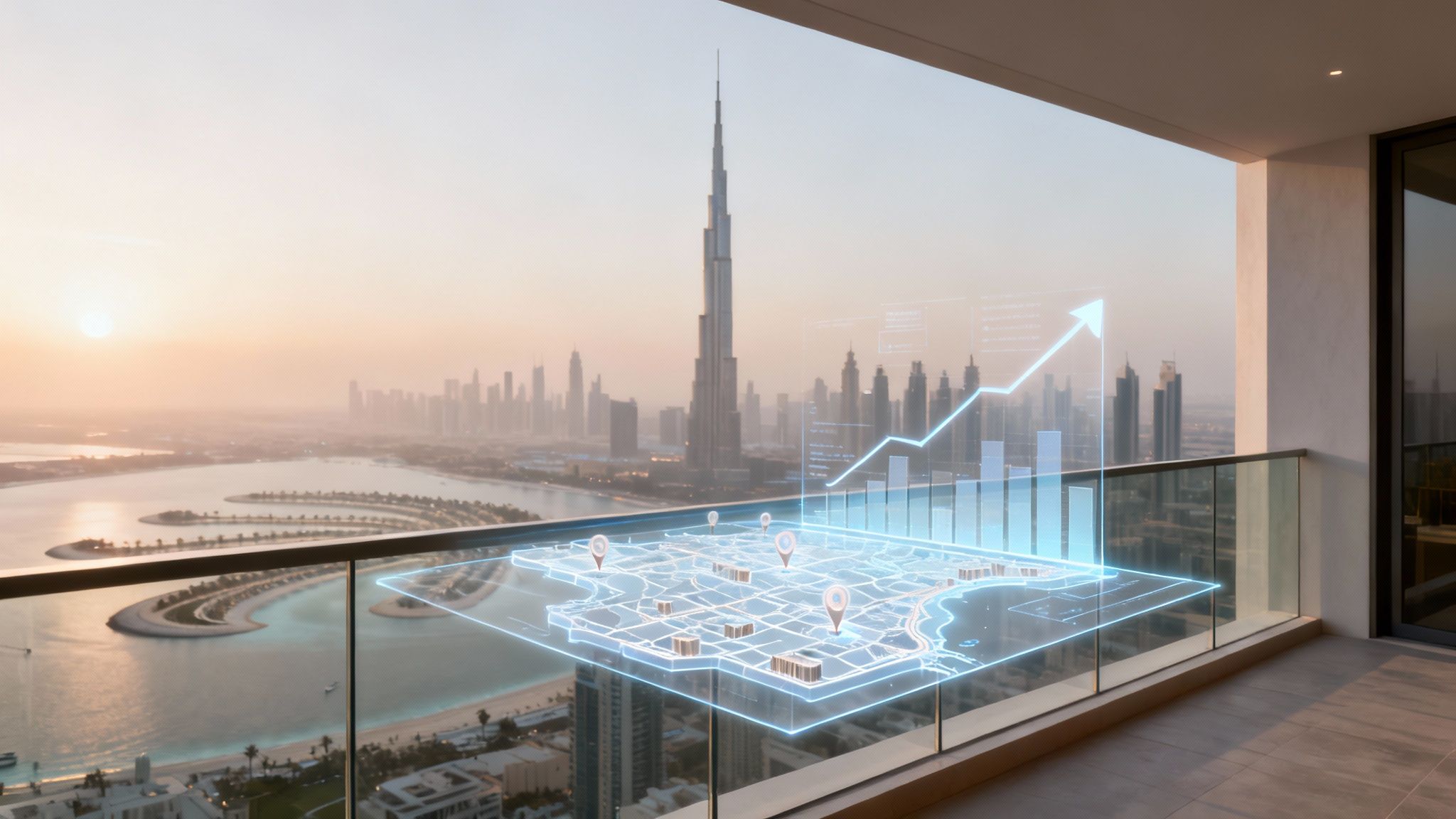
While many investors focus on Downtown's historical performance, the smart money entering 2026 has already pivoted to emerging master communities. Last year, off-plan transactions outpaced ready units for the first time since the post-Covid boom, a clear signal that the market has matured from a recovery surge into a sustainable growth cycle.
This Dubai property market analysis outlines the core economic drivers fueling this new phase and details the strategic shifts required for asset managers and HNWIs to secure alpha returns in the current market.
The Market Enters a Mature Growth Cycle
The period of exponential, across-the-board price jumps that defined the early 2020s is over. We have entered a phase where precise asset selection determines outcomes.
View the record transaction volumes of 2025 not as a speculative peak, but as the new foundation for a more stable and predictable market. This maturity is reflected in the buyer profile: a stronger presence from institutional players, family offices, and seasoned HNWIs. These are not short-term flippers; they are strategic investors focused on long-term performance, stable rental yields, and capital preservation. Their involvement adds a powerful layer of stability to the market.
Core Economic Underpinnings
The resilience of Dubai's property sector is anchored by solid macroeconomic fundamentals.
- Consistent GDP Growth: The non-oil economy continues its expansion, creating high-quality jobs and attracting skilled professionals who require housing.
- Proactive Government Policies: Initiatives like the expanded what-is-golden-visa-uae programme create a direct pipeline of real estate demand by linking residency to property investment.
- Tourism and Global Standing: Dubai's status as a global hub for business and tourism guarantees a constant flow of capital and potential residents, feeding both rental and sales markets.
The numbers are clear. Between 2021 and 2025, Dubai's real estate sector clocked total sales exceeding AED 2 trillion ($544 billion). This figure is proof of the emirate's gravitational pull for global capital. Discover more insights on Dubai's market momentum on arabianbusiness.com.
This shift from a momentum-driven market to a value-driven one demands a more granular approach. Investors can no longer rely on broad market trends. Success now means zooming in on micro-market dynamics, new infrastructure projects, and the unique value proposition of each asset. The era of passive gains has made way for a period that rewards diligent research and strategic foresight.
Forecasting Price And Rental Yield Trajectories For 2026
The primary question from my clients is whether the explosive growth story is over. The answer is no, but the dynamics have changed. We are past the market-wide recovery and into a mature cycle where performance splits between different property types and communities are distinct.
Last year's data provides a solid baseline. The REIDIN Residential Sales Price Index reported a healthy 15.6% year-on-year growth in 2025. Villas appreciated by 17.81%, while apartments climbed 15.22%. This reflects a sustained buyer preference for larger, family-sized spaces, a trend shaping new master communities.
Price Per Square Foot Stabilisation
The days of double-digit price jumps across every neighborhood are winding down. We are entering a phase of price stabilisation, a positive indicator. Growth is becoming more organic, tied to real-world factors like new infrastructure and community maturity.
This shift signals a healthy market. It filters out short-term speculators and rewards long-term investors.
Dubai’s property market has shown resilience over the last decade. Average prices per square foot surged by 51.9%, from AED 1,003 in 2014 to AED 1,524 in 2024. This history of strength, now backed by solid new uae-property-law, creates a stable launchpad for the calculated growth we expect in 2026.
This chart illustrates the market's engine room, showing how total sales volumes and a diverse mix of international buyers create a mature, stable environment.
The data confirms sustained investment from a wide international base. This is what underpins price stability as the market moves into its next, more sophisticated cycle.
The table below breaks down projections, comparing established benchmarks from 2025 with anticipations for 2026. This provides a data-driven view of the market's evolution.
Dubai Property Price and Yield Trajectory: 2025 Benchmark vs 2026 Projections
A comparative analysis of key performance indicators from the benchmark year of 2025 against forward-looking projections for 2026, highlighting shifts in market dynamics.
| Metric | 2025 Benchmark (Actual) | 2026 Projection | Strategic Implication for Investors |
|---|---|---|---|
| Overall Price Growth | 15.6% | 7-9% | Shift focus from broad market gains to community-specific appreciation. |
| Villa Price Growth | 17.81% | 8-10% | Continued outperformance, but at a more moderate pace. Premium for finished, quality units. |
| Apartment Price Growth | 15.22% | 6-8% | Growth driven by prime locations and new, amenity-rich master communities. |
| Prime Area Gross Yields | 5-6% | 4.5-5.5% | Yield compression continues. These are now primarily capital preservation plays. |
| Emerging Area Gross Yields | 7-8% | 7.5-8.5% | The best opportunity for income-focused investors. Focus on areas with new infrastructure. |
The data shows the strategy for 2026 is less about riding a universal wave and more about surgical precision—finding specific assets and locations poised to outperform.
Rental Yield Compression And Opportunity
For any income-focused portfolio, understanding rental yields is critical. In established prime areas like Downtown Dubai or Dubai Marina, we see yield compression. Capital values have risen faster than rental rates, tightening gross yields to between 5-6% for apartments.
The real opportunity to capture higher yields in 2026 lies in emerging master communities where the growth story is just beginning.
- Dubai South: With the massive expansion of Al Maktoum International Airport, rental demand from aviation and logistics professionals is set to climb. Early investors can realistically target yields of 7-8%. [Map: Location relative to Al Maktoum Airport]
- The Valley: As Emaar delivers more phases and builds out community amenities, this area is attracting families seeking better value, which will keep rental demand strong.
- Expo City: Its transformation into a residential and business hub is creating a built-in rental market, offering attractive returns for well-chosen properties.
For a deeper dive into specific communities, our comprehensive Dubai property market forecast provides the granular data needed to fine-tune your acquisition strategy.
The optimal play for 2026 is a balanced portfolio. Combine stable, blue-chip assets in prime locations with high-yield opportunities in these growth corridors. This approach hedges risk while capturing the upside from Dubai's planned urban expansion. The focus must be on cash flow and long-term value, not chasing last year's price hikes.
Navigating the 2026 Off-Plan Investment Market
A winning acquisition strategy for 2026 requires a laser focus on the off-plan market. The numbers from last year show investor appetite has decisively shifted towards future supply.
The Dubai residential market set historic records in 2025. Transaction volumes increased by 18.7%, while the total value of deals soared by 30.9% year-on-year. This is a structural change. In 2021, ready properties made up 59.6% of all transactions. That dynamic has completely flipped.
This pivot towards off-plan signals a maturing market. It demands an analytical approach from investors—one that moves beyond developer brochures and into the core fundamentals driving long-term value.
The Evolution of Payment Plans
A clear sign of market maturation is the change in payment plans. The once-common 1% monthly schemes have been phased out by top-tier developers.
Entering 2026, the industry standard has firmed up around more robust 60/40 or 70/30 structures. This means more capital is required during the construction phase, with the balance due upon handover. [Chart: 2026 Payment Plan Breakdown]
This shift filters out short-term speculators, creating a more stable foundation of end-users and committed long-term investors. It also gives developers healthier cash flow, translating to more reliable project delivery—a critical factor reinforced by RERA’s mandatory escrow account protections.
While this raises the entry barrier, it results in a healthier, less volatile market. For HNWIs, it offers greater assurance that projects are well-capitalised and that fellow buyers share a serious, long-term vision.
Strategic Master Communities with Clear Catalysts
Winning in the 2026 off-plan market is about pinpointing master communities backed by clear, undeniable infrastructure catalysts. These catalysts will inevitably drive future demand and capital growth.
Two areas should be at the top of any serious investor's Dubai property market analysis:
- Dubai South: The government's confirmed, multi-billion dollar expansion of Al Maktoum International Airport is the single biggest growth engine in the emirate. Buying off-plan here is a direct investment in the future of Dubai's aviation and logistics core.
- Palm Jebel Ali & Damac Islands: These waterfront mega-projects are the next frontier of Dubai's luxury coastline. They are not just residential developments; they are entire destinations. The investment case is tied to the proven demand for prime waterfront property and the creation of unique ecosystems that will command premium valuations on completion.
The table below breaks down the investment potential of key communities set to define the 2026 off-plan landscape.
Investment Analysis of Key 2026 Off-Plan Communities
| Master Community | Primary Developer | Projected ROI (3-Year) | Key Growth Catalyst | Investment Pros | Investment Cons |
|---|---|---|---|---|---|
| Dubai South | Multiple (incl. Emaar) | 18-25% | Al Maktoum Airport Expansion | Direct link to major economic infrastructure. High rental yield potential. | Longer-term hold required for full appreciation. |
| Palm Jebel Ali | Nakheel | 25-35% | New Luxury Waterfront Destination | Proven "Palm" brand equity. Scarcity of prime beachfront plots. | Higher entry price point. Phased, long-term delivery schedule. |
| Damac Islands | DAMAC Properties | 20-30% | Branded Residence Focus | Unique island living concept. Strong appeal to HNWI tourism market. | Newer, unproven master plan concept versus Palm. |
This data-driven approach is essential. The 2026 market will reward investors who can see past marketing hype and analyze the fundamental economic drivers that create real, sustainable value. The focus must be on acquiring assets within master plans that have a clear, logical path to future growth.
Identifying Prime Communities and Emerging Growth Corridors
While a city-wide view provides context, a high-net-worth portfolio demands granular analysis of specific communities and the infrastructure corridors connecting them. The smart money in 2026 has moved beyond known postcodes to locations with tangible, quantifiable growth catalysts. Micro-market dynamics are where real returns are made.
A successful acquisition strategy views the city as a web of interconnected economic zones. The corridor between Jebel Ali port and the Expo City site is a prime example. This entire stretch is becoming a self-sufficient economic engine, driving demand for both rental and end-user properties.
Contrasting Established Luxury with New Frontiers
The established luxury of areas like Downtown Dubai remains a solid capital preservation play. With average prices per square foot around AED 2,000 to AED 2,800 in early 2026, it offers stability and global recognition. The trade-off is compressed rental yields, making it less attractive for income-focused investors.
The real opportunity for a balanced strategy—growth and yield—lies in the newer, planned master communities. These locations often deliver a superior product at a more competitive entry point, backed by modern infrastructure.
- Dubai Hills Estate: This community is the gold standard for integrated living. Its blend of luxury villas, townhouses, and mid-market apartments creates a diverse tenant base, protecting investors from demand shifts in any single demographic.
- Branded Residences along Dubai Canal: The Canal's expansion unlocked fresh prime waterfront real estate. Branded residences here consistently command a rental premium of 20-30% over non-branded counterparts due to superior management and amenities.
A critical part of any dubai-real-estate-market-analysis is understanding that not all luxury is equal. The utility and cash flow of a new, branded two-bedroom apartment can often outperform an older, larger unit in a dated tower.
Data-Driven Micro-Market Selection
To move beyond sentiment, we must analyze transaction data and infrastructure timelines. For investors deploying capital in 2026, the following framework offers a clear path. Our team has also compiled a detailed guide on the best areas to buy property in Dubai, which takes a deeper dive into these micro-markets.
This table provides a high-level comparison of key investment metrics across distinct community types.
| Community Type | 2025 Transaction Value (Avg.) | 2026 Projected Rental Yield | Primary Growth Driver |
|---|---|---|---|
| Established Prime (Downtown) | AED 2.8M (2-Bed Apt) | 4.5% - 5.5% | Global Brand Recognition |
| Integrated Community (Dubai Hills) | AED 4.5M (3-Bed Townhouse) | 6.0% - 7.0% | Schools & Family Amenities |
| Emerging Corridor (Dubai South) | AED 1.5M (2-Bed Apt) | 7.5% - 8.5% | Al Maktoum Airport Expansion |
The data is clear: the highest yield potential is in emerging corridors directly benefiting from government-led infrastructure spending. While these areas may require a longer investment horizon for full capital appreciation, they offer superior cash flow advantages now.
The goal is to pinpoint these pockets of value before they become mainstream. By tracking infrastructure tenders and master plan updates, it becomes possible to make strategic acquisitions poised to capture the next wave of growth.
Structuring Your Investment for Asset Protection and Efficiency
Acquiring a high-performing property is only half the task. A sophisticated investor structures asset ownership to shield it from risk and maximize financial efficiency. For holders of multiple properties, direct personal ownership is rarely the optimal strategy.
The legal and administrative framework is as critical as the asset's address. A strategic approach to ownership, financing, and transactional costs is the core of asset management. The objective is a robust, compliant, and efficient vehicle for your real estate holdings.
The Corporate Holding Advantage
For investors holding—or planning to acquire—two or more properties, establishing a corporate entity is the most effective strategy. Using a mainland Limited Liability Company (LLC) to hold real estate assets offers clear advantages over direct ownership. It creates a legal firewall between personal wealth and the property portfolio.
This separation provides a crucial layer of liability protection and simplifies succession planning. It allows for a seamless transfer of assets based on shareholder agreements, bypassing potentially complex inheritance laws. For a detailed breakdown, our guide on a Dubai LLC company setup provides a clear roadmap.
Understanding the Total Capital Outlay
The property’s sticker price is just the starting point. A precise calculation of the total acquisition cost is essential for accurate ROI modeling. Investors must factor in several mandatory taxes-on-property and professional fees.
These costs are non-negotiable and must be budgeted for in every transaction:
- Dubai Land Department (DLD) Transfer Fee: A standard 4% of the property's purchase price.
- Real Estate Agency Commission: Typically 2% of the purchase price on secondary market deals.
- Trustee Fees: Administrative fees for processing the title deed transfer, usually between AED 2,000 to AED 4,000.
- Mortgage Registration Fee: For financed purchases, the DLD levies a fee of 0.25% of the total loan amount.
By factoring in these additional costs, which typically add up to 6-7% of the purchase price, investors can build a realistic financial model. Overlooking these figures leads to inaccurate yield calculations and flawed performance analysis.
The 2026 Financing Landscape for Non-Residents
While cash dominated the market last year, comprising roughly 87% of purchases, strategic financing remains a powerful tool for portfolio growth. For non-resident investors seeking a mortgage in 2026, meeting specific criteria is necessary.
Lenders focus on stability and verifiable income. General requirements include a minimum down payment of 20% (though 25-30% is more common for non-residents on their first property), a valid passport and visa, and detailed proof of income through bank statements and salary certificates. Adherence to frameworks set by both the Central Bank and RERA ensures every financing agreement is transparent and secure. Careful preparation of these documents is key to a successful mortgage application.
Final Thoughts: Strategy Over Speculation
The window for 'easy flips' has narrowed. Success in 2026 requires targeting communities with genuine infrastructure growth—specifically those connected to the expanding metro lines. We've moved past speculative frenzy into a nuanced environment where returns are driven by diligent analysis, not just momentum.
Success now demands a razor-sharp focus on specific communities with tangible infrastructure development. It is equally critical to partner with proven master developers who deliver on their promises, a key factor we break down when reviewing the top 10 developers in Dubai. Revised handover timelines from less established firms can completely derail your projected ROI.
The core shift for 2026 is from a momentum market to a performance market. This demands a more strategic, long-term approach to asset acquisition and management.
The emphasis must shift towards acquiring assets that generate consistent rental income and hold their value through periods of market stabilization. Your investment thesis should be built around properties that serve a clear end-user demographic—whether executive tenants for branded residences or families seeking townhouses in amenity-rich communities.
This is a market for strategic investors who treat Dubai real estate as a core component of a diversified global asset portfolio. At Proact Luxury Real Estate, our advisory is built on this principle of data-driven, strategic acquisition. If you are rebalancing your portfolio for 2026, let's run the numbers.
Frequently Asked Questions for Investors
Is the Dubai Property Market Heading for a Correction in 2026?
The data points more towards a market stabilisation—a healthy price adjustment—rather than a sharp correction. The transaction volumes of 2025 were driven by genuine demand from end-users and long-term investors.
With a supply pipeline of around 300,000 new units slated for delivery by 2028, the market appears to be keeping pace with projected population growth. We expect the rate of price increases to cool, especially in secondary areas. However, prime communities will likely hold their value. The market's fundamentals remain strong.
What Is the Most Significant Change in Off-Plan Payment Plans?
The most noticeable shift has been the move away from post-handover payment plans. Major developers have standardised their structures to a 60/40 or 70/30 split, where the bulk of payment is due during construction.
This change is a sign of a maturing market. It filters out speculators, creating a more stable investor base. It also gives developers better cash flow to ensure they hit project deadlines, a process secured by RERA's mandatory escrow account rules. For investors, it means more capital is required upfront, but the trade-off is a healthier market.
How Does the Golden Visa Programme Impact My Real Estate Investment?
The UAE Golden Visa programme is a constant and powerful demand driver. By linking long-term residency directly to a real estate investment of AED 2 million or more, the government has created a massive incentive for HNWIs to put down roots in Dubai. For a closer look at the requirements, you can review our guide on the Golden Visa UAE.
This policy effectively creates a price floor in the mid-to-luxury property segments and guarantees a steady stream of new, affluent residents. As an investor, owning a qualifying property is not just a financial asset; it is a residency solution, which enhances the investment's overall value proposition.
Which Property Type Offers a Better Balance of ROI in 2026?
Looking ahead to 2026, branded residences and townhouses in emerging master communities are hitting the sweet spot for a balanced return. While prime villas delivered incredible capital growth, their rental yields have now compressed to the 3-5% range, making them more of a capital preservation play.
Branded apartments, especially those managed by top-tier hotel operators, can command much higher rental rates and attract a steady flow of corporate tenants, pushing yields into the 6-8% range. At the same time, townhouses in communities like Dubai Hills or The Valley appeal directly to the growing family demographic, delivering strong rental yields (6-7%) plus solid potential for capital growth as the communities mature.
At Proact Luxury Real Estate LLC, we provide data-driven advisory to help investors navigate these market shifts. If you are rebalancing your portfolio for the realities of 2026, let's run the numbers together.