


Yes, foreigners can absolutely buy property in Dubai. Not only is it possible, but the government has made it a regulated and surprisingly straightforward process. In designated zones known as 'freehold areas', international investors can purchase real estate with 100% ownership, giving them the exact same property rights as UAE citizens.
Your Gateway to a Global Real Estate Portfolio
Dubai has cemented its reputation as a premier global hub for real estate, pulling in investors from every corner of the world. But what’s the real story behind its magnetic appeal? It goes far beyond the iconic skyline and promises of a lavish lifestyle. For foreign buyers, the city presents a powerful mix of financial incentives, rock-solid security, and serious long-term growth potential.
Think of this guide as your executive summary—a clear, high-level map for the journey ahead. We’re here to demystify the process, build your confidence, and show you exactly why Dubai's property market is a top-tier choice for diversifying your portfolio and investing in your lifestyle.
Core Drivers for Foreign Investment
For international investors, especially those coming from high-tax countries, Dubai's financial environment is a game-changer. The city’s pro-business attitude translates directly into tangible benefits for property owners.
Here’s what’s really pulling people in:
- Tax-Free Rental Income: This is one of the biggest draws. You can earn rental income without handing a slice of it back in personal income tax.
- A Clear Path to Residency: Investing in property can secure a UAE Residence Visa for you and your family, including the highly sought-after 10-year Golden Visa.
- Robust Regulation: The market is tightly managed by the Dubai Land Department (DLD) and the Real Estate Regulatory Agency (RERA), which means your transactions are transparent and your rights are protected.
Dubai’s progressive laws make it simple: when you buy a freehold property, you are the sole and complete owner. There’s no need for a local partner, which simplifies everything from the initial purchase to your eventual exit strategy.
Before you start your property hunt, it's helpful to have a clear picture of the key factors that will shape your investment journey. The table below summarizes the most critical points for any foreign buyer to consider.
Key Considerations for Foreign Buyers in Dubai
| Factor | Details for Foreign Investors |
|---|---|
| Ownership Rights | 100% freehold ownership is permitted in designated zones, granting you full legal title to the property. |
| Visa & Residency | Property investment can qualify you for a UAE Residence Visa, including the 10-year Golden Visa, for yourself and your family. |
| Tax Implications | Enjoy 0% personal income tax on rental income and 0% capital gains tax when you sell. |
| Regulatory Body | The market is regulated by the Dubai Land Department (DLD) and RERA, ensuring transaction transparency and investor protection. |
| Financing Options | Mortgages are available to non-residents from various UAE banks, though down payment requirements are typically higher. |
| Associated Costs | Budget for one-time costs like DLD fees (4%), registration fees, and agency commissions, which total around 7-8% of the property value. |
Understanding these fundamentals gives you a solid foundation, ensuring you navigate the market with confidence and make decisions that align with your financial goals.
Ever since 2002, Dubai has allowed 100% foreign ownership of properties within these designated freehold areas—a policy that truly sets it apart from many other international markets. This forward-thinking move allows you to hold the full legal title in your own name, free from complicated restrictions. There are no corporate ownership mandates or annual filing burdens, which keeps the process clean and simple for individual buyers.
Better yet, there are no limits on the number of properties a foreign buyer can own, opening the door to building a diverse and powerful portfolio. You can discover more about Dubai's unique property ownership laws and see how they are structured to benefit global investors. This foundation of legal clarity is precisely why buying property in Dubai has become such a secure and attractive move for foreigners worldwide.
Your Step-by-Step Path to Property Ownership
Navigating the property purchase process in Dubai might feel like mapping a new city, but it's a journey with clear, well-defined milestones. When you break it down, the path to ownership is a logical sequence of steps designed to protect everyone involved—buyer and seller alike.
Think of it as a carefully orchestrated relay race. Each stage is handed off to the next professional until you cross the finish line with the title deed in hand.
The whole system is regulated by Dubai’s Real Estate Regulatory Agency (RERA), which means every transaction follows a standardized, transparent procedure. This structure is a huge advantage when buying property in Dubai for foreigners, as it provides a secure framework and takes the guesswork out of the process. Let’s walk through it, turning what seems complex into a manageable checklist.
Stage 1: Laying the Financial Groundwork
Before you even start scrolling through listings, your first move is to get your finances in order. This isn’t just about knowing your budget; it’s about having your financing officially sorted.
- Set Your Budget: Figure out your total purchasing power. Don't forget to account for the associated fees, which typically add another 7-8% on top of the property price.
- Secure Mortgage Pre-Approval: If you need financing, getting pre-approval from a UAE bank is non-negotiable. This document confirms what a lender is willing to offer you, instantly making you a serious, credible buyer in the eyes of sellers and agents.
With your finances locked in, you can start your search with confidence, knowing exactly what properties are within your reach.
Stage 2: Assembling Your Professional Team
You wouldn't explore an unfamiliar market without a local guide, right? In Dubai’s real estate world, your guide is a RERA-certified agent. Their job isn't just to find properties but to be your advocate, negotiator, and procedural expert from start to finish.
A seasoned agent provides invaluable on-the-ground intelligence, helping you understand fair market values and advising you on how to negotiate. They are your professional partner, making sure your interests are protected at every turn. Picking the right one is a critical step toward a successful purchase.
Stage 3: From Offer to Initial Agreement
Once you’ve found the one, the formal transaction process kicks off. This stage involves a few key documents that legally lock in the agreement between you and the seller.
- Making a Formal Offer: Your agent will help you submit a formal offer. Once it's accepted, you'll provide a security deposit cheque (usually 10% of the property value) to the registration trustee’s office as a sign of commitment.
- Signing the MOU (Form F): Next up is signing the Memorandum of Understanding, also known as Form F. This is a RERA-standardized contract that spells out all the terms and conditions of the sale—price, payment schedule, and completion date.
- Obtaining the No Objection Certificate (NOC): The seller then has to get an NOC from the property developer. This certificate is crucial; it confirms there are no outstanding service charges or other debts on the property, giving you a clean slate.
An NOC is your guarantee that the property is free of any financial baggage with the developer. It’s a mandatory document required by the Dubai Land Department before the final transfer can happen.
This infographic shows how property ownership in Dubai leads directly to major benefits, from tax advantages to residency visas.
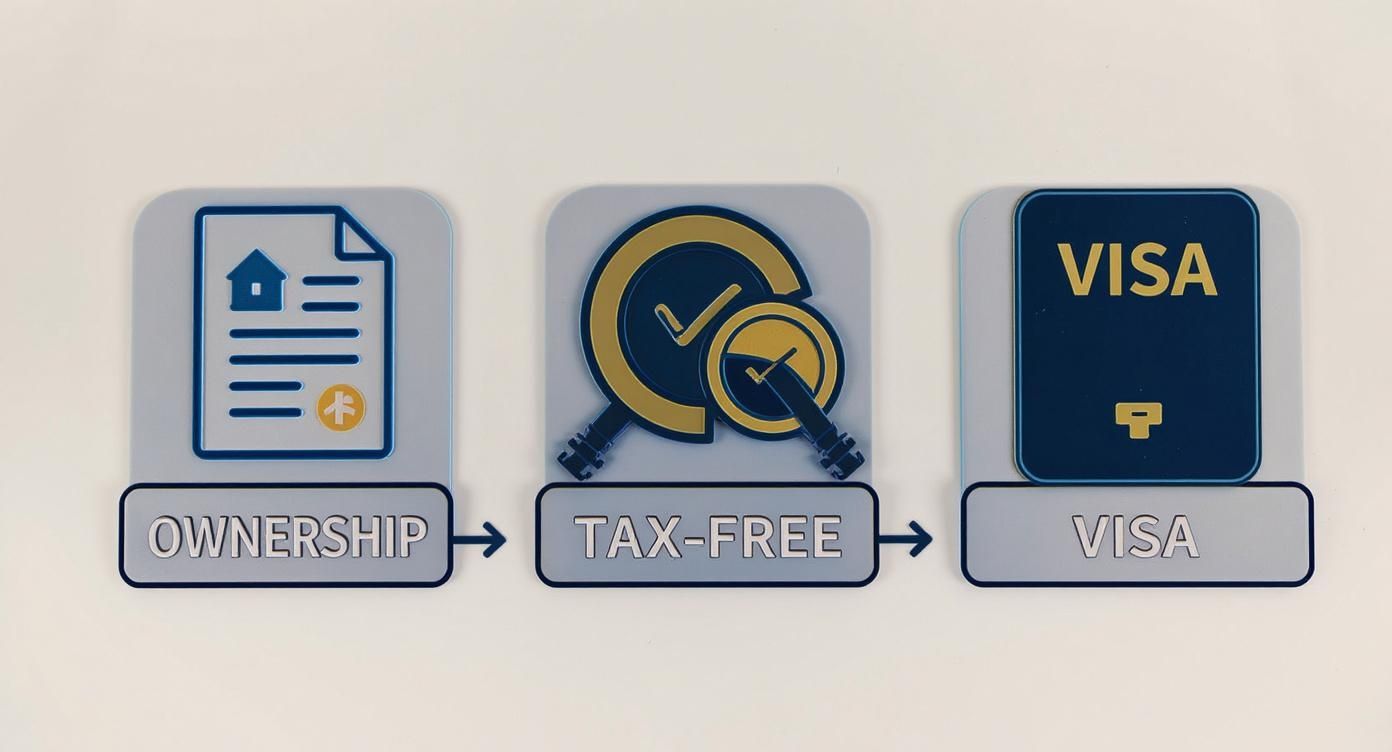
The flow is simple: securing ownership is the first step that unlocks significant financial and lifestyle perks.
Stage 4: The Final Transfer and Ownership
The final leg of your journey takes place at the Dubai Land Department (DLD) office. This is where the official transfer of ownership happens. You, the seller, and your agents will meet at a DLD-approved registration trustee office.
Here, the final payments are exchanged, all legal documents are submitted, and the DLD issues a new title deed in your name. Congratulations—you are now the official owner of a property in Dubai.
For those ready to explore deeper investment strategies, our guide on how to invest in Dubai real estate offers more valuable insights. This final step completes a secure, government-backed process built for clarity and investor protection.
Decoding the Full Cost of Your Dubai Property
The sticker price on a property is just the first number in a much larger equation. To make a smart investment, you need a complete and transparent view of all the costs involved, especially when you're buying property in Dubai as a foreigner. Thinking beyond the initial purchase price is the key to budgeting with confidence and avoiding any unwelcome financial surprises down the line.
Let's break down every single fee you’ll encounter, from the one-time charges at the point of purchase to the recurring costs of ownership.
Upfront Transaction Fees
When the property title is officially transferred to your name, several mandatory, one-time fees become due. These are typically paid on the day of the transfer and, all in, will add around 7-8% to the property's purchase price. It's a significant chunk, so you need to factor it in from day one.
Here’s a look at the main costs you can expect to pay upfront.
Typical Costs and Fees for Foreign Buyers
To give you a clearer picture, here is an itemized breakdown of the standard fees you'll encounter during a property transaction in Dubai.
| Fee/Cost Item | Typical Percentage/Amount | Payable To |
|---|---|---|
| DLD Transfer Fee | 4% of the property value | Dubai Land Department (DLD) |
| Real Estate Agent Commission | 2% of the property value (+ 5% VAT) | Real Estate Agency |
| Trustee Fees | AED 2,000 - AED 5,000 | DLD-approved Trustee Office |
| Mortgage Registration Fee | 0.25% of the loan amount | Dubai Land Department (DLD) |
These figures give you a solid baseline for your initial budget. Remember, while the 4% DLD fee is legally split between buyer and seller, it's common market practice for the buyer to cover the entire amount.
Ongoing Ownership Costs
Once the keys are in your hand, your financial obligations shift from one-time fees to recurring costs. The most significant of these are the developer service charges.
These are annual fees that cover the maintenance and upkeep of the community's common areas—think swimming pools, security, landscaping, and building maintenance. The amount varies widely depending on the community, the developer, and the size of your property, so always ask for a clear statement of these charges before you commit.
Think of service charges like a homeowners' association fee. They ensure the community remains pristine and functional, which is vital for preserving your property's value and attracting high-quality tenants.
Securing a Mortgage as a Non-Resident
The good news for foreign investors is that UAE banks are very open to lending to non-residents. The process is well-established, but the requirements are naturally stricter than for residents to mitigate the bank's risk.
The most important metric to understand is the Loan-to-Value (LTV) ratio. This is simply the percentage of the property's price that a bank is willing to finance.
- For Residents: LTV can go up to 80% for a first property.
- For Non-Residents: The maximum LTV is typically capped at 50-75%. This means you will need to provide a down payment of at least 25-50% of the property value in cash.
The Essential Documentation for a Loan
To secure a mortgage, you'll need to prove your financial standing and creditworthiness. While each bank has slightly different criteria, the core documents they ask for are fairly standard.
Be prepared to provide the following:
- A valid passport and visa copy
- Bank statements for the last three to six months
- Proof of address (like a utility bill from your home country)
- A salary certificate or other proof of income
- Credit reports from your home country
Having these documents organized and ready will make the application process much smoother. Securing financing is often the longest part of the purchase timeline, so starting early is always a smart move.
Choosing Where and What to Invest In
Your investment's success truly boils down to two critical decisions: where you buy and what you buy. Getting this right means matching your financial goals with the perfect property type and location. When you're a foreigner buying property in Dubai, this decision splits into two main paths, each with its own strategic advantages.
The first path is buying an off-plan property straight from the developer. Think of this as investing in a blueprint—you're securing a home before it’s even built, often at a very competitive price. The second path is the secondary market, where you purchase a pre-owned, ready-to-move-in property from its current owner. This is like buying an established asset with a proven history.

Off-Plan Versus Secondary Market Properties
Deciding between an off-plan property and one on the secondary market is a foundational step in your investment strategy. Neither is flat-out "better"—they simply serve different goals.
Investing in Off-Plan Properties:
- Lower Entry Price: Off-plan units almost always come with a lower price tag than their completed counterparts. This opens the door for significant capital appreciation by the time the project is handed over.
- Flexible Payment Plans: Developers lure in investors with attractive, staggered payment schedules. This lets you pay in installments over the construction period, easing the initial financial hit.
- Brand New Asset: You get a pristine property with the latest amenities and zero wear and tear, which is a massive draw for future tenants or buyers.
Investing in the Secondary Market:
- Immediate Returns: This is the big one. You can start generating rental income from day one. There's no waiting around for construction to finish.
- Established Community: You're buying into a known entity. The neighborhood is already built, with a clear track record of rental yields, service charges, and property management quality.
- Tangible Asset: You can physically walk through the property, inspect its condition, and get a genuine feel for the community before you commit a single dirham.
For investors who prioritize capital growth and manageable payments, off-plan is often the way to go. Our detailed guide on the best off-plan projects in Dubai dives deeper into current opportunities. But if you’re after immediate cash flow and lower risk, the secondary market is your ideal choice.
Spotlighting Prime Freehold Communities
Location is the anchor of any real estate investment. In Dubai, different freehold communities offer distinct lifestyles and investment profiles, catering to goals from high-yield rentals to luxurious family living. Let's take a look at some of the most sought-after areas.
1. Dubai Marina
Known for its stunning waterfront living and forest of skyscrapers, Dubai Marina is a constant favorite among expats and tourists. It's a high-energy district, always buzzing with restaurants, shops, and entertainment.
- Property Types: Mostly high-rise apartments with a handful of podium villas.
- Investor Profile: Perfect for those seeking high rental demand for both long-term and short-term lets. The average gross rental yield for apartments hovers around 6.5%.
2. Downtown Dubai
Home to the Burj Khalifa and The Dubai Mall, Downtown Dubai is the city's prestigious heart. It offers a sophisticated, cosmopolitan lifestyle with unmatched access to world-class attractions.
- Property Types: Luxury apartments, many with iconic views.
- Investor Profile: Attracts buyers looking for premium, trophy assets with strong potential for capital appreciation. The average gross rental yield is approximately 5.9%.
3. Palm Jumeirah
This man-made marvel is synonymous with ultimate luxury and exclusivity. It delivers a serene, resort-style life with private beaches and breathtaking views of the Arabian Gulf.
- Property Types: A mix of ultra-luxurious apartments, townhouses, and signature villas.
- Investor Profile: Tailor-made for high-net-worth individuals chasing a premium lifestyle or a high-value holiday home investment. Apartment yields average around 5.6%.
Choosing the right community is about more than just numbers; it's about matching the area's character with your investment thesis. A high-energy urban hub like Dubai Marina serves a different rental market than the tranquil, family-oriented Arabian Ranches.
Recent market data shows some clear buying patterns. High-net-worth individuals from the Gulf have been the main drivers behind luxury villa purchases, while Europeans have shown a strong preference for high-end apartments. This demand is getting a significant boost from Dubai's visa reforms, especially the Golden Visa, which grants residency to those who invest at least AED 2 million in property. With villa prices soaring by 32% in mid-2025, the city continues to outshine global markets, pulling in investors looking for superior rental yields. This strategic alignment of location and property type is fundamental to building a successful portfolio.
Unlock UAE Residency with a Golden Visa
For many international investors, buying a property in Dubai is more than just a financial move—it's a deliberate step toward a new lifestyle. The UAE's Golden Visa program takes this a step further, transforming your property purchase into a direct pathway to long-term residency. It offers a level of stability and freedom that few other global cities can really match.
This visa is a true game-changer. It's a 10-year, renewable residency permit granted to investors who meet specific criteria, and it completely removes the need for a local sponsor. Think of it as upgrading your investment from just a financial asset to a foundational piece of your family's future in the UAE.
Eligibility Criteria for the Property Investor Visa
To qualify for the Golden Visa through real estate, the main requirement is a minimum property investment of AED 2 million. This isn't just for a single property; you can also meet this threshold by purchasing a portfolio of properties that collectively add up to that value.
The rules have also become much more flexible to accommodate different investment strategies:
- Mortgaged Properties: You can absolutely use a mortgaged property to qualify. The key here is that your paid-up cash equity in the property—the amount you've actually paid off—must be at least AED 2 million. Banks can provide a statement to confirm this for your application.
- Off-Plan Properties: In a major update, investors can now secure a Golden Visa by purchasing off-plan properties directly from approved developers, as long as the investment value is AED 2 million or more. This allows you to start your residency journey while your property is still being built.
This forward-thinking approach means that whether you're buying a ready home with a mortgage or getting in early on a new development, the path to residency is wide open.
The Unmatched Benefits of Holding a Golden Visa
The perks of the Golden Visa go far beyond just being able to live in the UAE. It offers a complete residency solution that benefits your entire family and provides a level of personal and professional freedom you won't find elsewhere.
Here are the key benefits:
- Long-Term Stability: A 10-year visa that's renewable, offering genuine peace of mind.
- Family Sponsorship: You can sponsor your spouse, children (with no age limit for unmarried daughters and sons), and even your domestic staff.
- No Sponsor Required: Your residency is tied to your investment, not an employer, giving you total independence.
- Extended Stays Abroad: You can stay outside the UAE for more than six months without your residency being cancelled.
"The Golden Visa effectively bridges the gap between a temporary stay and long-term settlement. It provides investors and their families the confidence to build a genuine life in Dubai, making it a powerful incentive that drives international demand."
The diversity of Dubai’s property investors speaks volumes. In 2025, Indians are leading the charge, making up 22% of all foreign buyers, with British nationals close behind at 17%. Chinese investors account for 14%, Saudis 11%, and a mix of other nationalities contribute to a staggering AED 81 billion in total foreign investment from 155 different countries. This proves Dubai’s incredible global appeal. You can discover more insights about the top nationalities dominating Dubai's property market and understand its worldwide reach.
How to Apply for Your Golden Visa
The application process is designed to be straightforward, directly linking your property purchase to your residency status.
- Finalise Your Property Purchase: First, complete the transaction and make sure the title deed is registered in your name with the Dubai Land Department (DLD).
- Gather Required Documents: You'll need your title deed, passport copies, a personal photo, and proof of health insurance. If the property is mortgaged, you'll also need a No Objection Certificate (NOC) from the bank.
- Submit Your Application: You can submit your application online through the official government portals or in person at a designated service center.
- Complete Medicals and Biometrics: Once your initial application gets the green light, you'll need to complete a medical fitness test and provide your biometric data.
- Receive Your Visa: After the final approval comes through, your visa will be stamped in your passport, officially granting you long-term residency in the UAE.
Protecting Your Investment with Due Diligence
A smart investment is a secure one, and this rings especially true when you’re buying property in Dubai as a foreigner. Before you even think about committing, it's absolutely vital to do your homework—your due diligence—to safeguard your purchase and make sure everything is above board. This process is your personal quality control, letting you verify every last detail before signing on the dotted line.
Think of it like getting a vehicle history report before buying a car; you need to check the property's legal and financial background. Thankfully, Dubai's government has made this surprisingly simple. You can independently check a property's title deed and a developer's official registration status using the Dubai Land Department's (DLD) official Dubai REST mobile app.
Key Verification Steps
This digital tool is a massive asset for any foreign buyer. It lets you cross-check critical information straight from the source, so you’re not just taking someone's word for it.
- Verify the Title Deed: The app lets you confirm that the seller is the legitimate owner and that the property has a clean title, free from any legal disputes or holds.
- Check Developer Registration: Make sure the developer is officially registered and approved by RERA. This is non-negotiable, especially when looking at off-plan projects.
- Confirm Escrow Account Details: For off-plan buys, you can verify that the developer has an approved escrow account. This is huge—it means your funds are protected and can only be used for construction.
These checks are your first line of defence against any potential headaches down the road.
The Importance of Legal Review
While the DLD's tools offer great transparency, the legal jargon in a Sales and Purchase Agreement (SPA) can be a minefield of clauses that might not be in your best interest. This is exactly where professional legal oversight becomes invaluable.
Having a qualified legal expert or a licensed conveyancer review your SPA before you sign isn't just a good idea; it's a critical step. A conveyancer specializes in the legal side of transferring property and works only for you. They’ll go through the contract with a fine-tooth comb to spot any ambiguous terms, unfair penalty clauses, or hidden liabilities.
A conveyancer is your legal advocate in the transaction. Their role is to ensure the contract is fair, your rights are protected, and the transfer of ownership complies with all UAE laws, providing you with essential peace of mind.
Their expertise is particularly crucial when you're navigating the nuances of buying off-plan property in Dubai, where payment schedules and handover conditions are spelled out in detail. By investing in professional due diligence, you’re giving yourself the checks and balances needed for a secure, transparent, and confident property purchase.
Common Questions from Foreign Buyers
Diving into a new property market is exciting, but it naturally comes with a lot of questions. When it comes to buying property in Dubai as a foreigner, a few key queries pop up time and time again.
Let's cut through the noise and get straight to the answers. Below, I’m tackling the most common questions I hear from international buyers about mortgages, buying from abroad, and the real costs of ownership.
Can I Get a 100 Percent Mortgage as a Foreigner?
This is easily one of the most frequent questions, and the short answer is no. Securing a 100% mortgage as a non-resident just isn't on the table in the UAE. Local banks have specific lending rules to manage their risk, and that includes asking foreign buyers to have some serious skin in the game.
For non-residents, the maximum Loan-to-Value (LTV) ratio you can expect is somewhere between 50% and 75%. What does that mean for you? You’ll need to be ready with a cash down payment of at least 25% of the property’s price, plus all the associated fees. This substantial contribution is how you demonstrate your financial commitment to the bank.
Do I Have to Be in Dubai for the Purchase?
What happens if you’ve found the perfect investment but can’t just hop on a plane to Dubai to sign the papers? Good news: you don't have to. The system here is built for global investors, so you are not required to be physically present to finalize the deal.
The magic happens through a legally appointed Power of Attorney (POA). This is a formal legal document that gives someone you trust—like a lawyer or even a family member—the authority to act on your behalf. They can sign all the final transfer forms at the Dubai Land Department and wrap up the entire transaction for you, making a remote purchase completely doable.
A Power of Attorney is a game-changer for overseas investors, allowing for a smooth property purchase from anywhere in the world. Just be sure it’s properly drafted, legally attested in your home country, and authenticated by the UAE Embassy to be valid here.
What Are the Ongoing Ownership Costs?
Getting the keys is just the beginning. Your financial planning needs to account for the regular costs that come with owning a property in Dubai. These aren't just minor expenses; they're essential for maintaining your property and the community it's in, which ultimately protects the value of your asset.
Here are the main recurring costs you’ll need to budget for:
- Community Service Charges: Think of these as the annual fees you pay to the developer or building management. They cover the upkeep of common areas, security, landscaping, and amenities like pools and gyms.
- Utility Bills (DEWA): You'll be responsible for your own electricity and water bills, which are managed by the Dubai Electricity and Water Authority (DEWA).
- General Maintenance: It’s always smart to set aside a budget for routine upkeep and any unexpected repairs inside your own unit. This is just part of smart, long-term ownership.
Ready to navigate Dubai's property market with an expert guide? Proact Luxury Real Estate LLC provides research-driven advice to help global investors secure high-yield properties with confidence. Explore your investment options and book a one-on-one call at https://ritukant.com.
Article created using Outrank