


Investing in off-plan property in Dubai is a classic strategy for a reason. It often comes with lower entry prices and flexible payment plans, letting you secure an asset with huge potential for capital growth before a single brick is laid. It's a powerful way to get into a world-class market at a favourable price point, but success really comes down to knowing the landscape inside and out.
Is Buying Off Plan Property in Dubai Still a Smart Move?

The appeal of buying directly from a developer’s blueprint is as strong as ever, especially in a city that never stops growing. The biggest draw is the financial structure. Developers are constantly competing, which means they roll out attractive, staggered payment schedules that seriously reduce the upfront cash you need and improve your cash flow while the project is being built.
This approach also sets you up for potentially significant capital growth. By locking in a property at today's price, you’re positioned to ride the wave of market appreciation by the time you get the keys. As the project takes shape and the community around it matures, the value of your investment naturally climbs.
Market Dynamics Fuelling Demand
Dubai’s rock-solid economic fundamentals provide a sturdy foundation for the off-plan market. The city's population is always growing, thanks to investor-friendly government policies like the Golden Visa programme, which guarantees a steady demand for new homes. Major infrastructure projects and Dubai's reputation as a global business hub just keep pulling in talent and investment from all over the world.
The market’s recent performance speaks for itself. The latest data shows just how massive the volume and value of these deals are, cementing off-plan as a major force in Dubai real estate. According to a Cavendish Maxwell report, off-plan sales rocketed to 42,000 units in just one quarter, making up 76% of all residential sales. These transactions were worth a jaw-dropping AED 138 billion, a 24% jump year-on-year.
This isn't just about putting up new towers; it's a massive vote of confidence from investors in Dubai's long-term vision. It shows that both local and international buyers see off-plan deals not as a gamble, but as a calculated, strategic investment.
Weighing the Pros and Cons of Off Plan Investment
While the numbers are compelling, it's essential to look at both sides of the coin. Every investment has its upsides and potential pitfalls. Here’s a straightforward breakdown to help you see the full picture.
| Consideration | Potential Advantages | Potential Risks |
|---|---|---|
| Pricing | Lower entry prices and early-bird discounts can offer significant savings. | Market downturns could lead to the property value being less than the purchase price at completion. |
| Capital Growth | Strong potential for appreciation as the project progresses and the area develops. | Delays in community infrastructure can slow down value appreciation. |
| Payment Plans | Flexible, staggered payments make it easier to manage cash flow. | Defaulting on a payment can lead to penalties or even loss of the unit. |
| Customisation | Opportunity to choose finishes or layouts in the early stages. | The final product might differ slightly from the initial renders and marketing materials. |
| Rental Yield | Brand new properties attract higher rental income and quality tenants. | Delays in handover mean a longer wait before you can start earning rental income. |
| Developer Risk | Reputable developers have a strong incentive to deliver on time and to high standards. | Less-established developers might face financial issues, causing significant project delays or even cancellation. |
Ultimately, understanding these factors helps you make a more informed and strategic decision, turning potential risks into manageable variables.
Balancing Opportunity with Awareness
The potential returns are definitely there, but you have to go in with your eyes wide open. The market is strong, but it has its complexities. The key things to nail down are:
- Developer Reputation: Your investment is only as solid as the developer's history of delivering quality projects on time. No exceptions.
- Project Location: Being close to key infrastructure—think metro stations, schools, and shops—is absolutely critical for future rental income and resale value.
- Contractual Clarity: The Sale and Purchase Agreement (SPA) is your most important legal shield. You need to understand every single clause before you sign.
So, is buying off-plan in Dubai still a smart move? Absolutely, for those who do their homework. By zeroing in on quality projects from trusted developers and truly understanding the market, you can set yourself up for some serious returns.
For a look at what’s hot right now, check out our guide on the best off-plan deals in Dubai.
How to Vet Developers and Projects Like an Expert
When you’re buying off-plan property in Dubai, the success of your investment hangs almost entirely on two things: the developer’s reliability and the project's real-world value. A slick brochure and impressive 3D renders mean absolutely nothing if the company behind them has a poor track record.
Let's be clear: doing your homework isn't just a good idea; it's the absolute bedrock of a secure investment.
Assessing the Developer's Track Record
Your investigation should always start with the developer. Don't get distracted by what they promise for the future—dig into their past. A developer's history is the single most reliable predictor of their future performance.
Start by building a simple portfolio of their previous work. Go beyond the glossy images on their website. Pinpoint three to five of their completed projects and really scrutinise them.
- Timely Delivery: Were these projects handed over on schedule? Chronic delays are a massive red flag. They don't just frustrate you; they directly impact your potential rental income and tie up your capital for longer than planned. You can use resources like the Dubai REST app from the Dubai Land Department (DLD) to check the real-time construction status of many registered projects.
- Build Quality: If you can, visit their completed buildings in person. Walk through the common areas, check the finishing in the lobby, and just observe the overall maintenance. Does the quality on the ground match the luxury branding they promoted? A building that looks tired and worn out after just a few years is a sure sign that corners were cut.
- Community Feedback: This is priceless. Search for online forums and resident reviews for their past projects. What are actual owners and tenants saying? Are they complaining about constant maintenance issues, poor management, or facilities that never seem to work? This is the kind of ground-level feedback you won't find in a sales pitch.
A developer with a solid, consistent history of delivering high-quality projects on time—think industry giants like Emaar or Nakheel—obviously presents a much lower risk than a newer or less established firm.
Analysing the Project's Viability
Once you're confident in the developer, it’s time to shift your focus to the project itself. Even a great developer can launch a project in a less-than-ideal location. Your goal here is to assess its long-term potential for both rental yield and capital appreciation.
The master plan is your starting point. Look at the proposed layout of the entire community.
- Amenities and Green Spaces: Does the plan include parks, swimming pools, gyms, and maybe a few shops? A well-planned community with plenty of green space is always far more attractive to future tenants and buyers.
- Infrastructure Connectivity: How easy is it to get around? Proximity to a Dubai Metro station can significantly boost a property's value and rental demand. Also, look at the access to major highways, good schools, hospitals, and shopping centres.
- Future Supply: Do a bit of research on what other projects are planned for the surrounding area. A massive influx of new units all hitting the market at the same time could suppress rental prices and resale values. You're looking for an area with healthy growth potential, not one that's about to face a glut of supply.
A project's success is not just about the four walls of your apartment; it's about the ecosystem around it. An investor who buys in a well-connected, amenity-rich community is investing in a lifestyle, which always commands a premium.
Uncovering Red Flags and Verifying Legitimacy
Thankfully, Dubai’s regulatory framework gives investors powerful tools to protect themselves. The Real Estate Regulatory Agency (RERA) and the DLD have put systems in place to ensure a high level of transparency.
Your final checks should always include these non-negotiables:
- RERA Registration: First, verify that the developer and the specific project are both officially registered with RERA. If a project isn't registered, walk away. It's an immediate deal-breaker.
- Escrow Account Verification: The developer is legally required to have a RERA-approved escrow account for the project. Make sure your payments go directly into this account, not into the developer's main company account. This is crucial because it ensures your funds are ring-fenced and used specifically for construction milestones.
- Title Deed and Affection Plan: The developer must hold the title deed for the project land. Don't be shy about asking to see the affection plan, which is essentially the plot map approved by the authorities. This confirms the land is properly designated for the type of project being built.
By meticulously vetting both the developer and the project, you transform buying off-plan from a speculative gamble into a calculated investment. This diligence is what separates successful investors from those who end up facing costly delays and major disappointments.
To see how these principles apply to upcoming developments, you can explore some of Dubai's most ambitious property projects of 2025.
Decoding the Sale and Purchase Agreement
After you’ve done your homework on the developer and the project, you’ll come face-to-face with the single most important document in this entire journey: the Sale and Purchase Agreement (SPA). This isn't just paperwork; it's a legally binding contract that dictates every last detail of your purchase.
Signing this document without fully grasping what's inside is like navigating a minefield blindfolded. I've seen investors gloss over this part, and it almost never ends well. You have to know exactly what you’re committing to.
The SPA is far more than a receipt. Think of it as the architectural blueprint for your investment, detailing your rights, the developer's duties, and the exact specifications of the property you're buying.
Key Clauses You Cannot Afford to Skim
Every SPA is packed with dense legal jargon, but some clauses carry much more weight than others. These are the non-negotiables you must dissect before your pen even thinks about touching the paper. Focusing here is what separates a protected investment from a potential disaster.
Completion Date: This is a big one. The SPA must clearly state the anticipated handover date. Even more crucial, however, are the clauses that outline the developer's right to push this date back. Vague timelines are a massive red flag.
Delay Penalties (Compensation Clause): So, what happens if the developer blows past the handover date? A well-drafted SPA will have a penalty clause spelling out the compensation you're entitled to for every day, week, or month of delay. Make sure this is defined in no uncertain terms.
Unit Specifications and Floor Plans: The agreement has to include a meticulous description of the property—exact size in square feet or metres, room count, and a specific list of fixtures and finishes. "Premium materials" is just marketing fluff; the SPA should specify brands or quality standards. Always insist on having the approved floor plan attached as an annex.
Payment Schedule: This section breaks down the precise percentage of the purchase price you owe at each construction milestone. Cross-check this against the payment plan you agreed to. Crucially, ensure the milestones are tied to tangible construction progress, not just arbitrary calendar dates.
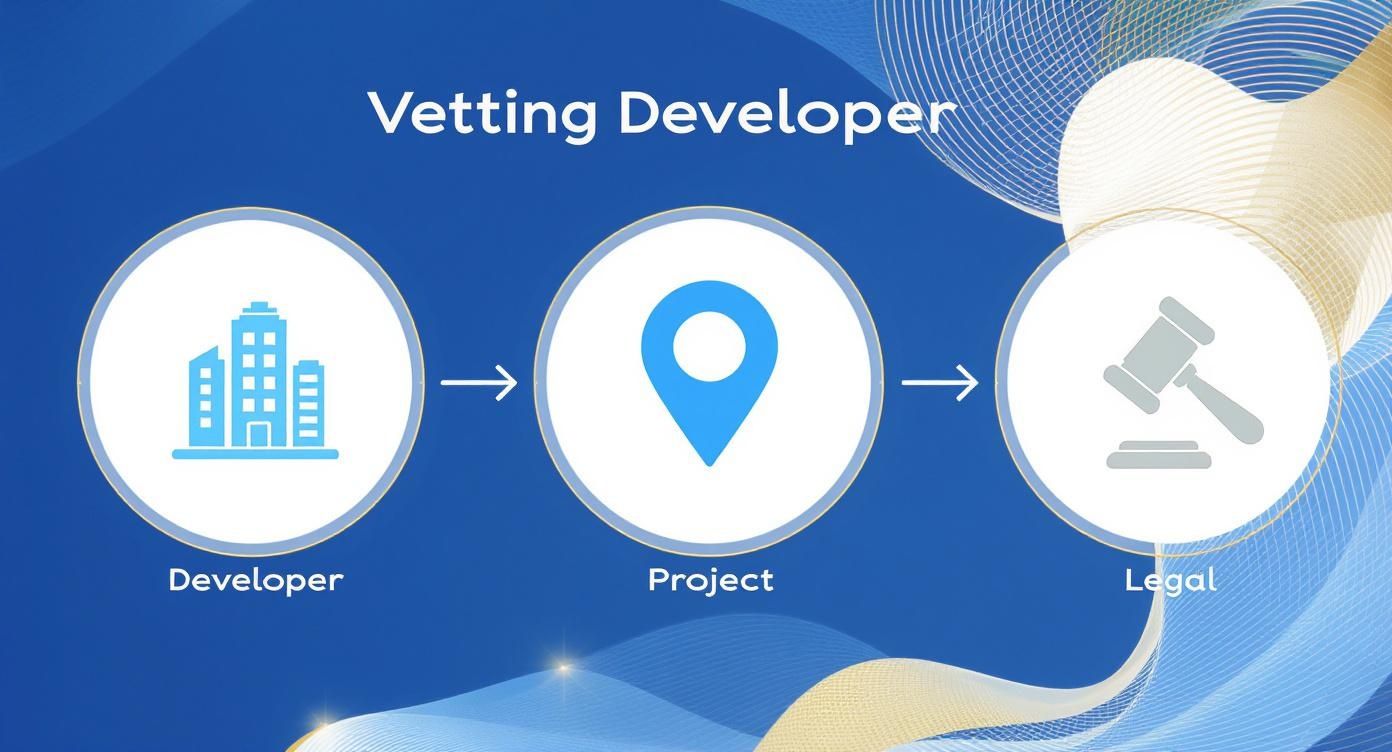
This visual gives you a clear map of the due diligence stages. You need to be confident about the developer and the project before you even get to the legal deep-dive on the SPA.
The Regulatory Safety Net: RERA, DLD, and Escrow
Thankfully, you aren’t going into this alone. Dubai has built a robust regulatory framework specifically to protect off-plan buyers. The Real Estate Regulatory Agency (RERA) and the Dubai Land Department (DLD) act as a critical layer of oversight.
Every single legitimate off-plan project must be registered with the DLD, and the developer needs to have all the necessary approvals from RERA. This registration is your first green light, confirming the project is legitimate.
The single most important protection mechanism for buyers is Dubai's Escrow Account Law. Your payments should never go directly into the developer’s bank account. Instead, every dirham is deposited into a RERA-approved escrow account tied specifically to your project.
This system is designed to safeguard your money. The developer can only access funds from the escrow account to pay for construction costs after hitting specific, pre-approved milestones. An independent consultant has to verify this progress, giving you peace of mind that your investment is being used exactly as intended.
Your Pre-Signing Checklist
Before you sign anything, treat the SPA review like a final exam. Go through it line-by-line with a legal advisor who specialises in Dubai real estate. Their fee is a tiny price to pay to avoid a multi-million-dirham headache.
Here is a final checklist to run through:
- Is the developer and project name correct and fully registered with the DLD?
- Does the unit number, size, and layout match the floor plan attached to the SPA?
- Are the payment milestones clearly linked to actual construction progress?
- Is the escrow account number listed? Have you verified it with the DLD?
- Is there a clear handover date and a well-defined penalty clause for delays?
- Are there any sneaky clauses allowing the developer to make significant changes to the unit or building without your consent?
By methodically decoding the SPA and leaning on the protections offered by RERA and the DLD, you can sign with confidence. This transforms the agreement from a source of anxiety into a powerful tool that secures your asset and protects your financial future.
Understanding Payment Plans and Financing Your Purchase

When you're buying off-plan in Dubai, the payment structure you lock in is every bit as critical as the price you negotiate. Developers are constantly competing for your business, and that's fantastic news for buyers. It means they're rolling out a wide variety of plans designed to suit different financial situations and investment strategies.
This isn't just about a simple deposit and final payment anymore. The options are far more sophisticated. Getting your head around these is key to making sure your investment aligns perfectly with your personal cash flow.
This landscape of buyer-friendly terms is a massive driver of market activity. In fact, off-plan deals recently made up a staggering 66% of both transaction volume and value in a single quarter. To keep that momentum going, developers are getting creative with low initial deposits and lengthy post-handover payment schedules. You can get a deeper dive into these market dynamics in this Q2 2025 market analysis.
Common Off-Plan Payment Structures
While every developer has their own twist, most plans fall into a few key categories. Knowing the real-world pros and cons of each will help you zero in on the right one for your goals.
- Construction-Linked Plans (e.g., 40/60, 50/50): This is the classic model. You pay a percentage—say, 40%—in instalments that are directly tied to construction milestones. The rest is due when you get the keys. It’s straightforward, and your payments are linked to tangible progress on the ground.
- Post-Handover Payment Plans (PHPP): These have become a game-changer for investors. A popular structure might be 60/40, where you pay 60% during the construction phase and the final 40% over several years after handover. This is an incredibly powerful tool because you can rent the property out and use that income to help pay off the remaining balance.
- Low Upfront Deposit Plans (e.g., 10/90): To get buyers in the door, some developers will offer plans with tiny initial deposits, sometimes as low as 5% or 10%. The catch? The huge remaining balance is due upon completion. These are great for securing a unit with minimal cash down, but you have to be absolutely sure you'll have the financing sorted for the lump sum at handover.
Choosing a payment plan isn't just a financial decision; it's a strategic one. A post-handover plan might lower your initial risk and boost your cash flow, while a traditional plan could be simpler if you have the capital ready and waiting.
Securing a Mortgage for Off-Plan Property
If you're looking at financing, getting a mortgage for an off-plan property is a different beast than for a ready unit. Not all banks in the UAE will touch off-plan projects, and the ones that do have a strict checklist for the buyer, the developer, and the project itself.
First things first, the bank must have the developer and that specific project on its approved list. This is non-negotiable. The bank is taking on the risk that the project will actually be completed, so your very first question to a mortgage advisor should be: "Which lenders are financing this development?"
The loan-to-value (LTV) ratios are also much tighter. For off-plan properties, UAE Central Bank regulations typically cap the mortgage at 50% of the property value for both residents and non-residents. This means you need to have at least 50% of the purchase price in cash to cover the down payment and fees.
Here’s what the mortgage process generally looks like:
- Get Pre-Approved: Do this before you even think about signing an SPA. A pre-approval tells you exactly what you can afford and signals to developers that you're a serious buyer.
- Submit Project Documents: Once you've found your property, you'll need to give the bank the SPA and all the associated project paperwork.
- Bank Valuation: The lender will carry out its own valuation to ensure the off-plan price is in line with the current market.
- Final Loan Agreement: If everything checks out, you'll get a final mortgage offer to sign.
Trying to juggle all this—coordinating between you, the developer, and the bank—can be tricky. Working with an experienced advisor makes the journey infinitely smoother, ensuring you tick all the boxes and land the best financing terms possible.
Planning Your Exit Strategy for Maximum Returns
The smartest investors I know all have one thing in common: they start with the end in mind. When you're buying off-plan property in Dubai, your strategy can't just end when you sign the Sale and Purchase Agreement (SPA). The real work begins by defining your exit from day one, whether you're chasing steady rental income or a big, profitable sale.
This foresight is what separates a good investment from a truly great one. Deciding on your primary goal upfront—rental yields or capital gains—will shape every decision you make, from the type of property and its location to the payment plan you choose.
Building a Strategy for Rental Income
If your goal is to generate passive income, you need to think like a future tenant. This means looking past the four walls of the unit and analysing the entire community. Is it close to a metro station? Are there good schools and shops nearby? These aren't just nice-to-haves; they are the core drivers of rental demand in Dubai.
Before anything else, you need to forecast your potential rental yield. A crucial first step is to research what similar-sized properties are currently renting for in the area, or in comparable communities already built by the same developer. This simple exercise gives you a realistic benchmark for your financial projections.
Think through these practical elements:
- Your Furnishing Strategy: Are you planning to rent it unfurnished, furnished, or as a fully serviced apartment? Furnished units can often command higher rents, especially from corporate tenants, but they do require a bigger upfront investment.
- Your Target Tenant: A one-bedroom flat near the DIFC is going to attract a very different tenant than a three-bedroom villa out in Dubai Hills Estate. Tailor your property choice to the demographic you're aiming for.
The market's performance really highlights the potential here. The Dubai Land Department recently recorded 226,000 total real estate sales in a single year, which is a massive 36% increase from the previous year, with off-plan returns being a major part of that story. We're seeing high demand in strategic areas like Jumeirah Village Circle and Business Bay, especially for projects near new transport links.
Crafting a Profitable Sales Exit
For investors who are focused on capital appreciation, the exit strategy is all about timing and reading the market. When it comes to selling an off-plan property, you've really got two main paths you can take.
Flipping the Contract Before Handover
This is a popular strategy that involves selling your rights to the property to another buyer before construction is even finished. The appeal is obvious: you can lock in a profit without ever taking ownership or needing to arrange a mortgage for the final payment. The catch, of course, is that this only works if the market has moved up since you first bought.
Most developers have rules around this. Typically, they require you to have paid a certain chunk of the property's value—usually 30-40%—before they'll let you resell. You'll also be on the hook for the 4% Dubai Land Department (DLD) transfer fee on the original price, and the new buyer pays their own 4% fee on the new, higher sale price.
Holding for Long-Term Appreciation
The other option is to take possession of the property at handover and hold onto it for several years. This strategy lets you benefit from both rental income and longer-term market growth. It’s generally seen as a less risky approach than flipping because it protects you from short-term market dips and volatility.
Your decision should really be guided by what the market is doing. A rapidly rising market is perfect for flipping, as demand is high and buyers are eager to pay a premium. In a flatter or slower market, a long-term hold strategy is often the smarter, more prudent move, allowing you to build equity while your tenant helps cover the costs.
Ultimately, having a well-defined exit plan gives your investment journey clarity and purpose. It shifts your purchase from a hopeful guess into a calculated business decision designed to hit specific financial goals. To dig deeper into this, you might find our guide on how to maximise ROI on property investments in Dubai really useful.
Common Questions About Buying Off Plan in Dubai
Even with the best strategy, buying off-plan property in Dubai can feel like navigating a maze. It's only natural that questions pop up. Here, I'll tackle the most common ones I hear from investors, giving you straight, clear answers to help you move forward.
Think of this as your go-to guide for those "what if" moments. Getting these details right isn't just important—it's what separates a smooth, profitable investment from a stressful one.
What Is the Biggest Risk and How Do I Mitigate It?
Without a doubt, the single biggest headache for off-plan buyers is project delay. It’s a common frustration that can push back your rental income or your move-in date, sometimes significantly. Delays can stem from anything—supply chain hiccups, slow approvals, you name it.
So, how do you protect yourself? Your best defence is doing your homework upfront.
Stick with the big, reputable developers like Emaar or Meraas. These guys have a public track record and a reputation to uphold when it comes to delivering on time. You can also use official tools like the Dubai REST app to keep a real-time eye on construction progress yourself.
You can't control global shipping lanes, but you absolutely can control which developer you trust with your money. Their history of on-time delivery is the most reliable predictor you've got.
Can I Resell My Off-Plan Property Before Handover?
Yes, you can. This is a very common strategy in Dubai, often called "flipping." But you can't just sell whenever you want; developers have rules.
Typically, you'll need to have paid a certain percentage of the property's value—usually somewhere between 30% and 50%—before the developer gives you a No Objection Certificate (NOC) to sell.
Just remember to factor in the costs. You'll be on the hook for the 4% DLD transfer fee on your original purchase price. Then, your new buyer pays their own 4% fee on the new, higher sale price. This strategy really shines in a rising market, where the appreciation more than covers these transaction costs and leaves you with a nice profit.
What Happens If the Final Product Differs From the Brochure?
That's a great question and a very valid concern. Those glossy 3D renders in the marketing brochure are just that—marketing. They aren't legally binding. Your real protection is in the fine print of the Sale and Purchase Agreement (SPA).
This is where you need to be meticulous. Your SPA must include a detailed "specification sheet" or annex that lists out the exact finishes, fixtures, brands, and materials. Vague promises like "high-quality finishes" are red flags and mean nothing.
- Demand Specifics: The contract should name the brand of the kitchen appliances or specify the type of marble for the flooring.
- Attach the Blueprints: Make sure the final, approved floor plans are attached as part of the contract.
- Get a Legal Eye on It: Before you sign anything, have a property lawyer review the SPA. They can spot clauses that give the developer too much wiggle room to change things without your consent.
If the finished apartment is wildly different from what was contractually promised, you have grounds to file a complaint and seek recourse through RERA or the DLD.
How Is My Money Protected During Construction?
Dubai has a pretty solid system for this, and it all revolves around one key thing: the RERA-regulated escrow account. It's the law. When you make a payment, your money doesn't go to the developer's bank account. It goes into a special, project-specific escrow account.
The developer can only access these funds in stages, as they hit specific, pre-agreed construction milestones. An independent consultant has to verify the progress before RERA gives the green light to release the funds. This system ensures your money is actually being used to build your property. Before you ever send a dirham, always verify the project's official escrow account details with the DLD.
Can Foreigners Get Mortgages for Off-Plan Properties?
Absolutely, but it’s a bit tougher than for a ready property. If you're a non-resident, the UAE Central Bank generally caps the loan-to-value (LTV) ratio at 50% of the property value for off-plan purchases.
What this means in practical terms is that you'll need to have at least 50% of the purchase price ready in cash to cover the down payment and all the fees. Also, not every bank will finance off-plan projects. The ones that do usually have a pre-approved list of developers they're willing to work with. My advice? Get a mortgage pre-approval sorted out very early in your search. It will give you a clear picture of your real budget and financing options.
Navigating the off-plan market requires more than just capital; it requires expert guidance. At Proact Luxury Real Estate LLC, we provide the data-driven insights and strategic advice you need to find high-ROI opportunities in Dubai's fast-paced market. Book a one-on-one advisory call with our experts today and let's build your property portfolio with confidence.
Article created using Outrank