


Investing in a Dubai villa isn't just about acquiring a piece of real estate; it's a strategic move to plant your flag in one of the most electric property markets on the planet. For savvy investors, the allure is clear: powerful capital growth, impressive rental yields, and a pro-business climate that makes it a top-tier destination for building wealth.
Understanding the Surge in Dubai's Villa Market
Choosing to buy a villa in Dubai is an investment in both a lifestyle and a remarkably resilient economic powerhouse. The city's real estate scene isn't just recovering; it's firing on all cylinders. This boom is fueled by smart government policies, a flood of high-net-worth individuals making Dubai their home, and an unmatched quality of life that keeps pulling in global talent.
This intense demand has created a market that's competitive but also incredibly rewarding. Getting a handle on what's driving this growth is the first step toward making a smart, profitable decision.
The Forces Fueling the Boom
So, what's really behind the frenzy in Dubai's villa market? It's not just a passing phase. We're seeing fundamental shifts that point to long-term stability and serious growth potential.
- The Golden Visa Effect: The UAE's long-term residency visas, directly tied to property investment, have been a total game-changer. It offers investors and their families a clear, secure path to residency, which has massively ramped up demand from international buyers.
- A Diversified, Stable Economy: Dubai has brilliantly moved beyond its oil-dependent past. Thriving sectors like tourism, tech, and finance mean a stable job market and a steady stream of expats looking for high-quality homes.
- A Tax-Friendly Haven: This is a big one. The lack of annual property taxes and zero income tax on rental earnings is a huge magnet for investors. It means more of your returns go directly into your pocket, boosting your overall profit.
The Numbers Don't Lie
Recent data paints a clear picture of just how hot the villa market has become. In the first half of 2025, the total value of villa sales exploded from AED 71.6 billion to AED 118.5 billion compared to the previous year. That's a staggering jump of about 65%.
At the same time, the number of transactions shot up by 55%, proving this is a market with both high value and high velocity.
Digging deeper, the capital appreciation in prime communities has been off the charts. According to ValuStrat, Jumeirah Islands saw annual capital gains of 41.1%, while Palm Jumeirah wasn't far behind with a 40.5% increase through mid-2025. This tells us that the real action is concentrated in the luxury villa space.
This isn't just a simple bounce-back from the pandemic; it's a structural realignment of the market. For a more granular look at these dynamics, our complete Dubai real estate market analysis breaks it all down. Think of this guide as your roadmap to turning these powerful trends into a winning investment strategy.
Choosing Your Path: Off-Plan vs. Ready Villas
Your first big decision when buying a villa in Dubai is a classic one: do you buy a brand-new property directly from a developer before it's even built (off-plan), or do you purchase a finished villa on the secondary market? This isn't just about picking a style; it's a fundamental strategic choice that will shape your financial commitment, your timeline, and your potential returns.
Each path offers its own unique advantages, and frankly, requires a completely different investor mindset.

Let's unpack both options from a boots-on-the-ground, investor's point of view. This will help you line up this crucial decision with your own financial goals.
The Allure and Risks of Off-Plan Villas
Buying off-plan means you're committing to a property based on floor plans and slick 3D renders. For many investors, especially those I work with from India, the main draw here is the financial structure. Developers roll out incredibly attractive, staggered payment plans that dramatically lower the initial cash you need to get in the game.
Instead of needing a massive lump sum, you might put down just 10-20% upfront. The rest is paid in installments tied to construction milestones. This structure is a game-changer because it opens the door for significant capital appreciation during the construction phase. If the market value of similar villas climbs by the time yours is finished, you’ve built equity before you've even made the final payment.
But let's be realistic—this path isn't without its risks.
- Construction Delays: While Dubai’s regulations are much tighter now, delays can and do happen. This could push back the date you start earning rental income.
- Specification Changes: Sometimes, the finished product has minor differences from the glossy marketing brochures. This is why you must meticulously review every clause in the Sales and Purchase Agreement (SPA).
- Market Fluctuations: The market could cool off during the 2-3 year construction period, which might affect your expected appreciation.
Investor Insight: The off-plan route often fits a more hands-off investor with a longer-term vision. If your primary goal is capital growth over immediate rental cash flow and you have the patience for the build time, this can be an incredibly powerful wealth-building strategy.
The Case for Ready Villas
On the flip side, a ready villa gives you the instant gratification of a tangible, physical asset. You can walk through it, touch the finishes, check the quality, and get a real feel for the community and its vibe. For a family planning to relocate or an investor who puts immediate cash flow first, this is almost always the better choice.
The single biggest advantage is the ability to generate rental income from day one. There's no waiting game. As soon as the title deed is transferred, you can get it listed and start seeing a return. That predictability is a huge draw for more conservative investors. The main drawback? The higher upfront cost. You'll typically need a hefty down payment (often 25% or more for non-resident mortgages) plus all the associated fees to seal the deal.
Off-Plan vs. Ready Villa Investment Comparison
To make this choice clearer, let's break down the key differences side-by-side. This table should help you weigh what matters most to you and your investment strategy.
| Factor | Off-Plan Villa | Ready Villa |
|---|---|---|
| Initial Cost | Lower upfront payment (e.g., 10-20% deposit). | Higher upfront cost (e.g., 25%+ down payment). |
| Payment Structure | Flexible, staggered payments tied to construction. | Lump-sum payment or mortgage financing required. |
| Rental Income | Delayed until handover (typically 2-3 years). | Immediate rental income from day one. |
| Capital Appreciation | Potential for high growth during the construction phase. | Appreciation is tied to current market performance. |
| Risk Profile | Higher risks (delays, market shifts, developer issues). | Lower risk; what you see is what you get. |
| Customization | Often possible to choose finishes or make minor layout tweaks. | Limited to renovations after purchase. |
| Property Condition | Brand new, with the latest designs and amenities. | Varies; may require maintenance or upgrades. |
Ultimately, the right choice hinges on your personal risk appetite, financial situation, and long-term goals.
Making the Right Choice for Your Portfolio
So, how do you decide? It really boils down to your personal circumstances and what you're trying to achieve.
Let’s look at a couple of real-world scenarios:
- An investor from Mumbai, looking to diversify their portfolio with a 5-year growth plan, might lean toward an off-plan villa in an up-and-coming community. The payment plan lets them manage cash flow smartly while aiming for that long-term appreciation.
- On the other hand, a high-net-worth individual from Delhi relocating their family to Dubai would almost certainly choose a ready villa. The ability to move in right away and the certainty of what they're buying far outweigh the potential savings of an off-plan deal.
At the end of the day, both are perfectly valid strategies for buying a villa in Dubai. The key is understanding the nuances of each—from payment structures to market risks—to make a decision that's right for you. To get a feel for what's out there, a great next step is to review our curated list of the best off-plan projects in Dubai and see what opportunities are currently on the market.
For a lot of my clients, especially those investing from overseas, the financial and legal side of buying a villa in Dubai can feel like the biggest hurdle. But the truth is, the system here is surprisingly transparent and built to attract foreign investment. Once you grasp a few key ideas, the whole process clicks into place.
It really all boils down to one critical concept: freehold ownership.
This is the legal framework that gives non-UAE nationals the right to own property outright in designated "freehold zones." Think of iconic communities like Palm Jumeirah, Dubai Hills Estate, or Emirates Hills—these are all freehold areas. It means you get the same full ownership rights you'd have back home, allowing you to sell, lease, or pass down the property as you see fit.
Securing Your Villa Financing
Once you're comfortable with the ownership rules, the next conversation is usually about financing. While cash deals are certainly common, many smart investors choose to leverage their capital by getting a mortgage from a UAE bank. And yes, banks here are quite open to lending to non-residents, but they do have specific criteria you'll need to meet.
Typically, a non-resident can secure a Loan-To-Value (LTV) ratio of up to 75%. This means you should be prepared for a down payment of at least 25% of the villa's price, plus the associated closing costs and fees.
To get the ball rolling, the bank will ask for a standard set of documents to verify your eligibility:
- Proof of Identity: A clear copy of your passport is non-negotiable.
- Proof of Income: This usually means your last six months of personal bank statements. If you're employed, you'll need a salary certificate; if you're self-employed, expect to provide audited financials for your business.
- Credit History: A credit report from your home country is almost always requested to show a track record of financial responsibility.
Pro Tip: One of the smartest things you can do is get a mortgage pre-approval before you even start scheduling viewings. Showing up to a negotiation with your financing already lined up instantly positions you as a serious, credible buyer. It gives you a massive advantage and strengthens your hand at the bargaining table.
Taking this step early on removes any financial guesswork and lets you make offers with confidence.
Choosing the Right Ownership Structure
The final piece of this puzzle is deciding how you'll actually hold the title to your villa. This isn't just a formality; it has real, long-term consequences for things like liability, inheritance planning, and asset protection. You generally have two main routes to consider.
Individual Ownership
This is the most direct and common approach. The property's title is simply registered in your name, or jointly with a spouse or family member. It’s clean, simple, and involves minimal setup costs.
Corporate Ownership
A more sophisticated option is to set up a company—often in a free zone like the Dubai International Financial Centre (DIFC) or Abu Dhabi Global Market (ADGM)—to act as the legal owner of the property. While this path comes with higher setup and ongoing administrative costs, the benefits can be substantial, particularly for high-net-worth investors.
Here’s why you might consider a corporate structure:
- Limits Personal Liability: It creates a protective barrier between your personal assets and your real estate investment.
- Simplifies Inheritance: It can offer a much smoother path for succession, helping to navigate local inheritance laws which can sometimes be complex for foreigners.
- Offers Anonymity: The property is owned by the company, not you directly, which provides an added layer of privacy.
Getting these financial and legal frameworks right from the start is absolutely fundamental. For a deeper dive, our complete guide on buying property in Dubai for foreigners covers even more ground. Making the right choices here ensures your investment is not only profitable but also secure for the long haul.
Your Essential Due Diligence Checklist
A smart investment is a well-researched one. Before you commit your capital to a villa in Dubai, treating due diligence as non-negotiable is the only way to play the game. This isn’t about just ticking boxes off a list; it’s about rigorously protecting your investment and ensuring the asset you acquire performs exactly as you expect it to.
Think of this process as your safety net. It’s what separates a confident, successful purchase from one riddled with nasty surprises and hidden costs down the line. Let's walk through the critical steps for both off-plan and ready properties so you can move forward with absolute clarity.
Vetting the Developer and the Project
When you're buying off-plan, your biggest variable is the developer. Their track record is the single most important predictor of your investment’s future. Don't just take the glossy marketing brochures at face value—you need to dig deeper.
- Project History: Get a list of their previously completed projects. Were they delivered on schedule? More importantly, what’s the build quality like a few years post-handover?
- RERA Registration: This is fundamental. Verify that both the developer and the specific project are officially registered with Dubai's Real Estate Regulatory Agency (RERA). No registration, no deal.
- Escrow Account Confirmation: Make sure your payments are going into a RERA-approved escrow account. This is a crucial protection for your funds, as the developer can only access the money after hitting certified construction milestones.
For a ready villa, your focus shifts from the developer’s promises to the property's present-day reality.
A professional snagging report is an absolute must for any ready villa. This detailed inspection, conducted by a specialized third-party company, will identify everything from minor cosmetic issues to potential structural defects before you finalize the purchase. It's a small investment that can save you a fortune.
Scrutinising the Legal and Financial Details
The real deal is defined in the paperwork. One of the most common and costly mistakes I see investors make is rushing through the legal documents. I can't stress this enough: get a qualified lawyer to review everything, especially the Sales and Purchase Agreement (SPA).
They have the expertise to spot clauses that could work against you, ensuring the terms are fair and your interests are properly protected. This legal oversight becomes even more critical when you're investing from overseas and aren't familiar with local nuances.
Another vital check involves the property’s ongoing expenses.
Annual Service Charges
You absolutely must get a clear, written breakdown of the annual service charges. These fees cover the upkeep of common areas, security, landscaping, and community amenities.
- Ask for the service charge history for the past few years to see if there have been any sharp or unreasonable increases.
- Confirm exactly what these charges include and, just as importantly, what they exclude.
- Understand the payment schedule and what penalties apply for late payments.
Finally, you have to confirm the property is free and clear of any financial baggage. Your agent or lawyer will help you verify that there are no outstanding service charges, utility bills, or mortgages attached to the villa. This is officially done through a No Objection Certificate (NOC) from the developer, a mandatory document needed for the final title deed transfer at the Dubai Land Department (DLD).
From Making an Offer to Getting the Keys
Once you’ve done your homework and pinpointed the perfect villa, it’s time to move from looking to owning. This is where the deal gets done—where papers are signed, funds are transferred, and the property legally becomes yours. A smooth closing hinges on understanding each part of this journey, from your initial bid right up to that moment you finally hold the keys.
The first move is always the offer. But a strong offer is more than just a number; it’s a signal that you're a serious, well-prepared buyer. This is where having your mortgage pre-approval is a game-changer. It shows the seller you're financially ready to go, removing a huge question mark from the equation and giving you a clear advantage over other bidders. Your offer should always be backed by hard data on recent sales of similar villas in that community.
Formalizing the Agreement
Once the seller accepts your offer, it's time to make it official with a Memorandum of Understanding (MOU), also known as Form F. This is a legally binding document that locks in all the key details: the final price, payment timelines, and the specific duties of both you and the seller. Think of it as the blueprint for the entire transaction.
This is also when you'll pay a security deposit, which is almost always 10% of the purchase price. This deposit is held securely by the real estate agent or another trusted third party to show you’re committed. Be aware: if you pull out of the deal for a reason not covered in the MOU, you could lose this deposit.
This infographic breaks down the essential stages of the closing process, from the initial developer checks to settling the final fees.
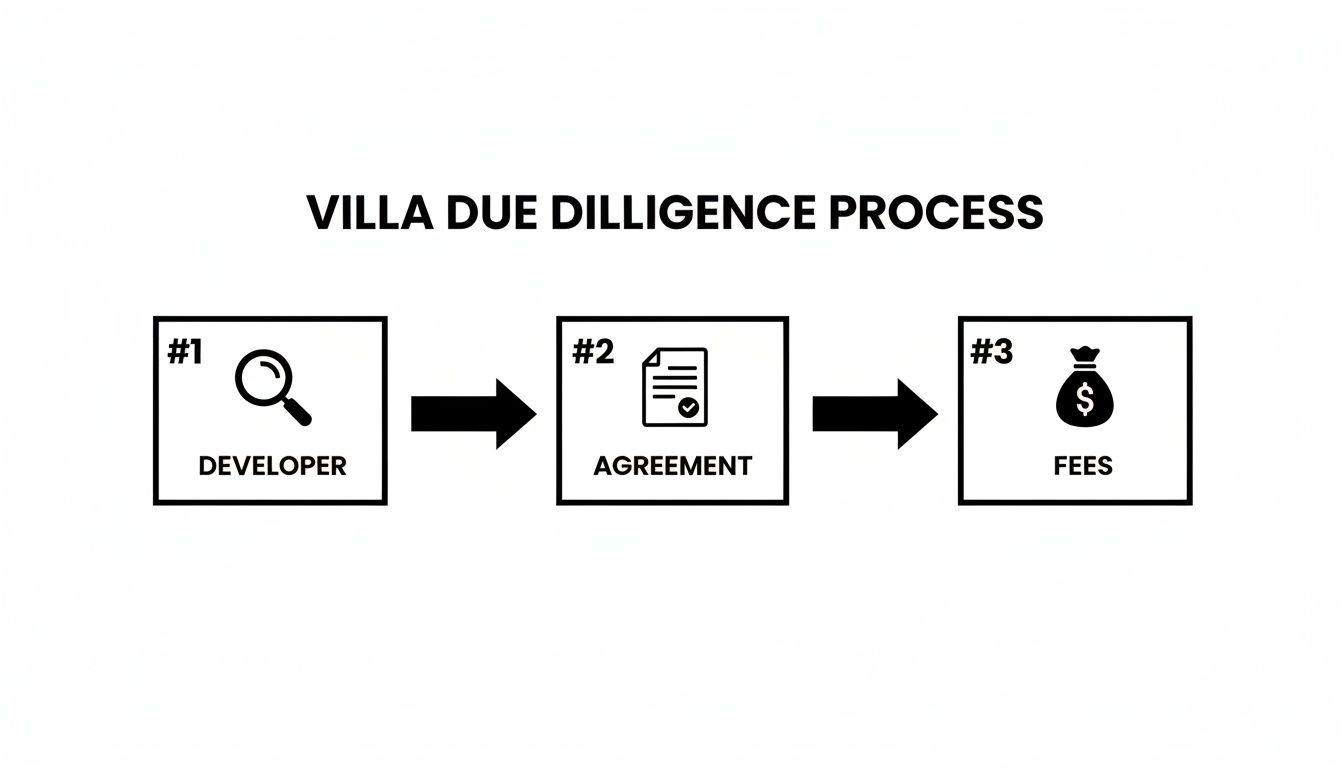
As you can see, getting the developer's green light and clearing all outstanding payments are absolute must-dos before the ownership transfer can happen.
The Critical No Objection Certificate
Speaking of green lights, the single most important document you’ll need is the No Objection Certificate (NOC). This is an official letter from the property developer confirming the seller has paid all their service charges and has no other financial loose ends tied to the villa.
The NOC is your guarantee that you’re inheriting a “clean” asset, free of hidden debts. Without it, the Dubai Land Department (DLD) simply won't proceed with the property transfer. Getting the NOC can take anywhere from a few days to a week, so you need to build that time into your closing schedule.
While you're navigating this process, it's helpful to remember just how dynamic the market is. For instance, market summaries from May 2025 showed the average villa price was around AED 3.4 million, but some reports put that figure closer to AED 5.2 million later in the year. And that doesn't even touch the ultra-prime end of the market, where a villa in Wadi Al Safa 3 sold for a staggering AED 158 million. This gives you a sense of the incredible depth of the market you're entering. You can dive deeper into these trends with Novvi Properties’ 2025 report.
The Final Transfer and Handover
The finish line is the DLD Trustee Office. This is where you, the seller, and your agents all meet to finalize the sale. Here, you'll pay the rest of the purchase price—usually with manager's cheques for security—and settle all the official government fees.
Below is a typical breakdown of the costs you can expect at this stage.
Estimated Transaction Costs for a Dubai Villa Purchase
This table outlines the standard fees and taxes involved when purchasing a villa in Dubai, using an example property valued at AED 5 million to give you a clearer picture.
| Fee/Tax Item | Percentage of Purchase Price | Example Cost (on AED 5M Villa) |
|---|---|---|
| DLD Transfer Fee | 4% of the property value | AED 200,000 |
| Mortgage Registration Fee | 0.25% of the loan amount | AED 10,000 (on a 4M loan) |
| Trustee Office Fees | Fixed administrative fee | AED 4,200 |
| Agency Fee | 2% of the property value | AED 100,000 |
| NOC Fee | Fixed fee (varies by developer) | AED 500 - AED 5,000 |
Note: These figures are estimates and can vary. Always confirm the exact costs with your agent and the relevant authorities.
Once all payments are confirmed and the paperwork is processed, the DLD issues the new Title Deed in your name. This is the ultimate proof of ownership. With that deed in hand, the final step is the official handover, where the seller gives you the keys, access cards, and any other important documents for your new home. Congratulations, you're now a Dubai villa owner
Your Top Questions on Buying a Dubai Villa, Answered
Even with the best plan in hand, questions are going to pop up as you get into the nitty-gritty of buying a villa in Dubai. That’s perfectly normal. I’ve been through this process hundreds of times with investors, especially those from overseas, and the same crucial questions tend to come up again and again.
To give you that extra bit of confidence, think of this as your personal cheat sheet for tackling those final uncertainties and practical details.
Can a Foreigner Really Buy a Villa in Dubai?
Yes, absolutely. This is usually the first hurdle for many international investors, but the answer is a clear and resounding yes. Back in 2002, the UAE government changed the game with the Freehold Law. This law allows non-UAE nationals to buy, sell, and rent out property with 100% ownership in specific, designated areas called freehold zones.
Chances are, any luxury villa community you’ve heard of is in one of these zones. We’re talking about places like:
- Palm Jumeirah
- Dubai Hills Estate
- Arabian Ranches
- Emirates Hills
- Jumeirah Islands
When you buy a villa here, you get full, outright ownership. It’s registered in your name at the Dubai Land Department (DLD), giving you the exact same property rights as a local Emirati owner. No strings attached.
Do I Need a UAE Residency Visa to Buy Property?
No, you don't need to be a resident to purchase a villa. In a smart move to attract global capital, the system is actually set up the other way around: buying property is one of the most popular and straightforward paths to getting long-term residency.
The UAE's renowned Golden Visa program is directly tied to real estate investment.
- An investment of AED 2 million (roughly $545,000 USD) in property can make you eligible for a 10-year renewable Golden Visa.
- An investment of AED 750,000 (around $204,000 USD) qualifies you for a 2-year residency visa.
This visa typically covers you, your spouse, and your children, which is why it's such a fantastic option for families looking to either relocate or simply establish a secure second home base.
What Are the Real Costs Beyond the Purchase Price?
This is a critical one. The sticker price of the villa is just the starting line, not the finish. A common rookie mistake is failing to budget for the various one-time fees and taxes due at the time of the property transfer.
Let's break down the main closing costs you should expect:
- DLD Transfer Fee: This is the big one, set at 4% of the property’s purchase price. While it’s technically split between buyer and seller, standard market practice is for the buyer to cover the full amount.
- Agency Fee: Typically 2% of the purchase price, paid to the real estate brokerage that helped you find and secure the deal.
- Trustee Office Fees: These are fixed administrative fees for handling the transfer paperwork, usually coming in around AED 4,200.
- NOC Fee: The developer charges a fee for issuing a No Objection Certificate (NOC). This can range anywhere from AED 500 to AED 5,000.
- Mortgage Registration Fee: If you're financing the purchase with a mortgage, the DLD charges 0.25% of the total loan amount to register it.
On a villa priced at AED 5 million, a savvy buyer should budget an additional 6-7% of the purchase price—somewhere between AED 300,000 and AED 350,000—to cover all these associated closing costs. Forgetting this can create a serious financial scramble right at the end.
How Much Rental Yield Can I Realistically Expect?
Dubai's reputation for strong rental yields is well-deserved and a major magnet for investors. Of course, yields can vary quite a bit depending on the community, villa size, and exact location, but a well-chosen property can generate fantastic returns.
As of early 2025, gross rental yields for villas in prime communities typically fall between 4.5% and 6.5%. For example, a family-oriented community like Arabian Ranches might deliver yields around 4.5%, while a high-demand area like Dubai Marina could push closer to 6.5%.
But here's a pro tip: always distinguish between gross and net yield.
- Gross Yield is simply the annual rent divided by the property price. It's the headline number.
- Net Yield is your actual take-home profit after you deduct all your expenses—things like service charges, maintenance, and any property management fees.
Always do the math for your potential net yield. That's the number that truly reflects your investment's cash flow performance.
What Ongoing Costs Should I Be Aware Of?
Once you have the keys, your financial responsibilities don't stop. Owning a villa in Dubai involves annual expenses that you absolutely need to factor into your long-term financial model.
The main ongoing cost is the annual service charge. These fees are paid to the community management company and cover the maintenance and upkeep of all the shared spaces that make the community attractive in the first place, including:
- Lush landscaping and community parks
- Swimming pools and state-of-the-art gyms
- 24/7 security services
- Street cleaning and general maintenance
These charges are calculated per square foot based on your property's built-up area (BUA). Before you ever sign a contract, you must ask for a clear breakdown of the current service charges and, just as importantly, see the history for the last few years to spot any worrying spikes.
On top of that, you'll be responsible for your personal utility bills (DEWA for water and electricity) and any routine maintenance specific to your own villa.
At Proact Luxury Real Estate LLC, our philosophy is simple: a well-informed investor is a successful investor. We live and breathe the nuances of buying a villa in Dubai. Our job is to give you the clarity and strategic guidance needed to make a decision that's not just confident, but highly profitable.
Ready to see what your investment options could look like? Book a one-on-one consultation with our lead advisor, Ritu Kant Ojha, and let's build a strategy tailored to your Dubai real estate goals.