

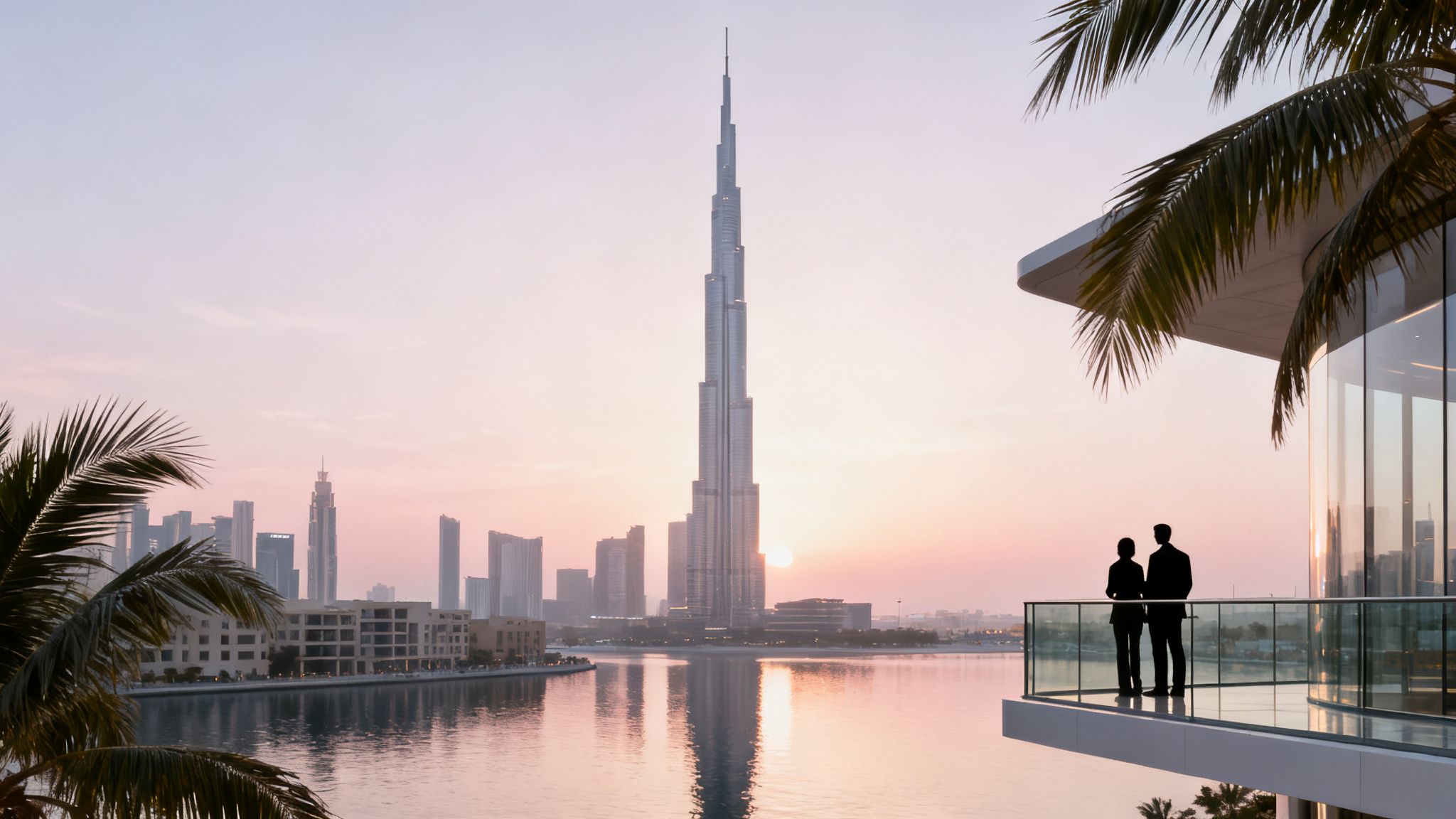
Entering 2026, the discussion around Dubai's trophy properties has shifted from marketing brochures to hard data. The Burj Binghatti Jacob & Co Residences, now a formidable presence in Business Bay, serves as a prime case study for portfolio managers and high-net-worth investors evaluating vertical assets in a maturing market cycle.
This hyper-tower, set to become the world's tallest residential building, represents a calculated fusion of Binghatti's development execution and Jacob & Co's ultra-luxury branding. This partnership is not cosmetic; it is a strategy designed to command a price premium and attract a specific tier of global capital, positioning the tower as one of Dubai's most ambitious property projects of 2026.
Analyzing The World's Tallest Vertical Asset
For the sophisticated investor, this is not about buying a luxury home. It’s about adding a resilient, high-yield vertical asset to a diversified portfolio, with a focus on quantifiable market confidence and long-term capital preservation.
Last year’s benchmarks set a clear performance baseline. The project’s vital statistics as of early 2026 provide the foundation for a rigorous financial analysis.
Burj Binghatti Jacob & Co Residences: Project Snapshot
| Metric | Data Point |
|---|---|
| Project Title | Burj Binghatti Jacob & Co Residences |
| Location | Business Bay, Dubai |
| Status | Under Construction |
| Developer | Binghatti |
| Brand Partner | Jacob & Co |
| Height | 557 metres |
| Floors | 104 floors + 7 basements |
| Construction Progress | 23% built (as of early 2026) |
| Estimated Handover | June 30, 2026 |
These metrics confirm the project's ambitious scale and establish the framework for the financial analysis that follows.
Project Scale and Timeline
Announced on November 16, 2022, this supertall skyscraper is designed to reach 557 metres with 104 floors and 7 basement levels, claiming the "world's tallest residential" title from New York's Central Park Tower.
Construction broke ground in February of last year. With the project 23% built as of early 2026, the developer is aligned with the scheduled handover of June 30, 2026.
Unit Configuration Overview
The tower’s inventory is structured to appeal to different segments of the UHNWI market, creating a strategic mix of units.
- Sapphire Collection: These two-bedroom residences are the foundational luxury offering, suitable for executives or as a prime rental investment.
- Emerald Collection: The three-bedroom units cater to those requiring more expansive living spaces.
- Exclusive Named Penthouses: At the apex are the pinnacle assets, including the Astronomia and Billionaire penthouses, which function more as vertical mansions.
This tiered structure allows for a diversified rental strategy post-completion, appealing to a wider range of high-end tenants.
Crunching The Numbers: Transaction Data And Price Premiums
To properly value an ultra-luxury asset, one must analyze hard market data. A close look at last year's performance provides a quantitative picture of the investment case.
Throughout 2025, Dubai Land Department (DLD) records show the tower registered 193 apartment sales at an average price of AED 28,567 per square metre. This figure is a critical indicator of the project's pricing power in a competitive market.
This pricing metric represents a 12-13% premium over comparable high-end, non-branded residential towers in Business Bay. That premium is the core of the branded residence value proposition, proving this asset class can command superior pricing and offer insulation against broader market adjustments.
Buyer Confidence And Market Positioning
The transaction velocity in 2025 points to solid buyer confidence. For HNWIs, this data validates the project's elite positioning. The consistent sales activity shows the Binghatti and Jacob & Co collaboration is viewed as a genuine value-driver that justifies the price point.
This performance is a key part of our broader Dubai real estate market analysis, which points to a maturing market where discerning buyers allocate capital into quality and brand equity. The specifications below underpin this landmark status.
These numbers are tangible assets that directly support its premium valuation.
What The 13% Premium Means for a 2026 Strategy
This 13% premium is a crucial data point for an investment strategy.
- A Defensive Moat: Trophy assets with proven pricing power tend to hold their value better during market corrections.
- A Solid Rental Anchor: The upfront premium typically translates into higher rental yields from an elite tenant base.
- Long-Term Resale Value: The "world's tallest" status is a unique selling point that will support stronger resale values compared to generic luxury buildings.
For investors structuring their purchase, this premium confirms the asset is leading its segment. The strong sales figures also provide a solid foundation for those seeking eligibility for programs like the UAE Golden Visa, a topic further detailed in our guide on what the UAE Golden Visa is.
Evaluating Developer Credibility And Timeline Risk
For any off-plan investment, the developer’s track record is the primary risk mitigation tool. With a project as ambitious as Burj Binghatti Jacob & Co Residences, Binghatti's history of execution becomes a critical piece of data.
Binghatti has a documented history of delivering 7,000 residential units with a 95% on-time completion rate. This consistent performance provides a data-driven framework to gauge the likelihood of meeting the Q2 2026 handover.
Current Progress And Regulatory Safeguards
As of early 2026, construction is 23% complete. This pace aligns with the projected timeline.
Beyond the developer’s record, the regulatory environment in Dubai adds a crucial layer of security. All investor funds are legally required to be held in a RERA-regulated escrow account. This means capital is ring-fenced for this project, with funds released only after hitting verified construction milestones. It is a key protection under UAE property law that de-risks the off-plan payment process.
Balancing Ambition With Execution
The scale of the Burj Binghatti is ambitious. However, any risk assessment must be grounded in the developer's proven performance and the strict regulatory oversight in place.
- Developer Risk: Mitigated by their historical 95% on-time delivery rate.
- Financial Risk: Shielded by mandatory RERA escrow accounts that tie payments to construction progress.
- Timeline Risk: The current 23% completion status is on track for the Q2 2026 handover target.
The combination of a strong delivery history and robust legal protections makes a compelling case for the project's viability. Understanding these safeguards is crucial when considering any new development in Dubai.
Figuring Out Who Rents What: Matching Units to Tenants
Long-term rental demand drives an asset's performance. The inventory at Burj Binghatti Jacob & Co Residences is tiered to attract specific segments of the ultra-high-net-worth (UHNW) market.
The entry point begins with the Sapphire and Emerald collections, which are sprawling residences built for a particular end-user.
Sapphire Suites (2-Bedroom): Targeted at transient global executives or UHNW individuals needing a prestigious city base, fitting the high-end corporate rental market.
Emerald Suites (3-Bedroom): Sized for small families or individuals needing a dedicated home office, designed to attract longer-term tenants.
Analyzing The Penthouse Tiers
The tower's pinnacle collections are private estates in the sky, each tailored for a unique UHNW profile. The 557-metre hypertower will feature exclusive named penthouses—Fleurs de Jardin, Astronomia, and the Billionaire Penthouse. The latter spans two floors with seven bedrooms and dedicated staff quarters, ensuring the building attracts a tenant base insulated from normal market swings.
The core strategy here is asset-to-occupant mapping. The Billionaire Penthouse is not competing with rental apartments; it competes with private villas in Emirates Hills. Its target tenant is a visiting royal delegation, a Forbes-listed CEO, or an A-list celebrity requiring absolute privacy.
Comparative Analysis Of Penthouse Tiers
This table maps each penthouse tier's features to its specific UHNW target profile.
| Penthouse Collection | Key Features | Target Occupant Profile |
|---|---|---|
| Fleurs de Jardin Penthouse | Expansive Layout, Private Pool, Skyline Views | International Entrepreneur, Tech Founder |
| Astronomia Penthouse | Full-Floor Privacy, Custom Finishes | Head of a Family Office, Private Equity Partner |
| Billionaire Penthouse | Two Full Floors, 7 Bedrooms, Private Cinema & Lounge, Staff Quarters | Royalty, Heads of State, Global Celebrities |
This strategic tiering allows the building to cater to multiple UHNW needs simultaneously.
The UHNWI Tenant Profile Post-2026
The tenant at Burj Binghatti requires a secure, fully serviced ecosystem. Their needs include quarters for a chauffeur, private kitchens for a personal chef, and robust security protocols.
This unique demand has direct implications for rental yield projections. The premium is for the operational infrastructure that supports their lifestyle. This differs greatly from conventional rental properties, such as the market for apartments for rent in Al Furjan, which serves a different demographic.
Modeling ROI And Long-Term Asset Strategy
An acquisition of this nature demands a clear vision for returns. We must model its financial performance by examining rental yields, capital growth potential, and a viable exit strategy.
Based on how similar branded residences in Downtown and Business Bay performed last year, a gross rental yield of 6-8% is a conservative baseline. Its status as the world's tallest residential building creates a prestige factor that could add a 1.5-2% premium, pushing potential gross yields into the 7.5-10% range, particularly for the penthouses.
Forecasting Capital Appreciation
Capital growth is tied to the development in the Business Bay corridor and broader economic trends. The current market points toward sustainable growth.
The "world's tallest" title acts as a defensive moat, insulating the property from price swings affecting generic luxury buildings. While the wider market might see appreciation of 5-7% annually after 2026, a unique asset like Burj Binghatti could realistically achieve 8-12% annual growth in its first few years post-handover.
The Impact Of Service Charges On Net ROI
A critical piece of any ROI model is accounting for operational costs, primarily service charges. For a tower with a private club, multiple pools, and concierge services, these charges will be in the premium bracket.
Based on last year's data from similar ultra-premium towers, a realistic projection for service charges is AED 30-45 per square foot. Factoring this into our model, the projected net rental yield settles in the 5-7% range—an exceptionally strong return for an asset of this caliber. This is where a deep understanding of buying off-plan property in Dubai is essential for financial planning.
Crafting A Viable Exit Strategy
The exit strategy for a trophy asset differs from a standard investment property.
- Medium-Term Hold (5-7 Years): This strategy allows for capitalizing on the first wave of appreciation while collecting rental income.
- Long-Term Hold (10+ Years): This approach treats the property as a legacy asset for wealth preservation, focusing on consistent income and long-term value growth.
The table below breaks down these two strategic pathways.
| Strategy | Primary Goal | Ideal Investor Profile | Key Consideration |
|---|---|---|---|
| Medium-Term Hold | Capital Appreciation & Yield | HNWI seeking portfolio growth | Timing the exit to coincide with a peak market cycle |
| Long-Term Hold | Wealth Preservation & Income | Family office, UHNWI | Focusing on asset management to sustain rental premiums |
The right strategy depends on an investor's financial goals, but both are built on the asset’s unique market position.
The Investor FAQ
HNWIs allocating capital in 2026 ask sharp, strategic questions. Here, we address the most common inquiries regarding the Burj Binghatti Jacob & Co Residences from a portfolio management perspective.
How Does The ROI Potential Compare to Other Branded Residences?
Based on 2025 transaction data, Burj Binghatti already commands a 12-13% price premium over top-tier, non-branded luxury towers in Business Bay.
Benchmarked against other elite branded residences, its ROI potential is amplified by its unique global status. While brands like Four Seasons deliver reliable yields, the "trophy asset" factor of Burj Binghatti attracts a specific UHNWI tenant willing to pay a premium for a globally unique address. This is why we project it will command superior net rental yields post-handover.
What Are The Primary Risks For An Investment Of This Scale?
The two principal risks in any off-plan investment—timeline delays and market corrections—are well-mitigated here.
- Developer Risk: Binghatti's 95% on-time delivery rate across 7,000 units provides a strong hedge against delays.
- Financial Risk: Investor payments are secured in a RERA-regulated escrow account, a key protection under current UAE property law.
- Market Risk: During price adjustments, demand from the global elite for one-of-a-kind properties remains relatively inelastic.
The main financial point to model post-handover is the elevated service charges, which must be factored into net yield calculations.
Is This A Golden Visa Qualifying Investment?
Yes. An investment in Burj Binghatti Jacob & Co Residences easily qualifies for the UAE Golden Visa, as the minimum investment of AED 2 million is well below the entry price for units in this tower.
This adds a layer of value beyond financial returns for international investors. For a detailed breakdown, review our guide on what the UAE Golden Visa is.
What Are The Expected Service charges?
While the final charge is set upon handover, investors should model for premium-tier fees. A realistic projection is AED 30-45 per square foot annually, based on comparable supertall branded residences.
These fees are an investment in maintaining the facilities and service levels that command high rental premiums and preserve the asset's long-term value.
Final Thoughts: A New Benchmark for Vertical Assets
The Burj Binghatti Jacob & Co Residences is a financial instrument operating at the peak of the global property market. Last year's transaction data confirms its pricing power, and Binghatti's delivery track record mitigates typical off-plan execution risks.
This asset is engineered for a specific purpose: to provide portfolio stability and outsized returns by attracting a tenant base largely insulated from global economic cycles. The focus is on long-term performance, not short-term speculation. The unwavering demand seen in 2025 indicates this tower is poised to set a new benchmark for rental yields and capital growth in the UHNWI segment.
If you are rebalancing your portfolio for 2026 and this asset class aligns with your objectives, let's run the numbers. At Proact Luxury Real Estate, we can model the net ROI against your specific financial targets and provide a clear, data-driven assessment.